

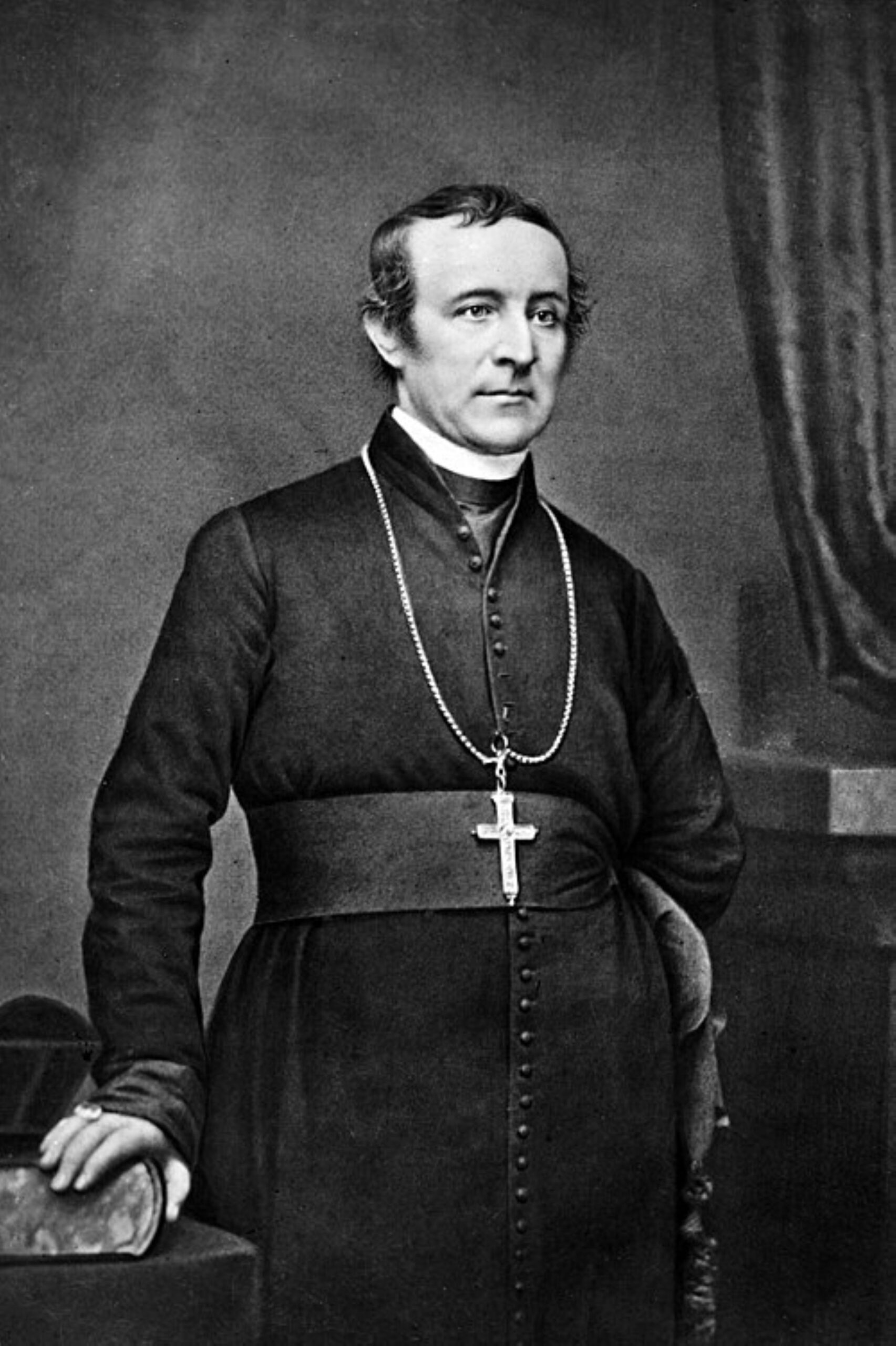
MIDTOWN MANHATTAN — There is no record of Archbishop John Hughes ever throwing a punch at anyone, but in the mid-1800s, when he was the shepherd for all Catholics in New York, he earned the reputation of a “pugilist.”
More to the point, he was called an “intellectual pugilist” for his pugnacious pushback against the anti-Catholicism of that era in New York City.
 Instead of fists, Archbishop Hughes used fiery writings, oratory, and behind-the-scenes political arm-twisting, but he didn’t win every fight. His quest to purge anti-Catholic biases from New York schools met setbacks before achieving reforms.
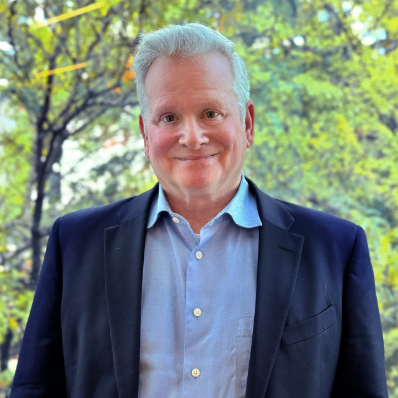
“He was a very pugilistic personality,” said John Loughery, author of the 2018 book, “Dagger John: Archbishop John Hughes and the Making of Irish America.”
“In fact,” Loughery continued, “he was always overstepping agreed-upon bounds as a priest. He actually found fighting very bracing, even exciting.”
Saintly Assistance
John Joseph Hughes was born in 1797 in County Tyrone, Ireland,14 years after the War of Independence that created the United States of America.
With anti-Catholic sentiments festering on the Emerald Isle, Hughes’ father, a tenant farmer, and other family members immigrated to Chambersburg, Pennsylvania, in 1816; 19-year-old John joined them a year later.
The young man wanted to be a priest, but with limited opportunities, he became a digger in a rock quarry.
Still, his priestly ambitions were strong, so he made repeated but unsuccessful applications to Mount St. Mary’s College in Emmitsburg, Maryland.
RELATED: Elizabeth Ann Seton Enjoyed Saintly Connections to Founding Fathers
The rector at the time, Father John Dubois, instead hired him as a gardener.
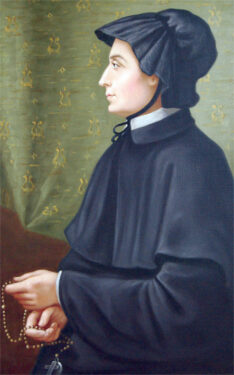
While there, Hughes met and befriended the future saint, Mother Elizabeth Ann Seton. She saw something in the gardener, so she asked Father Dubois to reconsider his application.
It worked, and Hughes became a seminarian at the college in 1820. His ordination was six years later.

Varela a Mentor
Soon, Father Hughes embarked on his legacy of pugilistic intellectualism.
“Hughes went to Philadelphia,” Loughery said. “And then, to the displeasure of some of his superiors, he gets into a debate in the public press with this prominent Protestant.”
The opponent, John Breckenridge, was a Presbyterian minister who was already well educated in Catholicism and papal history, Loughery said.
Father Hughes soon found himself outmatched, so he turned to another saintly person for help — the Cuban exile, Father Felix Varela.
“He was an erudite, brilliant scholar,” Loughery said. “His words meant a lot. So, Hughes is constantly writing to Varela, saying, ‘Give me some help here. I need some bibliographies.’ ”
RELATED: A Man for All Reason, Félix Varela
Years later, they were working together in New York, with Hughes as the bishop and Varela the pastor of Transfiguration Church, where he conducted massive aid programs for immigrants.
School Wars
In 1837, Pope Gregory XVI appointed Father Hughes as coadjutor bishop for the Diocese of New York, which was not yet an archdiocese. His boss was the former rector at Emmitsburg, later-to-be Bishop John Dubois.
Starting in 1840, Bishop Hughes was dismayed that school children from immigrant Catholic families suffered religious discrimination in the classrooms.
Bishop Dubois died in 1842, and Bishop Hughes replaced him as the top prelate for New York and northern New Jersey.
By that time, Bishop Hughes was fully committed to improving education for Catholic children in the so-called “School Wars.” As such, he lobbied for public funding for Catholic schools.
Loughery said the common textbooks back then described Catholic priests and their congregants as lazy drunkards.
Also, the standard Bible used in schools was the King James version, which had omitted books found in the Catholic Bible.
“It was very disdainful and made the children feel very small and unwanted,” Loughery said. “At that point, Hughes really rolls up his sleeves.”
Dagger John
Bishop Hughes’ aggressive advocacy earned the description of an “intellectual pugilist” from Samuel Prime, a Presbyterian minister and editor of the New York Observer.
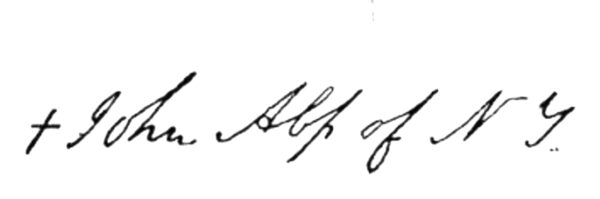
Although it’s hard to pin down the original source, the public started likening the archbishop to a cleric with a knife.
Historians, however, explain that his signature was preceded by a cross, which was common for bishops. But political and social commentators likened the motif to a dagger.
The nickname “Dagger John” stuck.
Loughery said Bishop Hughes was amused by the name, and he didn’t argue against it.
His attitude, Loughery said, was, “ ‘You’re going to call me Dagger John? That’s fine. If that makes you afraid of me, good.’ ”
“And,” Loughery added, “that was the case.”
Allies for the Cause
Being an astute observer of New York politics on the state and local levels, Bishop Hughes sought allies.
In the city, he courted the Democratic power brokers in Tammany Hall. A sympathetic ear in Albany was Gov. William Seward — a Whig Party member and the future secretary of state in the Abraham Lincoln administration who was targeted for assassination with the president, but he survived.
RELATED: Diocesan Designer — The Remarkable Unsung Legacy of Church Architect Patrick Keely
Loughery noted, however, that, as New York’s governor, Seward was upset that Catholic children were not being educated because their parents refused to send them to schools where they were mistreated.
The Legislature responded by creating the New York City Board of Education, but the board ruled that no money should go to schools that taught religion, a defeat for Bishop Hughes.
Still the Fighter
But Bishop Hughes, still the fighter, would not give up.
Alternatively, he rallied supporters to create an independent parochial school system funded by Catholics themselves.
Bishop Hughes, Loughery said, became an effective fundraiser for Catholic education, even during economic downturns.
RELATED: Defending Faith: Brooklyn’s Fight Against Nativist Violence in 1854
More than two dozen parochial schools opened in New York City during Bishop Hughes’ tenure. Their faculties were staffed by members of numerous religious orders, including the Sisters of Mercy, the Sisters of Charity, the Ursuline Sisters, the Jesuits, the Dominicans, and the De La Salle Christian Brothers.
And he didn’t stop there.
Since the diocese at that time included all of New York, he urged parishes throughout the state to do the same.
Bishop Hughes also founded Catholic institutions of higher learning such as Manhattan College and Saint John’s College, which is now Fordham University.
Empire of Charity
The Diocese of New York was elevated to an archdiocese in 1850, and Bishop Hughes subsequently became the first archbishop in the state.
In 1853, Pope Pius IX, with help from the new archbishop, ordered that Brooklyn, Queens, and the rest of Long Island be released from the archdiocese to become the Diocese of Brooklyn.
St. James Church in Downtown Brooklyn (today the Cathedral Basilica of St. James) was founded in 1822 and established its first school six years later. It has evolved into today’s Bishop Loughlin Memorial High School.
In 1884, American Catholic bishops decreed that every parish have a school that should be constructed even before a church building was erected to celebrate Mass.
By 1900, Catholic schools were a key part of the bishops’ “Empire of Charity.”
Not a Saint
Archbishop Hughes’ pugnacious reputation grew as he stood up against “nativist” mobs that threatened to burn Catholic churches.
His tactic was to suggest Protestant churches would, in turn, get torched. He also rallied parishioners to get guns and stand guard over their churches.
Ultimately, no churches burned, Catholic or Protestant.
Archbishop Hughes died in 1864 at the height of the Civil War when Irish Catholics from New York were shedding blood to prove their loyalty to the Union, not a pope in Rome.
RELATED: Modern-Day New York Guardsmen Honor Civil War ‘Irish Brigade’
Historians now assess that Archbishop Hughes spent more time politicking than interpreting the faith to the waves of immigrants filling the city.
“John Hughes didn’t want to be a saint; he wanted to be a cardinal,” Loughery said. “He had a love of politics and all that it involved, even though he knew that at times this could be seen by people as at odds with his spiritual calling. I mean, you’re not getting any original theology from him.
“But you’ve got here a man who just wants to make it a better situation for Catholics, for Irish Catholics, for immigrant Catholics.”
