

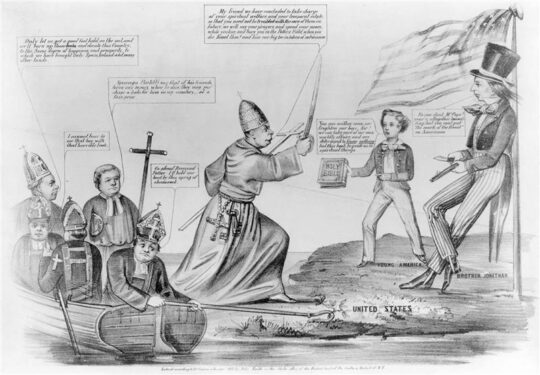
When the 56 men put quill pens to parchment, establishing the United States of America, little, if anything, changed for the Catholics living throughout the colonies. The anti-Catholic sentiment of the earliest settlers remained alive and well.
“The deep enmity between Protestants and the Catholic Church was a very powerful force … long before there was a United States of America … in what was essentially a country where the colonies were founded as white, Anglo-Saxon, Protestant colonies,” explained Kenneth C. Davis, an American history author.
Slowly but surely, the anti-Catholic sentiment that existed within the 13 colonies and in the founding of the country waned. Still, as this story looks at the history of religious freedom for Catholics in the U.S., it’s important to note that the anti-Catholic views of the earliest settlers informed the anti-Catholic undercurrents that have existed throughout the nation’s history.
Loyal to the Pope?
Even after the First Amendment was ratified on Dec. 15, 1791, guaranteeing religious freedom at the national level, Catholics were still largely confined to private worship across the 13 states. And due to the mistrust of Catholics that existed across those largely Protestant states, it would still be decades before many would adjust their constitutions to allow Catholics to hold office.
As the nation entered the 19th century, that inherent mistrust of Catholics only grew because of an influx of Catholic immigrants. Between the first decades of the 19th century and the start of the 20th century, the number of Catholics in the United States grew from about 200,000 to more than 14 million.
RELATED: Despite Risks, Jesuit ‘Circuit Rider’ Boldly Shared the Faith in Colonial America, and NYC
“The initial wave of immigrants really heightened anti-Catholic hostility,” explained Catherine Brekus, the Charles Warren Professor of the History of Religion in America at Harvard University. “We have these waves of immigrants in the 1820s, 1830s, all the way across into the early 1900s, first from Ireland and Germany and then from Italy and Poland, and the sheer influx of all those people really caused a lot of anti-Catholicism.”
Sometimes, throughout the 19th century, that sentiment led to violent clashes.
On August 11, 1834, a mob of anti-Catholic Protestants ransacked and burned to the ground the Ursuline Convent in Charlestown, Massachusetts.
A decade later, in multiple instances during the summer of 1844, violent clashes between native-born Protestants and Irish Catholic immigrants in Philadelphia became known as the Bible Riots. The violence stemmed from a belief that Catholics wanted to remove the Protestants’ King James Bible from public classrooms. More than 20 people were killed. Hundreds were wounded. Catholic homes and churches were burned.
The latter was perpetuated by the Know Nothing Party, a major anti-immigrant, anti-Catholic nativist political movement that was behind other similar riots and attacks.
“As we got into the 19th century, that deep, deep mistrust, outright hatred of Catholics really was the found voice in political parties, most prominently the Know Nothings,” Davis explained. “The Know Nothings were vehemently anti-Catholic.
“Many Americans believed that Catholics … were coming into America and they were going to set up the pope as the head of government and create a new Vatican.”
More People, More Influence
At the same time that anti-Catholic sentiment grew, so too did the influence of Catholics in American life, due to the undeniable numbers of Catholic immigrants.
By 1900, the number of Catholic dioceses grew to more than 80, and public worship was tolerated. Catholics had established parochial schools nationwide. More and more states lifted bans on Catholics running for public office.
“It’s really when those numbers become enormous, and we’re talking about millions of immigrants coming into the country and eventually gaining citizenship, that their political power was essentially far more significant than the religious questions,” Davis said. “The political power was slow in coming, but the numbers were eventually overwhelming.”
RELATED: How Immigrants Helped Shape the Diocese of Brooklyn’s Growth
Brekus also noted that through the 19th century Catholics began to climb the economic ladder, which gave them more influence, and that they were trying “really hard to emphasize their Americanness” and dispel the notion that they were loyal to the pope.
Al Smith, JFK, and WWII — A Shift
By the early 20th century, Catholics had gained true political influence, particularly in New York. In 1919, Al Smith was elected governor of New York — the first Catholic governor in the country’s history.
He served from 1919-1920, and again from 1923-1928. Smith then ran for the presidency in 1928, losing in a landslide to Herbert Hoover.
“The country was not ready to accept a Catholic president,” Davis said. “[The anti-Catholic sentiment] carried well over into the 20th century, a lot of it having to do with the growing political power of immigrant Catholics in some Democratic strongholds.”
The country was, however, ready to accept a Catholic president in 1960, when John F. Kennedy was elected the nation’s first Catholic president. Still, his faith led to skepticism.
Soon after his election, he gave a famous speech, in which he emphasized the separation of Church and state and his independence from Rome.
“I don’t think his election completely got rid of anti-Catholic sentiment,” Brekus said, “but the fact that he governed like any other president did a lot to ease people’s fears.”
Brekus also highlighted the World War II era — a time between Smith’s run and Kennedy’s election — as particularly significant. She noted that Catholics fighting alongside Protestants in the war, the GI Bill providing more Catholics the opportunity to attend college and integrate into secular life, and Catholics receiving a better portrayal in the media all led to eased discrimination against Catholics.
Something else that happened over the course of the 20th century, Brekus added, was that Christians began to accept Catholics as allies against a rising tide of secularism in the U.S., which led to where U.S. Catholics find themselves today.
Combatting Secularism, Advocates for All
As Brekus noted, “religious freedom for Christians — Protestants and Catholics — is fairly secure” in modern America. Christians and Catholics hold positions of power in all levels of government and run universities and companies across all facets of secular life. Even six of the nine Supreme Court justices are Catholic and have shown no appetite to infringe on religious liberties in recent years.
Still, as Cardinal Timothy Dolan, archbishop emeritus of New York, explained in a 2021 address, there is a fear “that our culture has moved … to now an outright antagonism to any voice inspired by faith having a welcomed place in the national discourse.”
He later added that it’s crucial that Catholics lead in defending religious liberty for all. “I vigorously defend our first and most cherished liberty, not because I’m a believer, but because I’m a citizen,” Cardinal Dolan said. “I defend it not to boost the Church, but to boost the human rights tradition at the heart of our Republic.”