
In the late 1850s, an emissary sent by the Holy See to the United States returned with two recommendations: establish a college in Rome for American seminarians and priests, and provide a place for American pilgrims to be received.
The first resulted in the renowned Pontifical North American College. The latter led to the perhaps lesser-known Bishops’ Office for U.S. Visitors to the Vatican, which, since 1859, has helped American travelers in the Eternal City.
And last year, with the Jubilee Year, the death of Pope Francis and the election of the first American pope, the office saw a spike in requests for tickets to Vatican events.
In 2025, according to the U.S. Conference of Catholic Bishops (USCCB), the office received requests for 24,000 tickets to 28 general papal audiences. Meanwhile, in 2024, it received about 21,900 ticket requests for 42 audiences. There were fewer audiences in 2025 because Pope Francis was hospitalized starting Feb. 14. After his death on April 21, audiences were on hold until after Pope Leo XIV’s election on May 8.
Father Paul Hartmann, associate general secretary of the USCCB, said it’s clear that Americans’ interest in traveling to the Vatican has increased since Pope Leo’s election.
“It’s a local boy,” Father Hartmann told The Tablet. “Everybody kind of has that little bit of hope that their sign will get particularly noticed, their Chicago White Sox ball cap will get particularly noticed, and things like that.”
Sister Marie Thérèse Savidge, the office coordinator, also acknowledged the clear interest in Pope Leo among American visitors.
“When they come, they like to tell us their connections to Pope Leo — either they’re from Chicago, or they’re from another part of the United States where someone in his family lived, or they know someone who knew him,” she told The Tablet.
RELATED: Chicagoans Celebrate One of Their Own With Mass, Festivities Honoring Pope Leo XIV
Located in the Casa Santa Maria, the residence for U.S. priests doing graduate studies in Rome, and near the Trevi fountain, the office has been led by the Sisters of Mercy of Alma, Michigan, since 2010, after supporting it since the 1990s. They took over leadership from Msgr. Roger Roensch, who had led the office since the 1970s. Today, five Sisters of Mercy live and serve in Rome.
“He really turned this into not just a place to give out tickets to papal events, but a place to help people coming to Rome make it a real pilgrimage experience,” Sister Marie said of Msgr. Roensch.
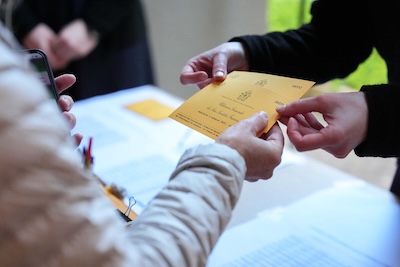
The main service the office provides is free tickets to papal audiences. Audiences are held every Wednesday when Pope Leo is in Rome, and reserved tickets are available for pickup the afternoon before.
The sisters can also sometimes help people secure tickets to papal Masses or other events, and with general information about other things, like scheduling a tour of the Vatican Museums or St. Peter’s Basilica. They also help host an English Mass every Sunday in Rome, near the Vatican, that pilgrims can attend before the Holy Father’s Angelus address. The sisters are aided by the American priests and seminarians studying in Rome, who will offer confession at the office a few hours a week.
The office is closed in July and August.
Generally, the busiest times for pilgrims to travel to Rome are leading up to Easter and Holy Week, and during Christmas, Sister Marie said. She also noted that October is a beautiful month in Rome and many people will make the trip.
“People are always very grateful,” Sister Marie said. “We help them as much as we can with the information that we have, and sometimes we receive very rewarding messages letting us know even about conversion experiences during their time in Rome.
“There are just some beautiful encounters that we’re able to have in that way.”
From the perspective of the U.S. bishops, Father Hartmann said the office is a way to facilitate connections with members of their own flock, with the See of Peter, and now with Pope Leo, in an atmosphere of hospitality, support, and assistance.
“It’s a comparison to the Road of Emmaus,” Father Hartmann explained. “There’s a journey. There’s learning along the way. There’s hospitality that’s experienced, and then there’s going back with some conviction and share something of it.
“How to re-create the Road to Emmaus — whether it’s the Holy Land, whether it’s Rome, whether it’s Fatima, Lourdes, or any number of Marion sites — I think that’s the reason why the bishops want to give that focus because it’s an opportunity for every person of faith to have that Emmaus experience.”