


SPRINGFIELD, N.J. — A special reunion on Nov. 3 brought together three longtime friends who have bonded over their shared Catholic faith and their shared privilege of each having known Servant of God Sister Thea Bowman.
The venue was the Springfield, home of Pearl Bernardin, a retired Catholic school teacher in the Diocese of Rockville Center on Long Island.
Joining her was Barbara McFadden, a retired registered nurse, and Darcel Wilamowski, the founder of the Sister Thea Bowman Mass Choir.
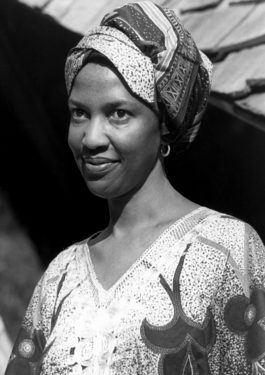
Each shared their experiences with Sister Thea, the famous Catholic educator, evangelist, and gospel music recording artist, who died of breast cancer in 1990 at age 52.
They described how Sister Thea exuded grace, love, and insights of someone filled with the Holy Spirit.
RELATED: Homecoming: Thea Bowman Mass Choir Returns to its Diocese of Brooklyn Origins
“Sister Thea had a way of getting around, you understand,” Wilamowski said. “She would come to a church, or she would go to someone’s house, and we were like children who wanted to get a little nibble of the good that was there in the room wherever she was.”
Wilamowski is also a former coordinator for the Office of Multicultural Diversity for the Diocese of Rockville Centre, which also drew participation from Bernardin and McFadden. That’s how they all met.
Sister Thea, as an evangelist, made several local visits, including attending a revival at St. Vincent Ferrer in the Diocese of Brooklyn, before her death.
Sister Thea, a granddaughter of slaves, belonged to the Franciscan Sisters of Perpetual Adoration. She also directed the Office of Intercultural Affairs for the Diocese of Jackson, Mississippi, in the late 1970s and 1980s, and was a founding member of the Institute for Black Catholic Studies at Xavier University in New Orleans.
The three friends met Sister Thea through their involvement in hosting events where the saintly candidate appeared. For example, they took turns driving her to and from the airport.
Missing from the group was Marie Watson, also a former Long Island nurse, but now living in Ohio. The trio credited Watson for distributing among them the contents of a “box of goodies” — belongings of Sister Thea.
RELATED: Catholic Student Center at Washington’s Howard University Named for Sister Thea Bowman
Her cause for canonization officially began in 2018 in Jackson, which includes her hometown of Yazoo City, about 45 miles north of Jackson.
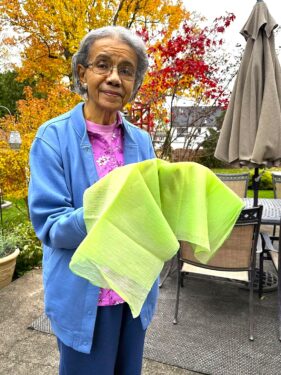
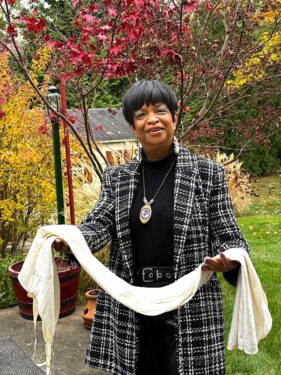
Some items included headscarves that Sister Thea wore to reflect her African American heritage, a small gift box with a floral design, and a slip worn by her. All three women expect these items to become second-class relics if Sister Thea is canonized.
Wilamowski recalled visiting Watson’s home shortly after the large box was unpacked.
“Now I don’t know who sent it, but Marie got this box,” Wilamowski said. “And I will never forget, when I walked into her house, she had Sister Thea stuff everywhere; on the dining room table; on a chair; and right up and down the stairs.
“But there was also a smell of sanctity, that smell of roses. Now, there were no roses in the house. If you are familiar with the smell of sanctity, then you know what I’m talking about.”
Bernardin, originally from Bedford-Stuyvesant, began her career in 1963, teaching for Catholic schools in the Diocese of Brooklyn.
Her item from Sister Thea’s box was a thin green headscarf.
RELATED —The Saintly Seven: Black Men and Women on the Path Toward Sainthood in the US
But Bernardin also shared another item not from that treasure trove — a letter of encouragement from Sister Thea when she also got a breast cancer diagnosis in 1988.
Bernardin said that by this time, the cancer had spread to Sister Thea’s bones, which became dangerously brittle. She dictated the letter to an assistant because she was too weak to write it herself, Bernardin said.
“In the closing of the letter, she said, ‘I know you’re a woman of faith, and if I know it, God knows it,’ ” Bernardin said. “And then she said, ‘You can just say simple things, like Jesus help me through this.’
“She was a woman of such faith, and she never stopped speaking her faith. She left an impression on me, which I’m still talking about. To me, that’s how we keep the memory.”
McFadden said that if Sister Thea is canonized, these items must be shared.
“What I have will go to an organized body or institution that will hold these relics for years to come,” McFadden said. “Those who come after me will be able to see them and see that this was a human being who took on the charge of living her life — authentically black and truly Catholic — and now is canonized.”
I am in tears. Many thanks to Jessica for doing a magnificent job. May thanks to everyone at the Tablet and NET.
I am so deeply moved, The African American community has been lifted up!