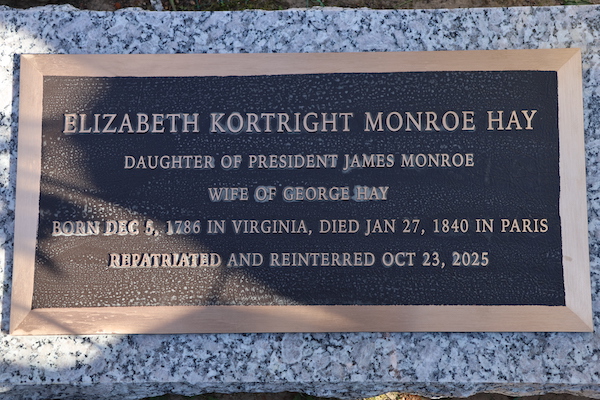
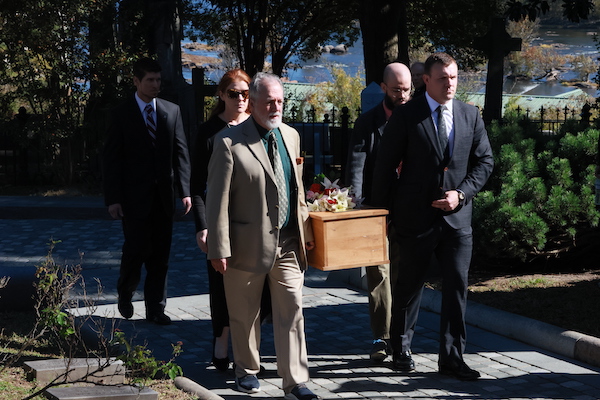
RICHMOND, VIRGINIA — As Barbara VornDick watched Eliza Monroe Hay’s casket get lowered into the grave next to her father’s — fifth U.S. President James Monroe — a calm came over her knowing that after almost two centuries, Hay was finally home.
“Immediately, there was joy and there was a sense of relief that she’s now with her family,” VornDick told The Tablet of the moment. “I just wanted to do what was right for her, and there it was — she was now with her family.
“It was very emotional, and I felt a calm of, ‘OK, she’s OK.’ ”
After nearly 200 years in an unmarked grave in France, Hay’s remains were laid to rest on Oct. 23 alongside her father and other family members at Hollywood Cemetery in Richmond. The day included a reinterment ceremony and a Mass of repose for her soul at the Cathedral of the Sacred Heart in the Diocese of Richmond.
It was the culmination of years of work by VornDick, a Catholic, to change the historical narrative of Hay, and to reunite her with her family — efforts that grew out of reading a few sentences about her in Monroe biographies that she couldn’t make sense of.
Changing The Narrative
Eliza Monroe Hay was born in 1786 and died in 1840 in Paris, France, at the age of 53.
While her father and family were not Catholic, records show that several years before her death, Hay converted to the faith at St.-Philippe-du-Roule Church in Paris, where a funeral Mass was held after her passing.
As VornDick describes, Hay is portrayed in her father’s biographies as “obstinate, argued with her family, and willingly abandoned her country and left her family to go off and live her life in Paris and die there.”
“Well, when I was checking the dates of when this supposedly happened, I realized that at the time she left this country, she had three grandchildren, and I’m a grandmother, and there’s no way I’m never going to see anybody again or be in touch,” VornDick explained. “There was something fishy about that. That didn’t sound right. It was that simple.
“And when I started digging, I found out that was actually not the case at all.”
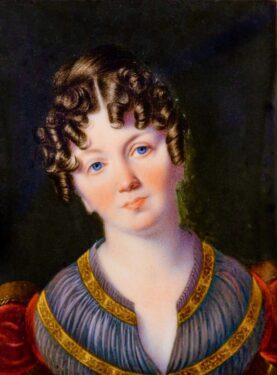
Instead, VornDick said that what she found in her research was that Hay left for France because she was advised to take a sea voyage to improve the health of her lungs after her father died of tuberculosis.
She arrived in Europe in 1838. As for why she never returned, VornDick said she found that Hay never received her inheritance from her father, even though she was supposed to.
“Her father specifically indicated that the executor [of his will] should take care of her and see that she was supported, and he never did,” VornDick said. “She never got a cent. So she ended up in Europe, became increasingly ill, and had no money.
“After a year and a half in Paris, when she died, she was living in what appears to be a boarding house.”
According to VornDick, the narrative surrounding Hay that she just “ran off to live in Paris” is all wrong.
“The story is the reverse. The legend had been that she abandoned her family. I believe that they abandoned her,” she said. “She was viewed as the black sheep of the family, and that wasn’t true.”
With all of her research, VornDick said she had two goals — to tell Hay’s true story “to right that wrong for her descendants so they can be proud of her,” and to bring her remains home because it was the right thing to do, “and she needed to be reunited with her family.”
VornDick accomplished the first goal in June of last year, when she published “Eliza’s True Story: The First Biography of President Monroe’s Eldest Daughter.” The mission of getting Hay’s remains home, her second goal, began about a year earlier.
Bringing Eliza Home
VornDick discovered Hay’s story while working as an interpreter of history at James Monroe’s Highland estate — a job she took in retirement in 2018 after a career in education. She wasn’t a historian, so the research and archival work she did was new.
She didn’t have any experience in foreign affairs or exhumations when she began the process of bringing Hay’s remains home in 2023, either.
Working with the city of Paris, she needed to get approval from every living descendant of Hay. She ultimately found them — “It was months to track down every living descendant … 20 to 25” — and got them to complete an official exhumation request form. To make it happen, she also had to receive approval from the owner of the burial plot in Paris, which she eventually did.
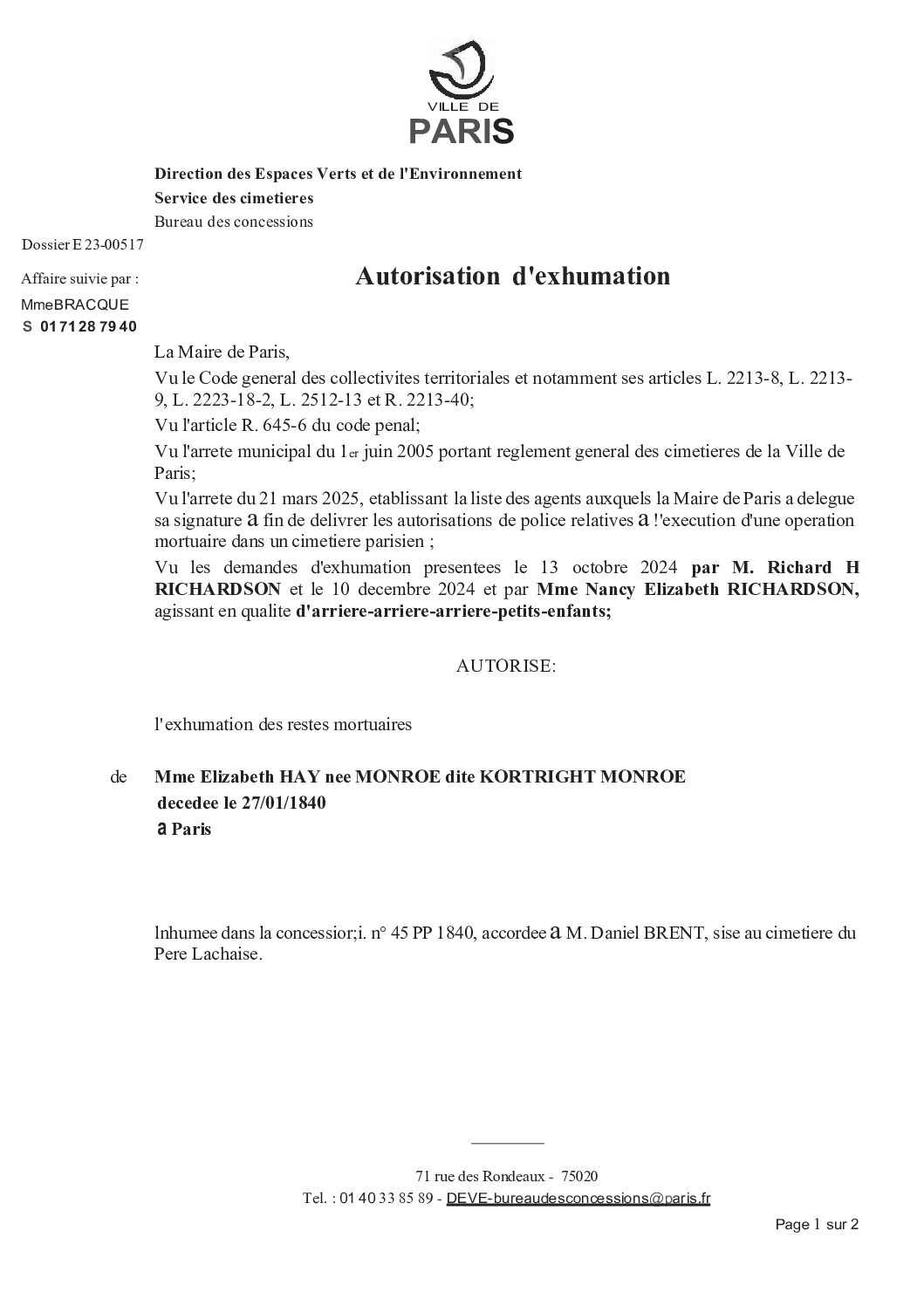
It took a few years, but in April, she finally got the approval from the city.
“In April, I got a letter … that said ‘yes.’ It had been approved, and there were all these certificates in there and everything, and I cried like a baby,” VornDick recalled. “When I got it, I was sobbing because this was finally going to happen.”
Hay’s remains arrived in the United States in May. VornDick met her remains at Dulles International in Virginia. “I cried then, of course, too,” she recalled.
Fast forward to Oct. 23, and Hay’s remains were laid to rest alongside her family.
More than 200 people attended, including descendants of Hay. VornDick gave the eulogy. Speaking with The Tablet through tears, she simply said, “It was amazing. It was a little overwhelming. It was a little humbling.”
Feelings of Gratitude
Michael Kamtman, a descendant of Hay (she would be his fifth great grandmother, and Monroe his sixth great grandfather), admitted he didn’t know much of anything about Hay’s story until VornDick contacted him. He said VornDick’s efforts are “immensely inspiring” and have become a launching pad for him to learn more.
“So you can imagine the gratitude, and I share this with other descendants, is immeasurable, really, for what I have learned,” Kamtman said. “And it has awakened in me a desire to want to learn more about not only Eliza but about the president, and others of my ancestors that came after Eliza.”
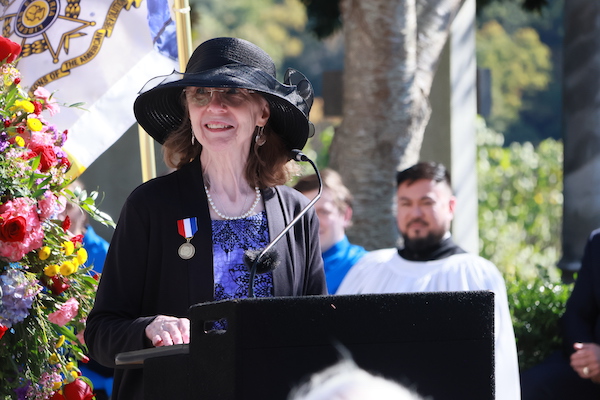
He, too, said the reinterment ceremony and Mass made for a perfect day.
“It was a kind of jubilation on so many levels that this is actually happening,” Kamtman said. “And this was going to be a family reunion of sorts after 185 years. Can you imagine? I was imagining what it would be like to welcome a relative back that I hadn’t seen for my entire life. What an extraordinary thing.”
Father Anthony Marques, rector of the Cathedral of the Sacred Heart, presided over the Mass and the reinterment ceremony. He said it was an honor of a lifetime, and that he will now always feel connected to the Monroe family.
“About a week ago, the thought struck me that, in a manner of speaking, I can say that I have some connection to President James Monroe in the sense that I’m taking care of someone very important to him — one of his daughters,” he said. “And that’s something that I will take with me, that I was given this privilege to commit to the earth the mortal remains of this significant person.”
As for VornDick, when she woke up on Oct. 24, she had completed her two goals, though she acknowledged she has at least one other project in the works.
“My first thought when I woke up was, ‘it’s only about an hour to Richmond, I’d like to get down to Eliza’s grave,’ ” VornDick said. “I want to see it filled in. I want to see the marker that we had made for her.”