
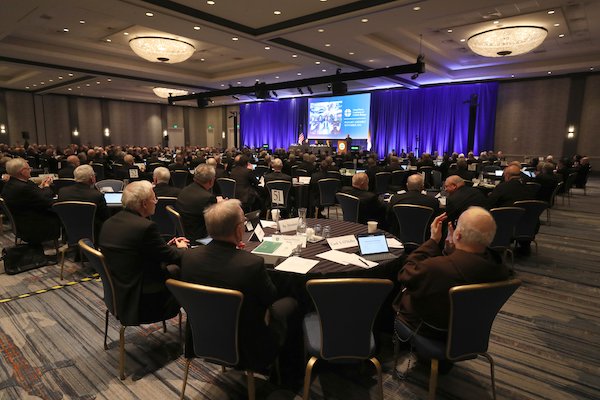
For the first time in more than a decade, the United States Conference of Catholic Bishops issued a “Special Message” — what the conference described as “a particularly urgent way of speaking as a body of bishops.”
The last such message came in 2013 in response to the federal government’s contraceptive mandate. This time, the message was on immigration, and it was overwhelmingly approved with 216 votes in favor, five votes against, and three abstentions.
Bishop Robert Brennan, who was present when the statement was made on Nov. 12 to close the final public session of the USCCB’s fall general assembly in Baltimore, highlighted the importance of the near unanimity of the vote.
“That’s what is special about this,” Bishop Brennan told The Tablet. “It’s pretty remarkable, when you think about it that this message was crafted by a writing committee, put together, had amendments, and we did all of this in a matter of a couple of days.
“It’s a message of solidarity of us bishops together, and solidarity with our people.”
RELATED: Immigration Concerns Top of Mind for US Bishops at Annual Fall Assembly
In the statement, the nation’s bishops said they “are saddened by the state of contemporary debate and the vilification of immigrants.”
The bishops expressed concern with the conditions of detention centers and the lack of access to pastoral care, the loss of legal status some immigrants face, threats against the sanctity of houses of worship, hospitals, and schools.
They added that they “oppose the indiscriminate mass deportation of people.”
“We pray for an end to dehumanizing rhetoric and violence, whether directed at immigrants or at law enforcement,” the bishops said. “We pray that the Lord may guide the leaders of our nation, and we are grateful for past and present opportunities to dialogue with public and elected officials.
“In this dialogue, we will continue to advocate for meaningful immigration reform.”
While perhaps the most notable, the special message was just one of many actions the bishops took at their annual fall general assembly, held Nov. 11 to 13 in Baltimore.
The gathering opened with a message to Pope Leo XIV, in which they assured the Holy Father of their “prayers and communion.” They also assured Pope Leo XIV that “the bishops of the United States … will continue to stand with migrants and defend everyone’s right to worship free from intimidation.”
Selfishness and individualism, economic and social impoverishment, polarization, animosity, political violence, a general lack of generosity, and threats to the life and dignity of every human person — “especially the poor, the elderly, and the unborn” — were other challenges the bishops told Pope Leo the nation faces.
“Despite these challenges, we are encouraged by the Christian virtues of hope and charity,” they said. “Where the world sees others as a problem or a burden, we must, and we will continue to show that each person is loved by God and therefore deserves to be respected, whether in the womb, a stranger, or homeless, hungry, in prison, or dying.”
The first notable votes were the elections of Archbishop Paul Coakley of Oklahoma City as the USCCB president and Bishop Daniel Flores as the USCCB vice president. Their terms began at the adjournment of the assembly and will run through November 2028.
With Auxiliary Bishop James Massa of Brooklyn at the helm as chair of the USCCB Committee on Doctrine, the bishops approved an updated version of “Ethical and Religious Directives for Catholic Health Care Services (ERDs)” — the conference’s guiding document on Catholic health care.
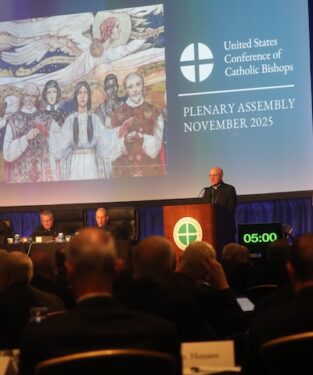
Notably, this seventh edition of the document bans Catholic health care institutions from providing surgical, hormonal, or genetic medical interventions that “alter the fundamental order of the human body in form or function.”
However, the document also states, while referencing a 2023 doctrinal note, that in accordance with the “mission of Catholic health care … services and providers ‘must employ all appropriate resources to mitigate the suffering of those who experience gender incongruence or gender dysphoria,’ and to provide for the full range of their health care needs.”
RELATED: US Bishops Consider Revisions to Catholic Health Care Guidelines on ‘Gender Interventions’
Bishop Massa told The Tablet that the new ERDs were developed with input from the Catholic Health Association, Alliance for Catholic Healthcare, the Catholic Medical Association, the National Catholic Bioethics Center, physicians, moral theologians, ethicists, and hospital leadership. Specifically on the gender issues, he said they met with transgender persons and the parents of transgender persons, as well.
With the vote of approval, the document is recommended as the policy for all Catholic dioceses and healthcare systems in the United States. Next, each bishop will make the directives official in their individual dioceses with a canonical decree.
“With the issues surrounding transgender persons and the rather alarming development over the last 15 years or so of more and more younger people, in particular identifying with the gender other than the one at birth, we needed directives for care for persons who experience gender dysphoria or gender incongruence,” Bishop Massa said of the new directives. “And so, this is really important.”
Looking ahead, the bishops approved major events for the years to come.
The conference approved the next National Eucharistic Congress for 2029, which will follow the 2024 congress in Indianapolis, which brought together more than 60,000 Catholics.
“There’s always excitement about something like this,” said Bishop Brennan, who led a delegation from the diocese to the 2024 congress. “And it’s one of those things where time makes the heart grow fonder. It’s good that something like this is spread out over a period of time so people can really experience something special.”
In addition to the congress, the bishops also voted to consecrate the United States to the Sacred Heart of Jesus in June 2026 as part of the Church’s commemoration of the nation’s 250th anniversary.
The initiative will include prayer resources, a novena leading up to the solemnity, and opportunities for dioceses and parishes “to engage the faithful through adoration and works of mercy,” according to the USCCB.
“It’s another opportunity to reconnect ourselves to the Lord,” Bishop Brennan said of the consecration. “Basically, it’s for us as Catholics to take a lead in terms of being a light to the people of this nation.
“Enter into the semi-quincentennial, for us to be a light and example of how to do so prayerfully, reflectively — maybe it’s an opportunity to model a way of putting political divisions aside and unite.”