


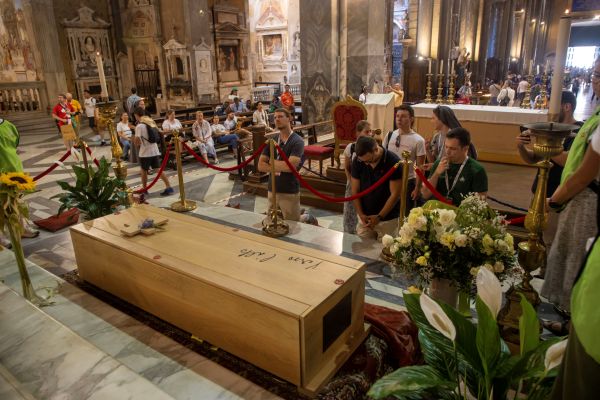
DOUGLASTON — Opportunities abounded this summer for venerating Blessed Carlo Acutis and Blessed Pier Giorgio Frassati in Rome, both set to be canonized on Sept. 7.
Pilgrims from the Diocese of Brooklyn were among the thousands of young Catholics who came to the Eternal City for the Jubilee of Young People. There, the 87-member delegation could view a relic of Carlo at the Church of San Marcello al Corso in Rome.
RELATED: Thousands Visit Blessed Frassati’s Remains in Rome for Jubilee of Youth
But they also made a side trip to see his whole body, encased in glass, in Assisi, Italy. There, the soon-to-be first millennial saint appears to be in serene slumber, even though his youthful countenance is a mask made of silicone.
Meanwhile, Frassati’s body was venerated at the Basilica of Santa Maria sopra Minerva in Rome. But pilgrims only saw the outside of his coffin, even though his body is thought to be miraculously resistant to normal decay — a condition called “incorrupt.”
Throughout the history of the Church, many people have believed that a saint’s incorruptibility was a sign of special grace from God, worthy of canonization. But those beliefs are debunked by one retired member of the Vatican’s Dicastery for the Causes of Saints.
“All of this is false,” said Msgr. Robert Sarno, who clocked nearly four decades as an investigator at the dicastery. “There is no such thing as incorruptible.”
RELATED: Retired Brooklyn Priest Had Hand in Blessed Frassati’s Canonization Cause
In that role, Msgr. Sarno probed reported miracles, which led to the canonization of saints, including Father Damien of Molokai and Mother Teresa of Calcutta. But many other reports were proven to be false.
Msgr. Sarno is now retired at the Bishop Mugavero Residence for Senior Priests in Douglaston, but he still handles requests for assistance from the dicastery. He also lectures on canon law.
The Church, he said, now sticks to precise criteria for determining true examples of divine intervention. The reported incorrupt condition of a body, he added, is not one of them.
Still, Church leaders once held different views about incorruptibility. Perhaps that is because human decay was a mysterious phenomenon when the Church began canonizing saints in the first century.
The ancient Egyptians were preserving bodies through mummification and embalming approximately 5,000 years before the birth of Jesus. But most corpses simply turned to dust. So, when a well-preserved body was discovered many years after death, people thought it was a miracle.
Catholic writer Joan Carroll Cruz featured 102 saints or blesseds in her 1977 book, “The Incorruptibles: A Study of the Incorruption of the Bodies of Various Catholic Saints and Beati.”
Among them are St. Cecilia, St. Francis Xavier, St. Stanislaus Kostka, St. Benedict the Moor, and St. Teresa of Avila.
In the 1700s, Pope Benedict XIV wrote a lot about incorruptibility in his book, “On the Beatification of the Servants of God and the Canonization of the Blessed.” In the chapter titled “On the Incorruptibility of Cadavers,” he declared that a body’s preserved condition is miraculous only if its lifelike condition remained over a very long period.
But the Church no longer considers incorrupt conditions while investigating a cause for sainthood, Msgr. Sarno said, adding that decomposition of human remains is now understood differently by modern science. A body may be slow to decay for many reasons, such as environmental conditions, but it still decays, he explained.
“For example, if there’s no humidity, the body can mummify, and we call that intact,” Msgr. Sarno said. “Bodies or parts may be intact, but to speak of them as incorrupt is absurd.”
Many saints are thought to be incorruptible, such as Pope John XXIII and Padre Pio. But they, like Carlo, are covered with masks. He said these are examples of magnificent cosmetology. “It’s all wax,” he said.
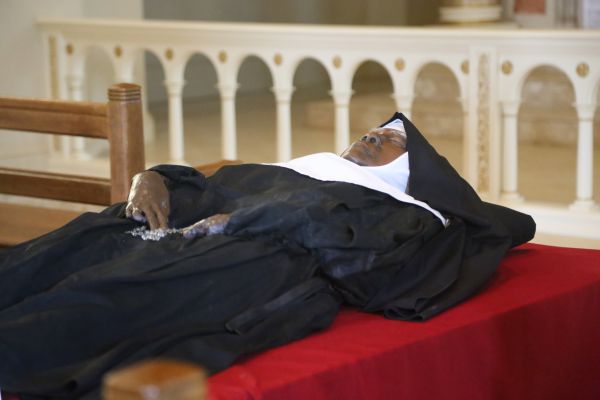
Still, Catholic media publishes reports about saints believed to be incorruptible who are venerated by pilgrims.
Msgr. Sarno said they are “wrong,” adding that the only criteria for sainthood are martyrdom, heroic virtue, or offering one’s life in charity toward others.
“Look,” Msgr. Sarno said, “I always taught my students, ‘everybody rots,’ with the exception of our Lord Jesus, who rose from the dead, and Mary, who was assumed into heaven.”