

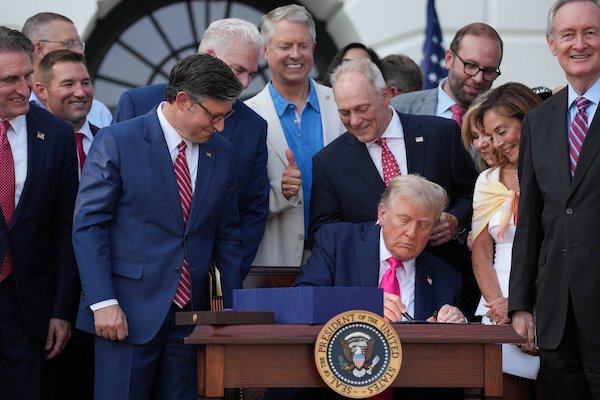
On July 17, the United States Conference of Catholic Bishops published a detailed list of all the migration-related provisions in the “One Big Beautiful Bill Act,” which President Donald Trump signed into law on July 4.
The following is a review of the USCCB list, including details of each provision, as well as the list itself, which has been edited for clarity and brevity.
Section 10108: “Alien SNAP Eligibility”
The Supplemental Nutrition Assistance Program provides food benefits to low-income families. This provision limits SNAP eligibility to lawful permanent residents (green card holders), Cuban/Haitian entrants, and other select migrants lawfully residing in the United States. This provision ends SNAP eligibility for refugees, asylees, people granted withholding of removal, victims of trafficking, and other noncitizens in the United States who were previously eligible.
Section 70104: “Extension and Enhancement of Increased Child Tax Credit”
For a child to benefit from the Child Tax Credit (CTC), the adult filing for the tax return will now be required to have a Social Security number. Previously, only the qualifying child was required to have a Social Security number. As a result of this change, U.S.-citizen children who do not have at least one parent with a Social Security Number can no longer benefit from the CTC.
Section 71109: “Alien Medicaid Eligibility”
Beginning October 1, 2026, with limited exceptions, this provision ends Medicaid eligibility for refugees, asylees, people granted withholding of removal, and other noncitizens in the United States who were previously eligible. Green card holders remain subject to a five-year bar before becoming eligible. Cuban/Haitian entrants will remain eligible for Medicaid, as well as those lawfully residing in the United States pursuant to the Compacts of Free Association between the United States and Micronesia, the Marshall Islands, and Palau.
Section 71201: “Limiting Medicare Coverage of Certain Individuals”
This provision ends Medicare eligibility for all refugees, asylees, and people withholding of removal. Cuban/Haitian entrants, and those lawfully residing in the United States pursuant to the Compacts of Free Association between the United States and Micronesia, the Marshall Islands, and Palau, remain eligible. For noncitizens who were entitled to, or enrolled in, Medicare coverage at the time this bill was enacted but no longer have a qualifying status, their eligibility/coverage will end after January 4, 2027. Green card holders remain subject to a five-year bar before becoming eligible.
Section 90001: “Border Infrastructure and Wall System”
$46.55 billion is provided and available through Sept. 30, 2029, for expenses related to border infrastructure and a wall system, including access roads and surveillance technology.
Section 20011: “Improving Department of Defense Border Support and Counter-Drug Missions”
As part of this provision, $1 billion is provided and available through Sept. 30, 2029, for the deployment of military personnel in support of border operations, counter-narcotics and counter transnational criminal organizations mission support, the operation of national defense areas and construction in national defense areas, and the temporary detention of migrants on Department of Defense installations.
Section 90002: “U.S. Customs and Border Protection Personnel, Fleet Vehicles, and Facilities”
$4.1 billion is provided to hire and train additional Border Patrol agents and other personnel, $855 million for vehicles, and $5 billion to acquire and improve facilities and checkpoints. All funding is available through Sept. 30, 2029.
Section 90003: “Detention Capacity”
$45 billion is provided and available through Sept. 30, 2029, for both single adult and family detention, with the indefinite detention of families permitted.
Section 100051: “Appropriation for Department of Homeland Security”
In addition to funding already provided, over $2 billion is provided and available through Sept. 30, 2029, for a wide range of purposes, including: hiring and training U.S. Customs and Border Protection agents and other personnel; transportation and related costs associated with the departure and removal of noncitizens; resources to “enhance screening and vetting” of all noncitizens seeking to enter or remain in the United States; and expedited removal of certain noncitizens, among other purposes.
Section 100002: “Asylum Fee”
A fee of at least $100 will now be required for all asylum applications, and no waiver or reduction of the cost may be provided for any reason.
Section 100003: “Employment Authorization Document Fees”
Asylum applicants, parolees, and Temporary Protected Status (TPS) holders will now be required to pay a fee of at least $550 for an initial application for employment authorization. No waiver or reduction of the cost may be provided for any reason.
Noncitizens paroled into the United States will now be required to pay a fee of at least $1,000, unless they meet the criteria of an exception. If someone does not meet an exception, no waiver or reduction of the fee will be provided for any reason.
Section 100010: “Fee Relating to Renewal and Extension of Employment Authorization for Parolees”
Parolees seeking to renew or extend their employment authorization will now be required to pay a fee of at least $275, and no waiver or reduction of the fee will be provided for any reason.
Section 100009: “Annual Asylum Fee”
For each calendar year that an asylum applicant’s case remains pending, the applicant will now be required to pay a fee of at least $100, and no waiver or reduction of the cost may be provided for any reason.
Section 100017: “Inadmissible Alien Apprehension Fee”
Any inadmissible noncitizen apprehended between ports of entry will now be required to pay a fee of at least $5,000.