
by John Lavenburg, X @johnlavenburg
PROSPECT HEIGHTS — When Bishop Brendan Cahill of Victoria, Texas, recently spoke at St. Thérèse of Lisieux Church in East Flatbush as part of a recent visit to the Diocese of Brooklyn, he referenced the following quote from Dorothy Day: “We know that one impulse of grace is of infinitely more power than a cobalt bomb.”
The quote comes from Day’s biography on the church’s namesake. It compares St. Thérèse of Lisieux’s “Little Way” approach to spiritual life — doing ordinary things with extraordinary love — to the destructive power of an atomic weapon. Bishop Cahill, meanwhile, referenced it as a response to the challenges immigrants face nationwide.
“I thought that message is probably appropriate for us now because it’s the individuals that need single acts of love for them, and we can do that,” he told The Tablet. “I’m sitting here feeling powerlessness, but what about a single act of love?”
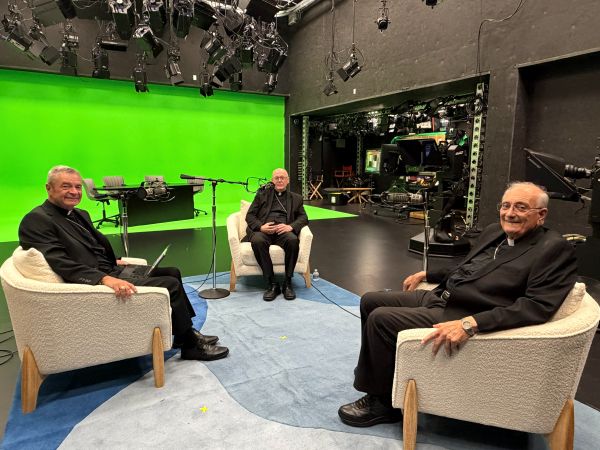
Bishop Cahill, who is chair of the U.S. Conference of Catholic Bishops (USCCB) Committee on Migration, spoke with The Tablet after recording an episode of the “Big City Catholics” podcast alongside Bishop Robert Brennan and Bishop Emeritus Nicholas DiMarzio. Their conversation, and the one that followed with The Tablet, centered on the reasons for his visit to the diocese and immigration, specifically the Trump administration’s decision to end Temporary Protected Status for Haitians.
Known as TPS, the status prevents the deportation of eligible migrants in the U.S. who cannot return to their homeland because of wars or other dangerous conditions. For Haitians, this round of TPS allowed them to come to the U.S. following the 2010 earthquake that ravaged their homeland.
By ending TPS for Haitians on July 27, the Trump administration has forced some 300,000 to 350,000 Haitian immigrants — at least 20,000 of whom may live in Brooklyn and Queens, according to Father Hilaire Belizaire, director of the Haitian Apostolate in the diocese — to return to a country that is in political, social, and economic chaos.
On the podcast, Bishop Brennan said the TPS decision has created a “troubling situation,” noting that Haiti is not a safe place to send people. Bishop Cahill said the decision was “not a good judgment,” explaining that he doesn’t believe the “process of picking people up and dropping them off is helpful.”
Afterward, speaking with The Tablet, Bishop Cahill also acknowledged his shock at the Trump administration’s decision to end TPS for Haitians.
RELATED: Diocese of Brooklyn’s Haitian Catholics Turn to Faith After Temporary Status Ends
“I thought it was going to be extended. I thought that legally we had a case. I thought we would win. I didn’t think that the government would send people back to Haiti,” he said. “When that decision was made, as someone who’s chair of a committee, feeling a responsibility, I felt pretty powerless, like a failure, like I wish I could have done more.”
Bishop Cahill said he felt he needed to do something to show his concern for those affected and considered places with large Haitian populations he could visit — Miami; Springfield, Ohio; and Brooklyn. Ultimately, his family connection to Brooklyn, specifically St. Thérèse of Lisieux Church, led him to the Diocese of Immigrants.
“[My mom] grew up in an Irish neighborhood. My mom and dad were married in 1953 at St. Thérèse of Lisieux Church. … My grandmother lived at a house on Clarendon Road until 1989,” he explained. “She lived through the transition of a community.”
Bishop Cahill said his connection to St. Thérèse of Lisieux was shaped in part by his mother’s memories of the parish, which she saw evolve from an Irish neighborhood church into a Haitian community.
“The Irish are kind of famous for their quick Masses,” he said, “and mom was like, ‘They (the Haitians) were singing and dancing, and Mass was long, but it was Catholic.’
“So, I thought maybe I could go there to connect. That’s kind of what led to this.”
While visiting, Bishop Cahill celebrated Mass at St. Thérèse of Lisieux Church, met with Bishop Emeritus Nicholas DiMarzio — who is a longtime leader in immigration advocacy and research and a consultant to the USCCB Committee on Migration — and met with a small group of Haitian leaders from the diocese.
He highlighted the power of public witness and hearing from those personally impacted by the end of TPS for Haitians. That, combined with the aforementioned words of Dorothy Day, he said, were the takeaways of his trip.
“That was a fruit (of my trip) — the public witness and the power of the small acts of love,” Bishop Cahill said. “You shouldn’t underestimate the power you have there.”