


WOODSIDE — In March of 1949, Dorothy Day, the journalist-turned Catholic convert and social activist, reflected on the humble servant leadership of Jesus as he washed the feet of his disciples.
Writing in her newspaper, The Catholic Worker, Day described this act as “the love which asked the servants to sit down so that the master could minister to them, wait upon them, wash their feet in a gesture of total and utter abandonment of love!”
“And,” she added, “how far we are from it all!”
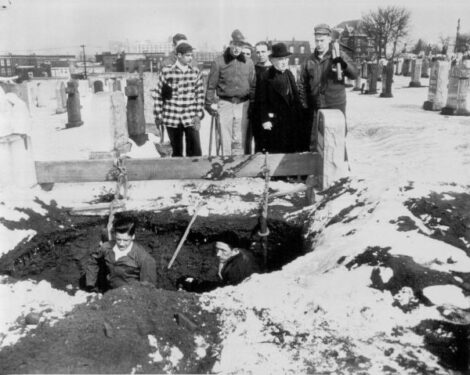
Day was connecting this Gospel scene (John 13:1-17) to the labor dispute between Catholic gravediggers at Calvary Cemetery in Woodside and its owner, the Trustees of St. Patrick’s Cathedral, owned by the Archdiocese of New York.
The archdiocese at that time was led by Cardinal Francis Spellman, a fierce anti-communist. He assailed the workers’ labor union, United Cemetery Workers Union Local 293, for its affiliation with the Congress of Industrial Organizations. While the CIO was never officially a communist union, some of its members at that time were unapologetic communists.
The Second Red Scare, also known as the “McCarthy era,” was underway in the U.S., and influential political leaders, such as U.S. Sen. Joseph McCarthy of Wisconsin, fueled anti-communist sentiment.
The strike began in mid-January of 1949. Nearly two months later, Cardinal Spellman ordered future priests at St. Joseph Seminary and College at Dunwoodie to cross the picket lines and dig graves.
The situation grieved Day, so she wrote the cardinal on March 4.
RELATED: Brooklyn Street Sign Honors Legacy of Catholic Worker Founder, Activist Dorothy Day
Christ-like Humility
In her note, she urged Cardinal Spellman to treat the workers with the humility of Jesus.
“And oh, I do beg you so, with all my heart, to go to them, as a father to his children,” she wrote. “It is easier for the great to give in than the poor.”
Day’s granddaughter, Martha Hennessy, said Day was against Cardinal Spellman’s use of seminarians to break the strike.
“She was very good at admonishing us and pointing things out in a way that was peaceful and not bitter,” Hennessy said.
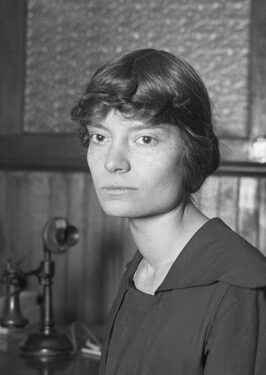
“So, I think the first and foremost lesson in this gravedigger strike story is to acknowledge the suffering of Catholic families who were in poverty.”
All Catholic
Calvary Cemetery, established in 1848, sprawls over portions of the Woodside, Maspeth, and Sunnyside neighborhoods of Queens. It is now the resting place of about 3 million people across 365 acres.
The diggers wanted a shorter work week, cutting it from 48 to 40 hours. But fewer hours also meant the weekly $59.40 they earned working 48 hours would be less. Thus, they sought a pay increase to keep their wages the same.
At that time, the cemetery employed 250 gravediggers, all of whom, according to Day, were Catholic.
Negotiations between the union and the Trustees of St. Patrick’s Cathedral began on Dec. 14, 1948, and continued into January 1949. The trustees had offered a 2.6% cost of living adjustment, but no change in the work schedule.
The diggers went on strike on Jan. 13.
Corporal Works of Mercy
As weeks passed, hundreds of recently deceased people were kept in temporary vaults.
Meanwhile, Cardinal Spellman ramped up criticisms of the union in letters carried in full by local media, including The Tablet.
On March 5, 1949, the newspaper published an article describing Cardinal Spellman’s plan to deploy 100 seminarians as strike breakers.
The headline stated, “Dead to Be Buried by Seminarians: Cardinal Seeks End to Strike Situation at Calvary.”
RELATED: Life and Work of Dorothy Day Is Captured in Artist’s Work
“The men and union made their decision,” the cardinal wrote in his lengthy statement. “Now I must make mine.”
“This evening,” he continued, “I shall go to Dunwoodie and suspend classes at the seminary, releasing all physically able seminarians to assist in the corporal work of mercy of burying the dead.”
He appealed to Catholics to pray, “beseeching God for wisdom and courage to see and resist such anti-American and anti-Christian evils!”
A Movement Misread
The Catholic Worker Movement was founded in 1933 by Day and fellow social activist Peter Maurin. According to members, the movement, while progressive, was not communist, and neither was Day.
“We’re not communists. We’re Catholic Workers,” Jane Sammon, a longtime member of the Catholic Worker movement, has previously told The Tablet.
“With her transition from being a socialist journalist to being a Catholic convert, she saw and understood the suffering of the people,” Hennessy said of her grandmother. “She saw that the communists had a program to help them.
“But they were atheistic, lacking the spirituality that Catholic social teaching clearly had, based on the Gospel.”
The gravediggers understood the difference, Hennessy explained.
“They did not petition communists,” she added. “They petitioned Dorothy. She said that they came to her because The Catholic Worker was not a communist outfit.”
The Saddest of All
Hennessy said Day and Cardinal Spellman were acquaintances whose paths had crossed after his installation in 1939. Day’s March 4 letter to him notes an earlier exchange.
“I remember talking to you about our position some years ago, pointing out that our position was that of pacifism in all wars,” Day wrote. “Now finally we have what we never thought we would have among us, another sample of war, the bitterest, the saddest of all, the antagonisms between worker and Church, between the laity and the cleric.
“It is shocking to think of, and heartbreaking to witness.”
Day concluded her letter by appealing to Cardinal Spellman’s role as a loving shepherd of the faithful.
“You have been known to walk the streets among your people, and to call on the poor parishes in person, alone and unattended,” Day wrote. “Why cannot you go to the union, ask for the leaders, tell them that as members of the Mystical
Body, all members are needed and useful and that we should not quarrel together, that you will meet their demands?
“Be their servant as Christ was the servant of His disciples, washing their feet.”
She Might Be a Saint
The strike ended a few days later in March after the workers cut ties with their union.
Historians differ on whether it was a victory or defeat for the gravediggers, who got an 8% wage hike but no change in their work schedules.
There is no record of Cardinal Spellman being moved by Day’s letter, but Hennessy believes that was the case.
“She was gracious enough to deal with him in a way that was compassionate, pacifist, gentle,” Hennessy said. “And I think that he was able to respond to that.”
A few years later, Day and the cardinal tangled again, this time over the name of her newspaper, The Catholic Worker. The word “worker,” he opined, smacked of communism. Advisers urged him to punish Day, but he ultimately declined, saying, “She might be a saint.”
The newspaper’s name is unchanged, and Day’s cause for canonization is underway at the Vatican.