 “Mrs. B,” a Canadian woman in her 80s and a resident of Ontario, suffered complications from coronary artery bypass graft surgery, so she considered assisted suicide.
Although Canada’s national Medical Aid in Dying (MAiD) Act was passed in 2016, Mrs. B ultimately chose instead to receive palliative care, citing her “personal and religious values,” according to a report by the Ontario MAiD Death Review Committee.
But her story took a different turn.
The report, in which she is identified as Mrs. B, described how her palliative care request was denied because she was in “stable condition” and hadn’t yet qualified for end-of-life hospice care. Instead, health officials suggested a long-term care strategy to manage her condition.
Meanwhile, according to the report, Mrs. B’s husband was “noted to be experiencing caregiver burnout.” He requested a second MAiD assessment, and a second physician deemed that Mrs. B was eligible for assisted suicide.
The report stated that she was dead by the end of the day.
RELATED: Gov. Hochul Signs Assisted Suicide Measure Into New York State Law
Pro-life advocates in the United States monitor Canada’s MAiD Act, noting that 14 states, including New York, now have it, while others are pursuing it.
“One of the statistics I saw is that one in 20 deaths in Canada is due to medical assistance,” said a Chicago-area physician, Dr. Robert Tiballi. “They’re becoming an innovator in this whole arena because it’s so widespread.”
Tiballi is an infectious disease specialist. He speaks on bioethical issues from a sanctity-of-life perspective as a member of the Catholic Medical Association.
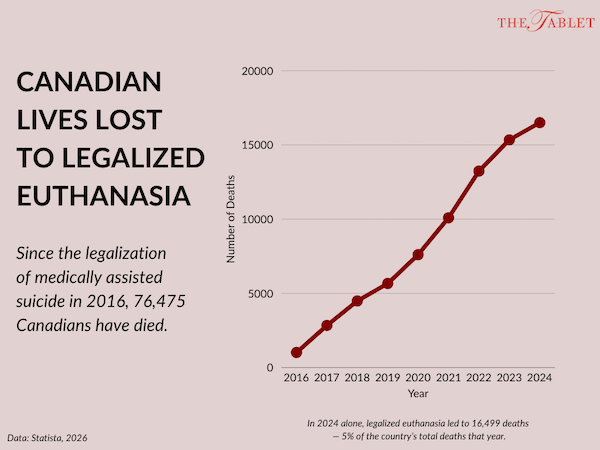
Data published by the Canadian government shows that in 2024, there were 16,499 MAiD deaths, which were about 5% of all deaths in the country. The data also shows that as of 2024, 76,475 Canadians have died by MAiD since its legalization in 2016.
The report from the Ontario MAiD Death Review Committee noted that in 2023, 65 people in Ontario, like Mrs. B, died on the same day they sought to die legally, and 154 died on the days following their requests, after a 2021 amendment removed the 10-day waiting period for cases where natural death is “reasonably foreseeable.”
Still, the speed of such requests and subsequent deaths is debated in Canada and the U.S.
RELATED: Bishops Praise Virginia Legislature For Halting Assisted Suicide Bill
MAiD in Canada allows euthanasia and assisted suicide. Both involve a medical professional helping a person to end their life. They differ in who performs the final act.
Assisted suicide means the patient personally ingests a lethal medication prescribed by a doctor. Euthanasia means the doctor administers the drug to the person.
Attempts to expand these methods are underway in Canada.
On Feb. 4, the Canadian Conference of Catholic Bishops issued a statement in favor of a bill that, if approved, would repeal the planned 2027 expansion of MAiD to cover mental illnesses.
The bishops restated earlier positions that euthanasia and assisted suicide “are always morally unacceptable.”
“These actions,” the bishops wrote, “disregard the inviolable dignity of every person, fracture family and relational bonds, and weaken our shared social responsibility to protect human life and provide care for the vulnerable and marginalized.
“Human life is a gift that must be protected and valued at every stage and in every circumstance.”
Tiballi said he is concerned people in the U.S. might travel to Canada for MAiD to end physical or even mental pain.
He said, “I know one lady who asked me, ‘Do they do assisted suicide in Canada?’ And I said, ‘Yeah, they do. Why do you ask?’ And she said, ‘Well, if my mother’s dying and if my husband dies and the pets die, I don’t want to live anymore.’
“It was her plan to go to Canada and request assisted suicide.”
Tiballi said he was unsure if the woman could have done that without becoming a Canadian citizen. But now, she has a local option as Illinois legalized medically assisted suicide in December.
Also, that month, Gov. Kathy Hochul announced she would support the assisted-suicide bill that passed the legislature in 2025. She made good on the promise Feb. 6, signing the bill with “guardrails,” including a mandatory five-day waiting period between when an aid-in-dying prescription is written and when it is filled.
The bill was opposed by the New York State Catholic Conference and the Patients’ Rights Action Fund (PRAF), a national group focused on ending assisted suicide in the United States.
Jessica Rodgers, PRAF’s coalitions director, agreed that Canada is closely watched for its handling of assisted suicide and euthanasia. She noted that changes that expand MAiD are regularly pursued there. The same goes for the United States.
“Every year we see a minimum of a dozen states introduce assisted suicide bills,” Rodgers said. “What we see consistently is that where these bills are passed, proponents come back to change the law to expand it further.”
For example, Rodgers said, like Canada, some states that initially implemented waiting periods have since reduced them, including California, Vermont, Washington, and Hawaii.
She added that people nearing the end of their lives often don’t want to be burdens for their loved ones, so they opt for assisted suicide or euthanasia.
Meanwhile, she said, medical professionals are too willing to accommodate them, despite guardrails.
“Again, we see a difference between the letter of the law versus the application of how it is actually used,” Rodgers said. “And the message that this policy sends to vulnerable patients is, ‘We agree with you; your life is no longer worth living. We agree that it’s easier if you just go ahead and die already.
“And a story like Mrs. B, as horrifying and tragic as it is, really exemplifies that it is sometimes just a matter of finding the prescriber who will go along with it.”