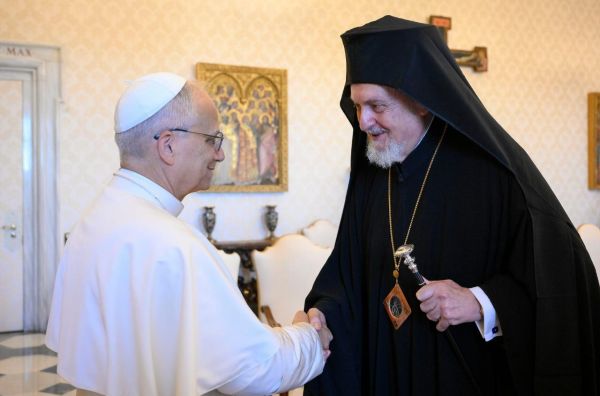
On the heels of a successful Catholic-Orthodox pilgrimage to Rome, Constantinople, and Nicaea, Pope Leo XIV continues to express his desire for unity between the two faiths.
The “From Rome to New Rome: An Orthodox and Roman Catholic Pilgrimage” took place from July 14 to 24 to commemorate the Jubilee and the 1,700th anniversary of the First Ecumenical Council of Nicaea. The pilgrimage, led by Orthodox Archbishop Elpidophoros and Cardinal Joseph Tobin, the Archbishop of Newark, comprised 50 Greek Orthodox, Byzantine Catholic, and Latin Catholic pilgrims from the United States.
Since his installation, Pope Leo has expressed his commitment to helping unite the faiths, following in the footsteps of Pope Paul VI and Ecumenical Patriarch Athenagoras, whose historic meeting in 1964 set the foundations for modern ecumenical dialogue, and Pope Francis, who was also committed to helping open doors to unite the Churches.
Pope Leo recently invited Patriarch Bartholomew of Constantinople to attend an ecumenical conference on the anniversary of the Council of Nicaea, and he also participated in the funeral for Pope Francis and the ordination of Pope Leo. The Pope cited the common celebration of Easter, observed on the same day in 2025 by those who follow both the Gregorian and Julian liturgical calendars, allowing all Christians to proclaim together that “Christ is risen! Truly, he is risen!”
In a Vatican address on June 28, Pope Leo said that he is “determined to restore full Communion between our Churches.” He further noted that, “After centuries of disagreements and misunderstandings, the resumption of genuine dialogue between the sister Churches of Rome and Constantinople was made possible through courageous and farsighted steps taken by Pope Paul VI and Ecumenical Patriarch Athenagoras.”
RELATED: East Meets West on Good Friday’s Way of the Cross
The Churches were once united until the Great Schism. This formal split occurred in 1054 between the Eastern and Western branches of Christianity, leading to the formation of the Eastern Orthodox and Roman Catholic Churches.
Pope Leo also reaffirmed his commitment to continued dialogue between the two faiths and his desire to prioritize Christian unity and the building of bridges between the Churches in a May 25 address, stating that “as Bishop of Rome, I consider one of my priorities to be that of seeking the re-establishment of full and visible communion among all those who profess the same faith in God the Father, the Son and the Holy Spirit.”
Bishop Gregory Mansour of the Eparchy of Saint Maron of Brooklyn and pastor at Our Lady of Lebanon Maronite Church in Brooklyn Heights further emphasized the importance of Pope Leo’s prioritizing unity between the Churches.
RELATED: Meeting Eastern Catholics, Pope Pledges to Be Peacemaker
“Pope Leo is the first canon lawyer we have had, and his background is in Church law,” explained Bishop Mansour. “In 1983, the code of the Latin Church was promulgated, but before that, there were a variety of different laws that the Eastern Churches abided by.”
Bishop Mansour explained that in 1990, Pope John Paul II introduced the Code of Canons for the Eastern Churches, a significant event that paralleled the 1983 establishment of the Code of Canon Law for the Latin Church. As a canon lawyer, Pope Leo would have recognized the importance of these milestones. He would have also been aware that John Paul II emphasized the goal of fostering deeper unity between the Eastern Catholic and Orthodox Churches through this code.
Bishop Mansour added that the bridge or footpath towards unity was established in 1990, looking forward to what is happening today. He said that there is a roadmap towards unity, but there are still issues that must be addressed. At present, there is no communion among the three Churches: the Church of the East, the Oriental Orthodox Churches, and the Eastern Churches. They are not in union with one another, and they are not in union with the Catholic Church.
“But all of them have several things in common,” he explained. “One is Apostolic succession, two is the seven sacraments, three is the same faith. So, my question is, what is holding us back?”
“The remaining differences may now be viewed as minor, compared to the past, with some concerns still needed to be discussed. However, none of these concerns are truly doctrinal in nature. In other words, all these Eastern Churches share the same Sacraments, the same Apostolic Succession, and the same Nicene Faith!”
Father Thomas Zain, pastor at St. Nicholas Antiochian Orthodox Cathedral in Boerum Hill, called Pope Leo’s statements a good thing by trying to promote goodwill while admitting that there is still work to be done.
“We are not at the point where unity is around the corner because the theological differences still need to be addressed,” Father Zain admitted.
“What’s happening between the Patriarchy of Constantinople and the Catholic Church is a good thing and demonstrates brotherly relations in the hope of unity,” he said. “But the idea that it will happen next week, or next month, or next year, that the two Churches are going to be unified may be getting people’s hopes up prematurely.”
Father Zain called Pope Leo’s focus on unification hopeful. Still, he said that in addition to the Church of Constantinople, there are 14 other independent Orthodox Churches that would have to agree and come to a consensus on unification.
“It’s very good that the new Pope is being engaged in doing this,” said Father Zain. “But we have to see what the fruits of it will look like and how we resolve the doctrinal differences that separate us. But there is always hope, and we pray for it at every Liturgy of the faith because that is what Christ wants.”
According to Bishop Mansour, there are many benefits to unification, including having priests fill in for one another in smaller towns and villages when one is unavailable, and allowing people to concelebrate.
“As we trust in the guidance of the Holy Spirit, this Maronite, and I believe all Christians of good will, desire as our Lord has always desired, that we may be able to move closer to fulfilling his prayer for unity as recorded in the Gospel of John, Chapter 17, ‘That they all may be one, as you, Father, and I are one.’”
With Pope Leo’s commitment to being open to working towards full communion between the Churches, the road to unification appears to be heading in the right direction, and complete unity between the Churches is more clearly and closely seen in the distance.