



WHITESTONE — In recent years, Native American Catholics in western Washington State appealed to the Archdiocese of Seattle for an iconic image representing their contributions to the faith.
Subsequently, leaders commissioned an artist to paint an “icon” of St. Kateri Tekakwitha — the “Lily of the Mohawks” — for Seattle’s St. James Cathedral.
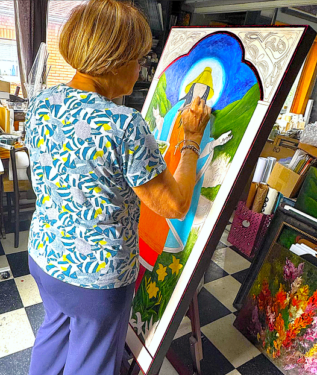
Their pick for the project, however, was on the other side of the nation in Whitestone, Queens — local artist Patricia Brintle, who has experience creating icons, including one of St. Kateri.
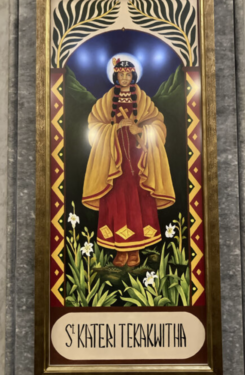
That original image is part of the award-winning, 12-piece “Inclusive Icons” project for the Church of St. Francis Xavier in Lower Manhattan.
RELATED: Diversity Lines the Walls at Church of St. Francis Xavier
Brintle, who was born in Haiti but now lives Whitestone, told The Tablet on Oct. 28 how the Seattle cathedral’s director of liturgy, Corinna Laughlin, was visiting New York City a year ago and had stopped by St. Francis Xavier, where she was amazed to find Brintle’s icon of St. Kateri.
After returning to Seattle, she contacted the artist to offer the commission, and Brintle happily agreed.
“She said there are many reservations near Seattle, and the icon probably would go visit the different ones for processions,” Brintle recalled. “I said, ‘OK.’ Then I started asking questions because, as you know, before I start an icon, I want to know as much as possible.”
Brintle also prays before she begins to paint, hoping for God to direct her brushstrokes for his glory. For icons, she paints with acrylic because its tones and textures come closest to replicating the egg tempera paints used by ancient Byzantine iconographers.
The “Inclusive Icons” project features a dozen portraits of famous people of various cultures and throughout the history of the Catholic Church. Most of the portraits are of saints, including Kateri Tekakwitha, the first Native American saint and a patron saint of the environment.
The project received the “Award for Religious Arts” from the Philadelphia-based Partners for Sacred Spaces, which is affiliated with the American Institute of Architects (AIA).
Brintle’s first icon of St. Kateri depicts the saint in the attire of a Mohawk woman from the mid-to-late 1600s in northeastern New York. Here she is surrounded by lilies, and she wears a traditional headband, shawl, long dress, and moccasins.
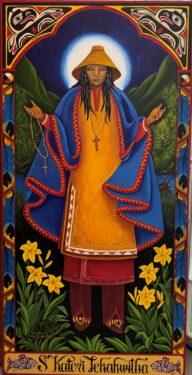
But Brintle knew she could not simply replicate the first Kateri image for the new icon. The Seattle version, she explained, reflected the indigenous Coast Salish culture of the Pacific Northwest.
RELATED: St. Kateri Can Aid Native American-Catholic Church Reconciliation
After numerous “Zoom” consults with the team in Seattle, a new icon of the saint emerged.
It shows her wearing a traditional brimmed hat made of thin tree bark, a blue blanket over her shoulders, and a sort of tunic layered over a long dress and leggings.
Unique regional accents include traditional “totem” style eagle heads and motifs inspired by the Coast Salish’s primary food source, the salmon.
This transformation reminds the viewer of how Catholics from Mexico to Portugal, Africa, Asia, and beyond have their own visual interpretations of the Blessed Mother, based on their local Marian apparitions in which she appears in their traditional attire and reflects their diverse cultural and ethnic backgrounds.
However, Brintle noted that St. Kateri is also special to Native American Catholics in the Seattle area due to a local connection — the second miracle required for her canonization by Pope John Paul II on Oct. 21, 2012.
Six years earlier, Jake Finkbonner, then a 5-year-old boy of Native American heritage, suffered a cut lip while playing basketball. Brintle said the cut became infected with a flesh-eating bacteria that covered his face.
He nearly died, but a religious sister, Kateri Mitchell, also of Native American heritage, placed a relic of Kateri, a bone fragment, on the boy and prayed with his parents for the Mohawk woman’s intercession.
RELATED: Native Americans Gather in North Carolina to Celebrate Catholic Faith, Traditional Culture
It worked, and Finkbonner is in his 20s today.
The new icon was unveiled Oct. 19 at the cathedral in Seattle. Brintle attended and was overwhelmed by the kindness shown to her by the people in the congregation.
They gave her several gifts, including a Native American blanket like the one around St. Kateri’s shoulders in the icon.
“Needless to say,” Brintle said, “I’m very sensitive, and I cried practically the whole time.”