


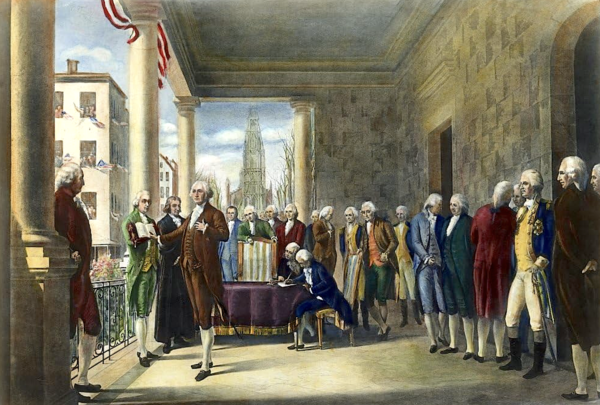
PROSPECT HEIGHTS — George Washington, the military hero of the American Revolution and the first president of the United States, seldom mentioned the Lord Jesus Christ in speeches, conversation, or writings.
Yet Washington, “The Father of His Country,” often talked and wrote about “providence” — that guiding and protective care of a creator God.
Take, for example, his signing of the First Proclamation of Thanksgiving for Thursday, Nov. 26, 1789. He signed it at Federal Hall on Wall Street in lower Manhattan, which at that time was the seat of the federal government.
 The message begins, “It is the duty of all nations to acknowledge the providence of Almighty God, to obey his will, to be grateful for his benefits, and humbly implore his protection and favor.”
This proclamation contained inclusive terms such as “people of this country” and “a blessing to all people.” He called upon citizens to beseech God to grant “all mankind” a degree of prosperity “as he alone knows to be best.”
The language contrasted the hostile anti-Catholic rhetoric entrenched in America and Europe since the Protestant Reformation began in the 1500s.
The year 1789 thus became a watershed year for Catholics in the U.S.
On March 4, Charles Carroll, the only Catholic signatory of the Declaration of Independence became Maryland’s first senator. On Nov. 6, his cousin, John Carroll, was appointed by Pope Pius VI to become the bishop of Baltimore, the first diocese in the new United States.
But Washington, a lifelong Anglican, added more conciliatory comments in a response to Bishop Carroll who had written to congratulate the nation’s first president. Washington’s letter to the bishop, written in March 1790, praises Catholics for patriotism.
“Your fellow citizens,” Washington wrote, “will not forget the patriotic part which you took in the accomplishment of their Revolution, and the establishment of their government: or the important assistance which they received from a nation in which the Roman Catholic faith is professed.”
‘Gunpowder Plot’
To appreciate the significance of Washington’s openness, it’s important to remember the treatment of Catholics before the war, said Daniel Soyer, professor of history at Fordham University.
“I teach immigration history,” he said. “But I don’t think people really understand the depth of anti-Catholicism and the role it played through the 19th century into the 20th century.”
RELATED: How the Seeds of Religious Freedom Were Planted in the Hard Ground of Colonial America
Timothy Milford, a history professor at St. John’s University, described how Protestant colonists routinely celebrated “Guy Fawkes Day” to commemorate the foiled “Gunpowder Plot” on Nov. 5, 1605, when Catholic conspirators tried to blow up King James I and Parliament. Fawkes guarded the explosives, but he was captured and executed.
“In New England, this celebration was known as Pope’s Day,” Milford said, because Fawkes and the Pope were similarly vilified.
Burned in Effigy
Fellow St. John’s professor Christopher Denny noted how Gen. Washington in 1775, defended Catholics by outlawing Guy Fawkes Day rituals among his troops.
“Sometimes in the colonies it was called Pope’s Day, and they burned the pope in effigy,” said Denny, a professor of Church history. Washington, he added, “said that was ridiculous.”
Milford and Denny both said Washington’s order was practical because he didn’t want to offend potential allies, especially French Catholics in Quebec, who ultimately chose to stay home.
Providence in Brooklyn
In the summer of 1776, Washington rushed to New York City to prepare defenses as the British launched an invasion onto the Long Island on Aug. 21. And so began the Battle of Brooklyn.
On Aug. 27, Washington stood atop Cobble Hill — present-day Atlantic Avenue at Court Street — to observe the 1st Maryland Regiment attack a British fortification of 2,000 troops and artillery at the “Old Stone House” on present-day 3rd Street.
“Good God,” Washington said, “what brave fellows I must this day lose!”
Most of the “Maryland 400” were killed; many were taken prisoner, and only a dozen could join the retreat to Brooklyn Heights. Still, their rear-guard action gave Washington time to evacuate the Continental Army — some say under a “miraculous” fog — across the East River to Manhattan.
“The war could’ve ended right there,” Denny said.
Providence at Saratoga
On Oct. 7, 1777, British Brig. Gen. Simon Fraser boldly rode onto the battlefield near Saratoga in the Upper Hudson Valley to rally his troops.
American Sgt. Tim Murphy, a backwoods sharpshooter from Pennsylvania, climbed a tree to take a difficult 250-yard shot at Fraser, who fell from his horse, mortally wounded.
Demoralized, the British fled the field but were routed by the colonials. It was the first major victory of Americans over a similarly sized field army. Frenchmen were then convinced to join the fight, but not from Canada.
France, a Catholic nation, sent thousands of troops, artillery, and sea power, which set the stage for the Americans’ victory in 1783.
To Set a Tone
Washington’s courting of forces who happened to be Catholic showed pragmatism, but Soyer, Milford, and Denny each said he had a second goal.
“I think he was also trying to set a tone for what this new republic would be,” Soyer said. “When it came to religion, he certainly was trying to lead the way to a kind of pluralism.”
To that end, Soyer said, Washington corresponded with leaders of multiple faiths, including Jews. He noted the president’s letter to the Hebrew Congregation in Newport, Rhode Island on Aug. 17, 1790.
Washington wrote, “May the children of the stock of Abraham, who dwell in this land, continue to merit and enjoy the goodwill of the other inhabitants.”
Diverse, but American
Despite Washington’s efforts, anti-Catholicism didn’t die with the Revolution.
Milford, Soyer, and Denny all noted the emergence of “nativism” in New York City during the 19th century. It assailed immigrants — many of them Italians, Irish, and Germans — and their common religion, Catholicism.
Meanwhile, the nation struggled to resolve slavery. Washington himself owned slaves on his Mount Vernon, Virginia, plantation, as did Jesuits in neighboring Maryland.
RELATED: With ‘Reconciliation’ Funds, Jesuits Begin Atoning For ‘Historic Sin’ Of Slaveholding
Denny said there is evidence that Washington was “willing to envisage a sort of incremental approach to getting rid of slavery,” but nothing happened.
“That’s sort of the gaping wound that you have with the founding of the country,” he said
Still, Denny said, Washington’s vision of pluralism has taken root, even amid today’s roiling of cultural and political differences.
“I think, a testament to George Washington is that America today is a place for religious liberty, religious freedom,” Denny said. “We can all be Americans and yet be of diverse faiths.”