
View this post on Instagram
When Lena Horne died on May 9, 2010, at the age of 92, she was revered as one of the most important women of the 20th century. And it all started in the Diocese of Brooklyn for the award-winning singer, actress, and civil rights activist.
Horne, who was born in Bedford-Stuyvesant, was taught by the Sisters of the Blessed Sacrament at St. Peter Claver School, part of St. Peter Claver Church, the first predominantly black parish in the diocese.
The church is now part of St. Martin de Porres Parish, where fellow entertainer Pearl Bailey performed in the choir during the early part of her career. Horne joined the choir at the behest of Msgr. Bernard J. Quinn. Msgr. Quinn founded St. Peter Claver in 1922, and like Bailey and Horne, was an advocate for the African American community.
RELATED: St. Peter Claver Church’s Centennial Celebration Marks 100 Years of Black Catholic Ministry
Today, St. Martin de Porres Parish is led by Father Alonzo Cox.
Victor Antoine, a Eucharistic minister at the parish, was baptized at the church 68 years ago and recalls that his father attended St. Peter Claver School around the same time as Horne.
“I heard from my parents that Msgr. Quinn knew a lot of people and, among many achievements, had started Little Flower Children’s Services on Long Island, and ultimately encouraged Lena Horne to join the choir,” he said. “I’ve always loved her music, and it made me feel proud to know that she was from this parish and lived in this neighborhood.”
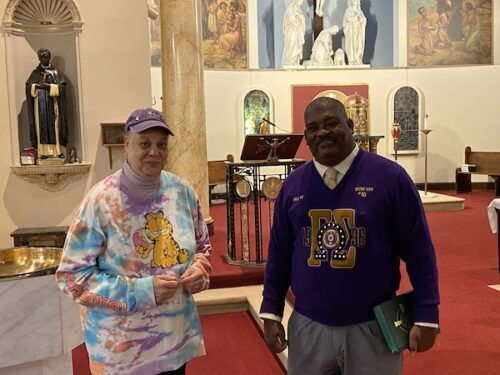
Violet Chandler, also a Eucharistic minister at St. Martin de Porres, said that Horne, having been a member of the parish, is a source of pride.
“She was of my parents’ generation, and they had her albums which they played along with Billie Holiday, Duke Ellington, Louis Armstrong, Harry Belafonte, and Pearl Bailey,” recalled Chandler. “She was an icon, a beautiful woman, and a ceiling breaker as far as black entertainers go.”
LISTEN: Lena Horne’s Legacy – A curated Spotify playlist from The Tablet.
Horne’s father left the family and moved to Pittsburgh when she was 3 years old. Her mother was a traveling actress with a black theatre troupe. So, Horne was primarily raised by her paternal grandparents. When she was 5, she moved to Georgia and traveled with her mother. She returned to Brooklyn when she was 12 and attended St. Peter Claver and then Girls’ High School in Bedford-Stuyvesant. She dropped out at 16 to live with her father in Pennsylvania, where she studied music with Pittsburgh music legends Billy Strayhorn and Billy Eckstine.
Horne’s performing career began in the chorus line at the iconic Cotton Club in New York City, and she made her first film appearance as a dancer in the 1935 musical “Cab Calloway’s Jitterbug Party.” She released her first single, “That’s What Love Did to Me,” on Decca Records in 1941 and her first album, “Moanin’ Low,” in 1942 on RCA Victor.
In 1941, she recorded her first version of the Harold Arlen classic “Stormy Weather,” a song Arlen himself had first recorded in 1933 with Leo Reisman and His Orchestra. It remained at No. 1 for eight weeks. When Horne rerecorded it two years later for the movie of the same name, in which she starred, it became her first charting single, reaching No. 21, and went down in history as her signature song.
Two years later, she recorded the classic jazz-blues ballad “One for My Baby (One More for the Road),” which also reached No. 21 on the pop chart. In 1955, Horne released “Love Me Leave Me,” which reached No. 19 on the pop chart — her highest charting single.
By the 1960s, Horne had become more involved with the civil rights movement. In addition to being with Dr. Martin Luther King Jr. at the March on Washington in 1963, she also participated in an NAACP rally with Medger Evers in Jackson, Mississippi, the weekend before he was assassinated, and she visited President John F. Kennedy at the White House two weeks before his assassination in Dallas.
RELATED: MLK and the Songs of the Civil Rights Movement
In 1970, she appeared with Harry Belafonte, a multi-talented Catholic entertainer like herself, for the television special “Harry & Lena.” In 1976, she starred with Tony Bennett in the special “Tony and Lena,” also, like her, a practicing Catholic born and raised in Queens.
While Horne never recorded a strictly gospel album, she did perform many spiritual songs throughout her career including “Ain’t it de Truth,” where she sings “Ain’t it the gospel truth,” and the traditional folk spiritual “Nobody Knows the Trouble I’ve Seen,” which praises God in the lines, “If you get there before I do, Oh, yes Lord; Tell all my friends I’m coming, too, glory Hallelujah.” And in “Sometimes I Feel Like a Motherless Child,” she sings that though she’s far from home and struggling, she is still a “true believer.”
Among her many awards and accolades are four Grammys, including Best Female Pop Vocal Performance in 1981 for “Lena Horne: The Lady and Her Music,” a Grammy Lifetime Achievement Award in 1989, and Best Jazz Vocal Performance in 1995 for “An Evening with Lena Horne.”
In addition, she won multiple Tony Awards and was inducted into the Songwriters Hall of Fame in 1994 and the International Civil Rights Walk of Fame in 2006.
In 2018, she was honored with a forever stamp as part of the Black Heritage stamp series. In June 2021, her home borough celebrated her by renaming an outdoor performance venue in Prospect Park the Lena Horne Bandshell.
Lena Horne’s life was a testament to endurance, and there’s no doubt that she was able to overcome adversity through her faith. As her song “Stormy Weather” says, “All I do is pray; The Lord above will let me walk in the sun once more.”
And there’s no doubt that for Lena Horne, those prayers were answered.