
All told, there has been a Catholic presence in the United States for more than 400 years. It began with Spanish explorers who settled in Florida, and Tlaxcalan Indians who came over from Mexico and settled in New Mexico.
Then there were the Jesuits in Maryland, who established the oldest active parish in the 13 colonies. Finally, in 1821, under the leadership of the first U.S. bishop, John Carroll, the nation’s first cathedral was founded, and the rest, as they say, was history.
Here, The Tablet looks at some of the historical sites that established the earliest Catholic roots in the U.S.
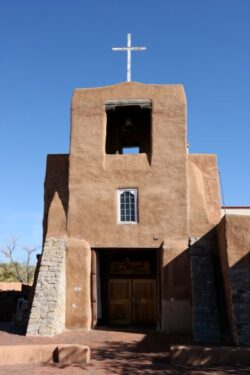
San Miguel Chapel
Santa Fe, New Mexico
Made of adobe by Tlaxcalan Indians who came over from Mexico in the early 1600s, the San Miguel Chapel is known as the oldest church structure in the continental U.S.
The chapel exists on the historic Santa Fe Trail in Santa Fe, New Mexico. Since 1859, it has been owned by St. Michael’s High School in Santa Fe and the Christian Brothers Educational Foundation. It is also consecrated by the Archdiocese of Santa Fe.
While today the San Miguel Chapel is primarily a place for people to visit along the trail, Mass is celebrated there on the first Sunday of every month at 3 p.m.
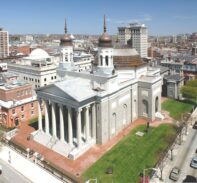
The Baltimore Basilica
Baltimore, Maryland
Constructed between 1806 and 1821, the Baltimore Basilica, formerly known as the National Shrine of the Assumption of the Blessed Virgin Mary, is America’s first cathedral — the seat of the nation’s first archdiocese led by John Carroll, the nation’s first bishop and archbishop.
Following its completion, the Baltimore Basilica became the spiritual center of the Catholic Church in the U.S. According to its website, most early American bishops were consecrated at the basilica, and for generations, more priests were ordained there than in any other Catholic church in the United States.
Pope Pius XI elevated it from a cathedral to the rank of minor basilica in 1937, and it was designated a national historic landmark in 1971. The United States Conference of Catholic Bishops named it a national shrine in 1993.
Today, the Baltimore Basilica continues as an active house of worship.
St. Ignatius Church
Chapel Point, Maryland
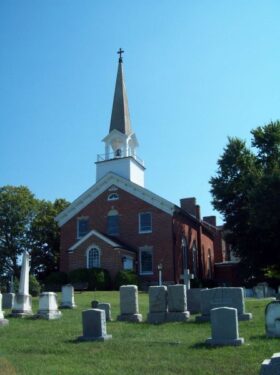
St. Ignatius Church is the oldest active parish in the original 13 colonies.
In 1641, Jesuit priest Father Andrew White established Chapel Point as a small settlement on the bank of the Port Tobacco River near where it meets the Potomac in an effort to preach the Gospel to the Native Piscataway people. Within five years, he and his companions were forced out of Chapel Point by English Protestants across the Potomac. That wouldn’t, however, mark the end of the Jesuits’ time in the area, as 17 years later, in 1662, the Jesuits returned to Chapel Point.
Father Henry Warren built a log chapel at the river’s edge with the help of a land grant from the Maryland colony’s Catholic proprietor, Lord Baltimore. The log chapel was the start of a permanent Jesuit presence in the area.
In 1697, the Jesuits built a small brick chapel and residence on a bluff overlooking the original Chapel Point settlement, which still exists today as the sacristy for the present St. Ignatius Church. A new residence, St. Thomas Manor, was built in 1741, and a brick church adjacent to it in 1798, replacing the original brick chapel.
More than 200 years later, that brick church remains St. Ignatius Church, which the Jesuits have served without interruption since it’s completion.
The Cathedral Basilica of St. Augustine
St. Augustine, Florida
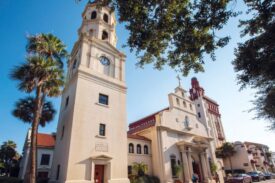
While the San Miguel Chapel is the oldest church structure in the continental U.S., the Cathedral of St. Augustine in St. Augustine, Florida, represents the oldest parish community. Spanish explorer Pedro Menéndez de Avilés founded and established the city of St. Augustine on Sept. 8, 1565. That day, the Spanish settlers constructed a make-shift church and celebrated a Mass.
That make-shift church was destroyed by Englishmen who arrived in St. Augustine 20 years later, in 1585. A second church they built — made of straw and palmetto — was then destroyed by a natural fire. A third was then built, only to be destroyed by James Moore, the British governor of South Carolina, in 1702.
St. Augustine then went without a church for about 90 years — first because of a lack of funding, and then because the English took control of Florida. When the English ceded Florida back to Spain in 1784, a revival of Spanish Catholicism began. At the instruction of Spanish royalty, construction of a church in St. Augustine began in 1793 and was completed four years later. In 1870, that church had its status raised to the level of cathedral with the creation of the Diocese of St. Augustine. It was made a minor basilica by Pope Paul VI in 1976.
It has been renovated a few times over the years, but regardless, the Cathedral of St. Augustine remains a lasting reminder of those earliest Catholic settlers in the U.S.