


PARK SLOPE — If you live in the Diocese of Brooklyn, you don’t have to read history books to learn about the American Revolution. History is right on your doorstep.
Brooklyn neighborhoods served as the backdrop of the Battle of Brooklyn on Aug. 27, 1776 — the first battle of the Revolutionary War following the Declaration of Independence.
RELATED: How Catholics Helped Save the American Revolution at the Battle of Brooklyn
Take the Old Stone House, for instance. Situated in Washington Park in Park Slope, the two-story house is, as the name suggests, made of stone, and played a significant role in the battle.
British forces won the battle but the Americans, led by General George Washington, won the war.
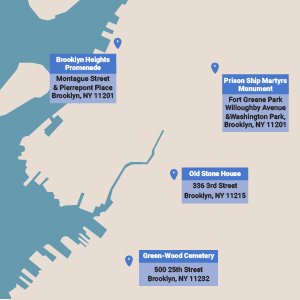
Father Anthony Andreassi, C.O., administrative vicar for the Oratory Church of St. Boniface in Brooklyn Heights, holds a doctorate in history from Georgetown University and led The Tablet on a tour of four sites connected to the Battle of Brooklyn.
OLD STONE HOUSE
Our first stop was the Old Stone House.
British soldiers occupied the house, which had walls that were two-feet-thick. The British turned it into an artillery position from which they fired on the Continental Army.
“The patriots were incredibly outnumbered,” Father Andreassi said. “When the British ships arrived in New York, that was the largest flotilla of ships the world had ever seen up to that point.”
According to the New York City Parks Department, which oversees the Old Stone House, a group of American soldiers known as the Maryland 400 — many of whom are believed to have been Catholic — put up a fierce fight, even wresting control of the house twice during the battle before ultimately falling to the British.
The house survived the war. However, in the late 19th Century, after street grading rose the level of Fourth and Fifth avenues (the avenues on either side of what is now Washington Park) only the second floor of the house remained above ground.
The Parks Department obtained the house in1926 and in 1934, the city completed construction of a replica of the house using some of the original stones.
The Old Stone House is listed on the National Register of Historic Places. In tribute to the bravery of the Maryland 400, a Maryland flag hangs from the front of the house.
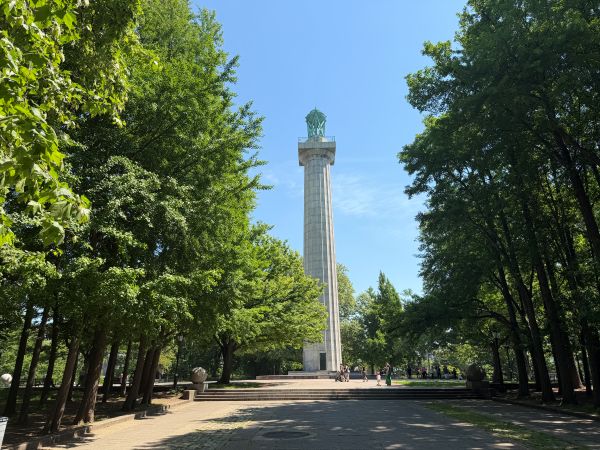
PRISON SHIP MARTYRS MONUMENT
Joggers running through Fort Greene Park might not be aware of it, but the towering structure standing atop the park’s tallest hill is a burial ground.
American patriots who died in British custody are interred in a crypt beneath the Prison Ship Martyrs Monument, a 149-foot-tall tower.
There is a tragic story behind the monument.
During the American Revolution, the British kept captured Americans on 20 ships floating in the waterway between the present-day Manhattan and Williamsburg bridges.
The conditions were “unspeakably horrible,” said Father Andreasi, who explained that 11,500 prisoners of war died in captivity.
Prisoners lived in cramped cells with sealed portholes and poor ventilation. “There was no light. The men, and some women, were forced to eat vermin-infested food,” Father Andreassi said.
One ship, the HMS Jersey, was built to hold 400 sailors and often had 1,400 prisoners on board.
There was a way to win one’s freedom, but most prisoners of war refused to take that route. “You could get off these ships very easily if you said you were loyal to the crown,” Father Andreassi said.
The British threw the remains of deceased prisoners overboard or buried them in mass graves along the shoreline.
In 1808, the remains of some of the deceased were recovered and were re-interred in an area of what is now the Brooklyn Navy Yard.
The remains were undisturbed for decades. But the prison ship martyrs were not forgotten.
In 1873, the remains were moved again and placed to a 25-foot by 11-foot brick vault in what is now Fort Greene Park and over the next several years, a campaign was launched to create a monument to the Prison Ship Martyrs.
It took several years, but on Nov. 14, 1908, the monument, which boasts a 149-foot-tall Doric column topped by a giant bronze lantern, was officially dedicated.
President-elect William Howard Taft presided over the ceremony which was attended by 15,000 people.
“In a sense, it’s a cemetery,” Father Andreassi said.
BROOKLYN HEIGHTS PROMENADE
Our next stop was the Brooklyn Heights Promenade in Brooklyn Heights, which juts out over the Brooklyn-Queens Expressway and offers a view of the harbor, the waterway that served as a lifeline for General Washington when he ordered a strategic retreat that saved the lives of thousands of his soldiers.
Brooklyn at the time was composed of a series of six towns that had been settled by the Dutch — Brooklyn, Bushwick, Flatbush, Flatlands, Gravesend, and New Utrecht — and the entire population numbered roughly 3,600, Father Andressi explained.
“At the time of the Revolution, most of the people who lived in Brooklyn were loyalists and were also Dutch speaking,” he added.
Washington, who was the commander-in-chief of the Continental Army, watched the battle unfold through spy glasses (a type of telescope) from what is now the corner of Atlantic Avenue and Court Street.
He knew he was facing overwhelming odds, so he ordered his troops out of Brooklyn. “What happens is that Washington secretly evacuates 9,000 soldiers across the river to Manhattan — quietly. It was bad weather. There was a lot of fog, a lot of mist. The British didn’t know what was happening,” Father Andreassi explained.
By the time General William Howe, the commander-in-chief of British forces, reached Brooklyn Heights with his troops, the Continental Army had fled.
“We lost the Battle of Brooklyn; we absolutely did,” he said. “However, you might say that Washington saved his troops for another day. And that really was the genius of Battle of Brooklyn.”
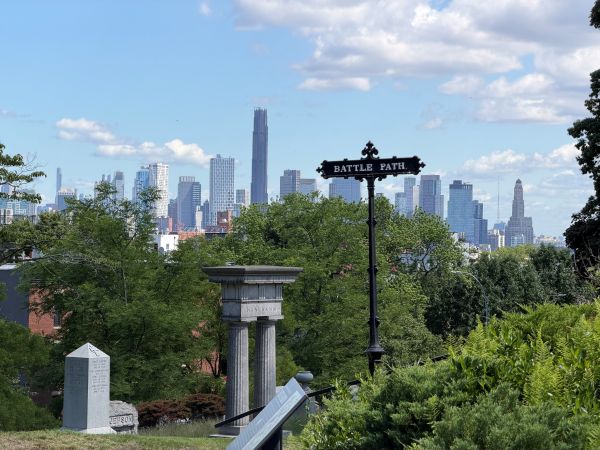
GREEN-WOOD CEMETERY
The final stop on our tour was Green-Wood Cemetery, a 478-acre final resting place for hundreds of thousands of people. Located in Greenwood Heights, the cemetery was designated as a national historic landmark by the U.S. Department of the Interior in 2006.
According to the cemetery’s website, 60 Revolutionary War soldiers are buried there.
The cemetery opened in 1840, decades after the American Revolution, but it sits on land where much of the fiercest fighting took place during the Battle of Brooklyn.
We stood with Father Andreassi on a hilltop known as Battle Hill, the highest natural point in Brooklyn, which is the reason it was sought after by both the British and the provided Continental Army. It provided the opportunity to secure the high ground — a vantage point from which to fire upon enemy troops.
RELATED: Battle of Brooklyn Remembered at Green-Wood Cemetery
Today, the hill offers a clear view of New York Harbor and the Manhattan skyline.
“Obviously, there are skyscrapers, beginning with the Williamsburg Savings Bank, that are higher. But in 1776, there were no tall buildings, so this was the highest point,” he said. “And the Americans quickly tried to take it. They actually took it briefly from the British. They were pushed off eventually.”
The patriots who were captured were taken as prisoners of war. “But the British lost something like 86 men in this particular part of the battle, which was the highest loss of life for the British that day any one place,” Father Andreassi said.
A century and a half later, in 1920, a memorial was erected on Battle Hill. It depicts Minerva, the Roman goddess of wisdom, watching over the hill, seemingly waving hello to the Statue of Liberty in the harbor. At the base of the statue are the words, “Altar to Liberty.”
Minerva was chosen as the statue subject because of her role as the goddess of wisdom, Father Andreassi said. “There was great wisdom in the writing of the Declaration of Independence,” he added.
In addition to Minerva, there are other notable sites on or near Battle Hill. One is a sculpture dedicated to Margaret Corbin (1751-1800), who was believed to have been the first woman to fight in a war for the U.S. — the Battle of Fort Washington in Upper Manhattan. The sculpture is designed to resemble a casket with Corbin resting on top wearing a three-corner hat and a soldier’s jacket.
When her husband was killed, she took his place. While the location of her remains is unknown, The Green-Wood Cemetery decided to have a tribute to her erected.
Another is the Liberty Tree; a Dutch Elm planted in 2025 to commemorate the nation’s 250th birthday. It was planted in memory of a famous Liberty Tree that stood near Boston Common in 1776 and served as a gathering point for patriots to protest the British.