


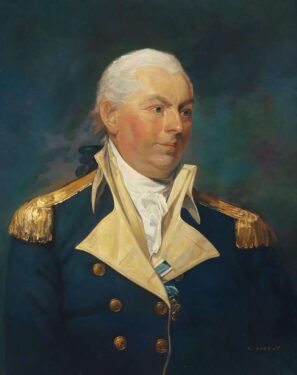
PROSPECT HEIGHTS — Despite being a small percentage of the population in the original 13 colonies, Catholics played a crucial role in the Revolutionary War and the birth of the new nation.
Catholics comprised less than 2% of the population, yet there were heroes like Commodore John Barry, a naval commander who helped win the war and was commissioned as an officer in the U.S. Navy.
Other prominent Catholic figures from that era included Gilbert du Motier, more famously known as Marquis de Lafayette; John Fitzgerald, General George Washington’s aide-de-camp; Thomas Fitzsimons, who was one of only two Catholics to sign the U.S. Constitution; and Stephen Moylan, commander of the cavalry in the Continental Army and the first person credited with using the term United States of America.
Barry (1745-1803), who began each day at sea reading the bible, was known as “The Father of the American Navy.” He was named commander of the Continental Navy in 1776 and won many naval battles during the war, including the last one off the coast of Florida in 1783. Washington then promoted him to the rank of commodore.
Catholics were mistrusted in Colonial America, which made their contributions to the war in the early days of the nation even more remarkable, said Timothy Milford, a professor of history at St. John’s University.
“The vast majority of the population was Protestant, which of course, came from England,” Milford explained. “British American patriotism, as it was then understood, was deeply anti-Catholic. Protestants were equated with literacy and progress, and liberty. Catholicism was equated with authority and lack of liberty.”
However, war can create unusual alliances.
“In 1775, when Washington became commander-in-chief (of the Continental Army), it wasn’t that he was in love with Catholics,” Milford said, “but he understood that you had to have as big a tent as possible.”
Lafayette (1757-1834), who was French, volunteered to join the Continental Army in1776 at the tender age of 19. He commanded troops in the siege of Yorktown in 1781, the last battle of the war.
His nationality is key to understanding the Catholic contribution to the war, Milford said. “America would have won the revolution eventually anyway, but it won it as it did because we had French help. And 95% of those guys were Catholic,” he said. “With the French Alliance, suddenly American officers are fighting alongside French officers, and while war can be a deeply divisive and nasty experience, it can bring people together.”
Fitzgerald (1751-1799), General George Washington’s aide-de-camp, was so trusted by the future president that he handed sensitive military communications.
Moylan (1737-1811), who grew up in Ireland, evaded British laws that forbade Catholics from receiving an education by leaving his homeland to attend schools in Paris. In a letter he wrote in January of 1776, he used the term United States of America. It was the earliest known use of that phrase.
RELATED: How the Knights of Columbus Are Celebrating America’s 250th Anniversary
There are only two Catholic signatories to the Constitution. One of them was Thomas Fitzsimons (1741-1811), who had fought in the war and represented Pennsylvania in the Constitutional Convention. He was also a major financial supporter of St. Augustine Catholic Church in Philadelphia.
The distrust of Catholics didn’t totally disappear. But the camaraderie that stems from working for a common cause — like giving birth to a new nation — was a factor in breaking religious barriers, Milford said.
“Because everyone was fighting for the same cause,” he said, “religious differences get pushed to the background in a way they weren’t during the run-up to the war.”