The Tablet Staff
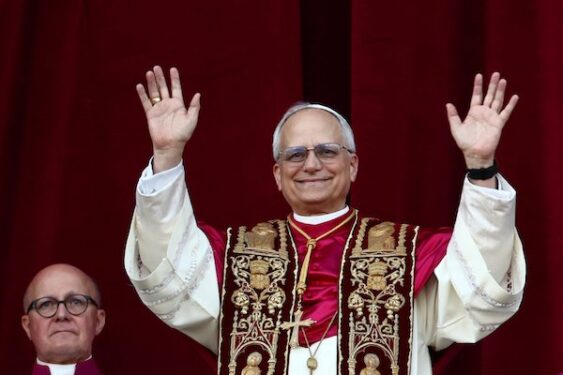
On May 8, 2025, Pope Leo XIV gave his first speech as the 267th successor of Peter.
“Peace be with all of you,” Pope Leo, the first American pope, began from the balcony of St. Peter’s Basilica, continuing with a message on the importance of peace and faith.
“We are disciples of Christ. Christ goes before us. The world needs his light. Humanity needs him as the bridge that leads us to God and his love.
“Help us — and help one another — to build bridges through dialogue, through encounter, so that we may all be united as one people, always in peace.”
Those first words have guided Pope Leo’s first year. He has issued an apostolic exhortation on the need of many Christians “to go back and re-read the Gospel.”
He has advanced multiple sainthood causes, including two men revered by American Catholics.
And perhaps most notably, he has made two papal trips to regions rife with instability, bringing his presence and message of peace directly to those who need it.
From Rome, he has consistently made similar calls for peace regarding the wars between Russia and Ukraine, Israel and Palestine, and most recently between the United States and Iran.
Following the one-year anniversary of Pope Leo’s election, The Tablet takes a more in-depth look at some of the highlights of his first year.
“Dilexi te” (“I Have Loved You”): Pope Leo’s First Apostolic Exhortation
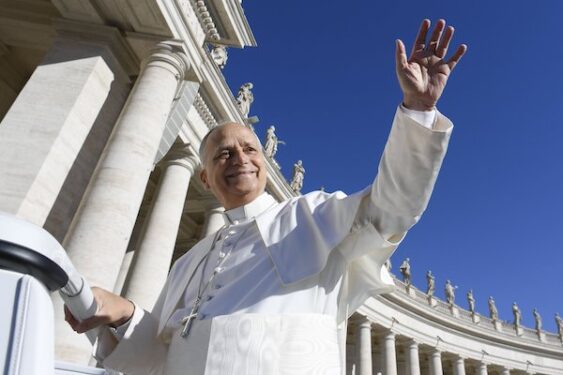
In Pope Leo’s first major papal document, signed on Oct. 4 and published by the Vatican on Oct. 9, he wrote that many Christians “need to go back and re-read the Gospel” because they have forgotten that faith and love for the poor go hand in hand.
“Love for the poor — whatever the form their poverty may take — is the evangelical hallmark of a Church faithful to the heart of God,” the Holy Father wrote.
Pope Francis started the document, Pope Leo said, but he added to it and wanted to issue it near the beginning of his papacy “since I share
the desire of my beloved predecessor that all Christians come to appreciate the close connection between Christ’s love and his summons to care for the poor.”
Bishop Robert Brennan has encouraged Catholics to read the apostolic exhortation, noting that it challenges people to be attentive, to see the needs of the poor and those who are suffering, and to respond with love.
“[Pope Leo] encourages us to see the eyes of Jesus Christ in those who are poor,” Bishop Brennan said in a homily on Oct. 9. “He asks us to really think about the political and economic systems which demean human dignity. He asks us to look in our own hearts to see how we respond to those around us.”
A Journey of ‘Hope’ to Turkey and Lebanon
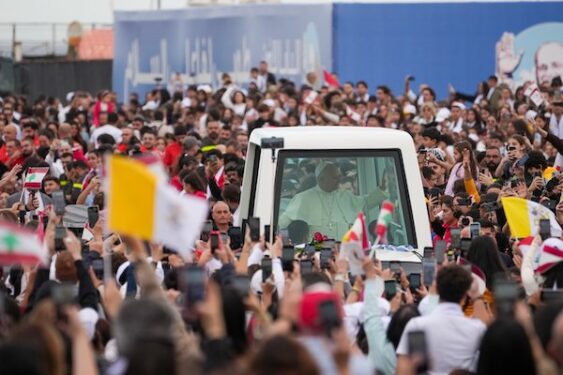
Throughout the first year of his papacy, Pope Leo has steadfastly voiced his concerns for Christians in the Middle East. Putting those words
into action, the Holy Father traveled to Turkey and Lebanon from Nov. 27 to Dec. 2, bringing a message of unity and peace, and marking the 1,700th anniversary of the Council of Nicaea.
While in Turkey, in an address to civic leaders, including President Tayyip Erdoğan, Pope Leo highlighted the importance of religious liberty
and the dignity of all people.
“In a society like the one here in Turkey, where religion plays a visible role, it is essential to honor the dignity and freedom of all God’s children, both men and women, fellow nationals and foreigners, poor and rich,” Pope Leo said. “We are all children of God, and this has personal, social, and political implications.”
Marking the anniversary of the Council of Nicaea, the Holy Father met with Ecumenical Patriarch Bartholomew of Constantinople, the spiritual leader of Eastern Orthodox Christians, at the Patriarchal Palace. There, they jointly signed a declaration, the topic of which was not disclosed.
The two faith leaders also partook in an ecumenical blessing. In an address, Pope Leo urged unity among Christians.
“We are all invited to overcome the scandal of divisions,” he said, calling on Christians to embrace “the desire for unity for which Lord Jesus prayed and gave his life.”
Pope Leo brought a similar message of peace and unity to Lebanon.
“You look at some of the beautiful comments he’s made about Church unity — he longs for it, and this is an opportune time, especially in the face of secularism and anti-Christian sentiments throughout the world,” Bishop Gregory Mansour of the Eparchy of Saint Maron of
Brooklyn told The Tablet. “This is the time for the Churches of the East to get together and not be divided.”
Father Antoine Rizk, superior general of the Basilian Salvatorian Order, an Eastern Catholic monastic order in Joun, El-Chouf, near Sidon,
Lebanon, told The Tablet the central message of Pope Leo’s visit to Turkey and Lebanon is that “Christians are not forgotten, and that we have to hope to live in peace with everyone.”
Sainthood Causes, and the American Connection
Two of the sainthood causes Pope Leo has advanced in his first year have strong connections to the faith in America and provided a boost to many Catholics nationwide.
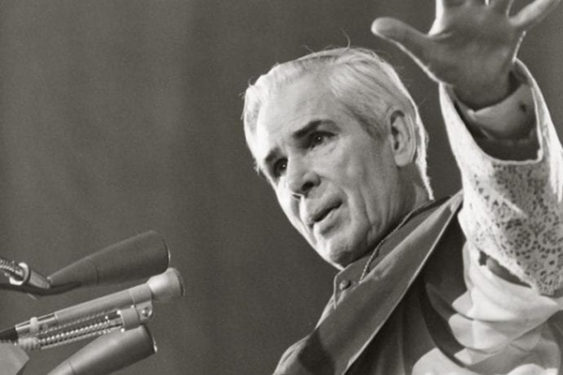
On Feb. 9, the Diocese of Peoria, Illinois, announced that after years of delays, the Vatican had greenlit the beatification of Archbishop Fulton Sheen — a beloved preacher, author, and media pioneer of the 20th century. The beatification date will be Sept. 24 in St. Louis, according to the Dicastery for the Causes of Saints.
“He used television extremely well,” said Father Robert Lauder, a philosophy professor at St. John’s University, one of Archbishop Sheen’s faithful viewers. “He understood the power of the television camera and the power of the closeup. He was a compelling figure to watch, and he used television to evangelize, to bring people to God.”
On March 23, Father Edward Flanagan was declared venerable by Pope Leo. Father Flanagan, an Omaha priest, founded Boys Town — a nonprofit organization that provides housing, education, job training, and health care in a nurturing environment for at-risk boys from low-income or troubled families.
“We continue to pray that he will one day be beatified and ultimately declared a saint,” Archbishop Michael McGovern of Omaha said in a statement. “In the meantime, we will continue to work to affirm the dignity of every person created in God’s image by serving the poor, the abandoned, and the vulnerable, especially at-risk youth.”
Pope Leo’s decisions to advance the causes of Archbishop Sheen and Father Flanagan have been celebrated by Catholics nationwide.
Similarly, while anecdotal, American Catholics have also spoken of a general reinvigoration of Catholicism in the United States since Pope Leo’s election.
A ‘Message of Peace’ Delivered in Africa
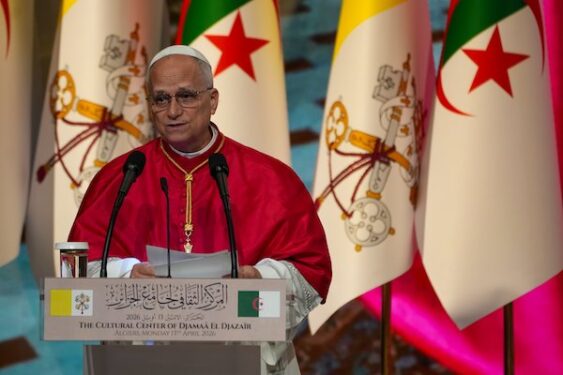
For his second papal trip, Pope Leo traveled to four African nations — Algeria, Cameroon, Angola, and Equatorial Guinea — from April 13 to 23. Reflecting on the trip in a general audience in St. Peter’s Square on April 29, the Holy Father said his trip “was meant to offer the world a message of peace at a moment marked by conflicts and frequent violations of international law.”
“Along with the call for peace,” Pope Leo said, “I also denounced the grave injustices that exist in those countries that are so rich in natural resources, urging the international community to overcome neo-colonial attitudes and engage in authentic collaboration.”
The Holy Father’s first stop was Algeria, the homeland of his spiritual father, St. Augustine. Early on, he visited the Great Mosque in the majority-Muslim country and the Basilica of Our Lady of Africa, where he honored Christian martyrs and highlighted the importance of interreligious dialogue.
The basilica, he said, is a “sign of our desire for peace and unity,” symbolizing “a Church of living stones, where communion between Christians and Muslims takes shape.”
During his flight to Cameroon, Pope Leo reflected on Algeria as “a special blessing,” noting that St. Augustine’s life offers a vision of unity and respect across differences.
That message carried into Cameroon, a country scarred by separatist violence.
The highlight of the trip to Cameroon was his visit to Bamenda, in the heart of the conflict zone. Addressing Catholics at St. Joseph’s Cathedral, the pope was met with enthusiasm after declaring, “I am here to proclaim peace.”
From Cameroon, Pope Leo traveled to Angola, where, across multiple stops he provided hope to more than 20 million Catholics who struggle in the face of inequality, corruption, and a legacy of civil war that claimed up to 800,000 lives. About 100,000 faithful attended Mass
celebrated by Pope Leo in Kilamba.
Addressing government leaders, the pope urged them to prioritize the common good.
“Place the common good before every particular interest,” he said. “Never confuse your own part with the whole.”
Concluding his trip in Equatorial Guinea, Pope Leo appealed for justice and ethical governance in a country long criticized for corruption and human rights abuses.
In his final Mass in Malabo Stadium on April 23, he offered hope to the country’s Catholics, urging them to seek strength, justice, and hope from the Gospel and the sacraments.
As the Mass concluded, the pope bid farewell to the African continent, saying that the region is “an invaluable treasure of faith, hope, and charity.”
“I entrust this intention to the intercession of the Virgin Mary,” the Holy Father said, “to whom I commend myself wholeheartedly, as well as your families, your communities, your nation, and all the peoples of Africa.”