


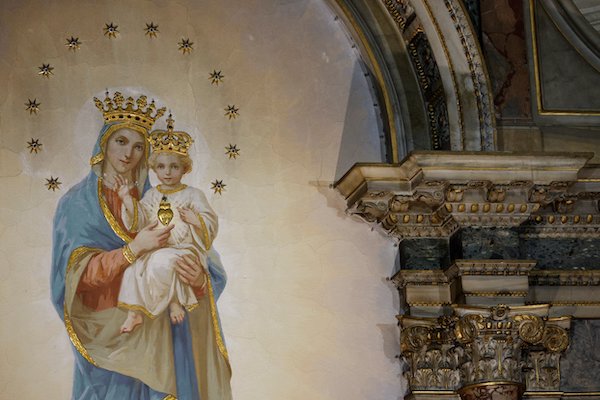
JAMAICA — She is known by various names, including the Virgin Mary, the Blessed Mother, and Mary, the mother of Jesus. Or simply Mary.
The feast days that honor her are varied and plentiful, like Our Lady of Lourdes, Our Lady of Fátima, Our Lady of the Rosary, and many others.
But whatever name Catholics prefer to call her, there is one thread that runs through all of the titles — a deep love and devotion for her.
What makes the various titles and feast days connected to Mary noteworthy is the fact that they were inspired for the most part by ordinary, everyday Christians throughout the centuries — as opposed to being imposed by the Church’s hierarchy — said Christopher Denny, professor of history of Christian theology at St. John’s University in Jamaica.
“In general, the titles applied to Mary arise first and foremost out of popular devotion,” Denny said. “I think that the theology of Mary in the Roman Catholic Church is distinctive because Marian devotion is something that comes from the grassroots.”
Denny noted that “in the ancient Church, crowds aren’t reading theological treatises,” but instead were listening to clergy preaching to them.
“And so, that popular preaching and the response to it sort of drove to the Church’s theology and its devotion to Mary in a very critical way,” he said.
Many of the feast days celebrating the Blessed Mother stem from apparitions in which she appeared to the lowly and the poor.
As examples, Denny pointed to the feast of Our Lady of Guadalupe, which celebrates the Blessed Mother’s appearance before an indigent Mexican named Juan Diego in 1531, and to Our Lady of Lourdes, which marks the apparition in 1858 when Mary appeared to a peasant girl named Bernadette Soubirous 18 times.
RELATED: Diocese of Brooklyn’s ‘Guadalupanos’ Celebrate Our Lady of Guadalupe Feast Day
And then there is the apparition in Fátima, in which Mary appeared to three Portuguese peasant children.
“I think some sort of sociological reality applies here,” Denny said. “I’m surrounded in my office by books, books written by people with degrees. And they’re sometimes complicated to read.
“But of all the different facets of Catholic theology, Marian theology is the one that I think is in touch with the most profound extent with the grassroots.”
Another interesting aspect of Marian devotion is how each nationality embraces Mary as its own, Denny said. “The way Mary appears to Bernadette in Lourdes and to Juan Diego in Mexico is different than the way she appeared in Fátima,” he added.
However, there were two titles by which Mary was known that the Vatican recently ruled against — co-redemptrix and mediatrix of all graces.
The Vatican’s Dicastery for the Doctrine of the Faith issued a decree on Nov. 5 stating that the Blessed Mother cannot be referred to as a co-redemptrix because it gives the erroneous impression that she is a redeemer, when only Jesus will lead the faithful to salvation.
The dicastery discourages Mediatrix as a title for Mary because she cannot serve as a mediator to hold back God’s wrath.
Denny said the Vatican seems to be seeking to clarify Mary’s role.
“I think if you don’t qualify titles like co-redemptrix and mediatrix, Mary ends up looking like the fourth person of God,” he explained, adding that there could be a second reason. “I think the Church is trying to put guardrails on the use of these titles.”
However, there are many names and titles for Mary approved by the Church.
“If you go to the Basilica of the National Shrine of the Immaculate Conception in Washington, D.C., you see a plethora of chapels, and so many of them are devoted to Mary with different titles,” Denny said. “I think this indicates how global the church with Marian apparitions being part of people’s devotions on six continents.”
The Tablet presents a sampling of the feast days of Mary.
OUR LADY OF LOURDES
Feast Day: Feb. 11
Perhaps one of the most well-known names by which the Blessed Mother is known, it refers to the events in Lourdes, France, in 1858, when she appeared to Bernadette Soubirous, a 14-year-old peasant girl, on 18 occasions. Today, 171 years later, Lourdes remains one of the most visited destinations for people of faith.
OUR LADY OF GUADALUPE
Feast Day: Dec. 12
The Virgin Mary appeared to Juan Diego, an indigenous man, on the Hill of Tepeyac in what is now Mexico City in 1531 while he was on his way to Mass. She requested that she ask the local bishop to build a shrine at the site and that she would bless those who came to the shrine. The bishop demanded proof. Juan Diego returned to the spot and gathered roses, even though it was winter, and placed them in his cloak. When he went to see the bishop, the roses fell out of the cloak, and an image of Mary was imprinted in the garment.
OUR LADY OF MOUNT CARMEL
Feast Day: July 16
The title of Our Lady of Mount Carmel for the Blessed Mary dates back to the 12th century, when a group of hermits established a community on Mount Carmel in Israel. The hermits founded the Carmelite Order and devoted themselves to a life of prayer and devotion to the Blessed Mother. They also built a chapel dedicated to her.
OUR LADY OF THE SNOWS
Feast Day: Aug. 5
It miraculously snowed in August on Esquiline Hill in Rome on Aug. 5, 352, an event that led to the title of Our Lady of the Snows. A wealthy couple prayed to the Blessed Mother for guidance on how to donate their possessions. She appeared to the couple and to Pope Liberius in a dream in which she requested that they build a church in her honor and that she would send them a sign — that snow would fall on the hill. It is now the site of the Basilica of St. Mary Major.
OUR LADY OF PERPETUAL HELP
Feast Day: June 27
The name Our Lady of Perpetual Help comes from a work of art. A portrait of Mary and Jesus, believed to have been painted in the 14th century in Crete, depicts them with two angels, Michael and Gabriel, hovering above them. It is believed to have been brought to Rome by an Italian merchant in the 15th century and placed in the Church of St. Matthew. In 1866, the painting was brought to the Redemptorist Church of St. Alphonsus, where it remains today.
OUR LADY OF FÁTIMA
Feast Day: May 13
In 1917, the Blessed Mother appeared to three peasant children — Lucia Santos and her cousins Francisco Marto and Jacinta Marto — seven times in Fátima, Portugal. She asked them to pray the rosary, to pray for sinners and for the world to be consecrated to her immaculate heart. She also entrusted them with three secrets. The feast day is celebrated on the day Our Lady of Fátima first appeared to the three children.
OUR LADY OF SORROWS
Feast Day: Sept. 15
Our Lady of Sorrows signifies the seven sorrows the Blessed Mother faced in her life. It is meant to inspire Catholics to keep the faith despite hardships. The seven sorrows are: the circumcision of Jesus, the flight into Egypt, the loss of the child Jesus in the Temple of Jerusalem, the fourth station of the cross (Jesus meets his mother on the way to his crucifixion), the crucifixion of Jesus, Jesus’ descent from the cross, and the burial of Jesus.
OUR LADY OF CZESTOCHOWA
Feast Day: Aug. 26
The feast day of Our Lady of Czestochowa is significant in Poland and to Polish Americans. It refers to an icon of Mary and Jesus in Czestochowa, Poland, that is believed to have been painted by Luke the Evangelist in the 6th century on a cedar tabletop that came from the house of the Holy Family. In the painting, Mary has three scars on her face, the result of an attack by Hussites in 1430. Despite several attempts to repair the damage, the scars remain.
MARY QUEEN OF HEAVEN
Feast Day: Aug. 22
This day honors the fact that Mary was crowned Queen of Heaven after her assumption into heaven, body and soul. The feast of the Assumption is celebrated on Aug. 15. Pope Pius XII instituted the feast of Mary, Queen of Heaven, in 1954 and set its date as May 31. However, Pope Paul VI moved it to Aug. 22 in 1969 as part of a series of changes to the liturgical calendar established by the reforms of Vatican II earlier in the decade.
OUR LADY OF THE ROSARY
Feast Day: Oct. 7
The feast day of Our Lady of the Rosary. It commemorates the Battle of Lepanto (off the coast of Greece) in 1571, in which the Christian forces’ victory was attributed to the Blessed Mother’s intercession. The feast was established by Pope Pius V in 1571, the same year as the battle. Originally called the feast of Our Lady of Victory, it was renamed to Our Lady of the Rosary by Pope Gregory XIII in 1573.