
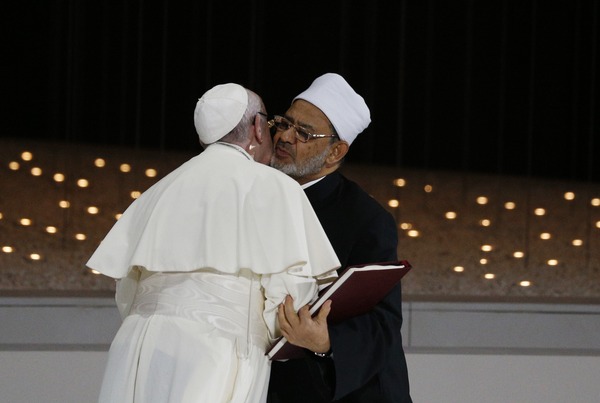
Among the many trips Pope Francis took after he was elected to the papacy in 2013, his historic first visit to the Arabian Peninsula was a landmark journey. He was the first pope to visit the region and meet with leaders from different religious backgrounds for an interfaith summit.
Pope Francis landed in Abu Dhabi on Sunday, Feb. 3, 2019, and departed on Tuesday, Feb. 5, after celebrating a historic Mass marking the first time the bishop of Rome had traveled to the birthplace of the Muslim faith.
The trip began with a private meeting with Sheik Ahmed Al-Tayeb, the grand imam of Al-Azhar (the 1,000-year-old seat of Sunni Muslim learning), and the members of Foreign Affairs, Tolerance and Culture at the Great Mosque of Sheikh Zayed.
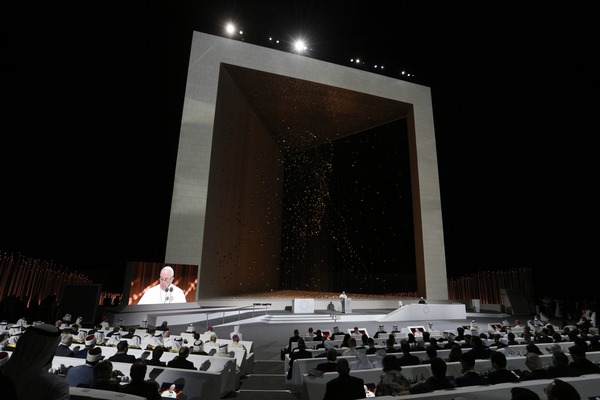
It was followed by an interfaith meeting at the Founder’s Memorial where Pope Francis, the grand imam and members of the Muslim Council of Elders were received by the Crown Prince, Sheikh Mohammed bin Zayed Al Nahyan.
Afterwards, the Holy Father delivered his historic address promoting “human fraternity” to all of the countries on the Arab Peninsula. “There is no alternative: We will either build the future together or there will not be a future,” he told the crown prince, along with hundreds of imams, muftis, ministers, rabbis, and swamis gathered in the Emirati capital. “God is with those who seek peace.”
RELATED: Through Writings Pope Francis Was Champion of Fraternity and Environmentalism
Pope Francis had always prioritized the need for tolerance and understanding between Muslims and Christians. He met five times prior with Sheik Ahmed AlTayeb and visited sacred sites including the Al-Aqsa Mosque in Israel and the Blue Mosque in Turkey.
In the address, the Holy Father also highlighted the need for peace in the region, citing St. Francis of Assisi, who visited the region 800 years earlier and met with Sultan Al-Malik al Kamil. “I have welcomed the opportunity to come here as a believer thirsting for peace, as a brother
seeking peace with the brethren,” he said. “We are here to desire peace, to promote peace, to be instruments of peace.”
Pope Francis also stressed the need to bridge religions by explaining that “every person is equally precious in the eyes of God,” adding, “in the name of God the Creator, therefore, every form of violence must be condemned without hesitation, because we gravely profane God’s name when we use it to justify hatred and violence against a brother or sister. No violence can be justified in the name of religion.”
The theme of the address was human fraternity as “an ark of peace” and the conviction of the Catholic Church that “we cannot truly call on God, the Father of all, if we refuse to treat in a brotherly way any man, created as he is in the image of God.”
At the time there were an estimated 1 million Catholics living in the United Arab Emirates among a population of approximately 9 million. He concluded his address by expressing the importance of open dialogue between religions in the hope that “our being together today is a message of trust, an encouragement to all people of goodwill, so that they may surrender to the floods of violence and the desertification of altruism.
God is with those who seek peace. From heaven he blesses every step which, on this path, is accomplished on earth.”
On the last day, Pope Francis celebrated Mass at Zayed Sports City Stadium in Abu Dhabi, with an estimated 180,000 faithful in attendance from 100 countries. He also met various officials of the United Arab Emirates.
The pope condemned and called for an end to the multiple wars taking place at the time in the Middle East, including conflicts in Syria, Lebanon, Iraq, Libya, and Yemen, urging religious leaders to join together in opposition to war and to re- main meek while following God. He made a broad appeal in the birthplace of Islam for Christian and Muslim leaders to work together in promoting peace and rejecting war.
RELATED: Pope Prioritized Challenging Just War Doctrine Amid Many Global Conflicts
Pope Francis’ 2019 visit opened the door for interfaith dialogue and three years later he returned to the region to expound upon his message of interfaith unity.
From Nov. 4 to Nov. 6, 2022, he met with dignitaries from the Arab world including Hamad bin Isa Al Khalifa, the king of Bahrain.
On the last day of his journey, while in the predominantly Muslim country of Bahrain in the Persian Gulf, Pope Francis prayed with Catholic priests and other religious leaders promoting peace throughout the region and called on all the faithful to stay meek in following the Lord and bold in proclaiming the Gospel.
The visit included the first ever papal Mass in Bahrain, which attracted over 30,000 attendees to the country’s national soccer stadium. His visit ended with a Sunday prayer service attended by 600 Catholics serving in the Arabian countries of Bahrain, Saudi Arabia, Kuwait, and Qatar, along with some clergy from Lebanon.
He spoke about the joy of knowing and loving Christ and implored the faithful to not keep it to themselves, but to work to help it grow.
Pope Francis left an indelible mark on interfaith relations throughout the Arab world by boldly journeying where no pope had gone before and spreading the Gospel.
In a land known for religious intolerance, Pope Francis’ message to the Christian and Muslim leaders in the region was to work together in human fraternity to promote peace and put an end to war, simply stating, “God is with those who seek peace.”