


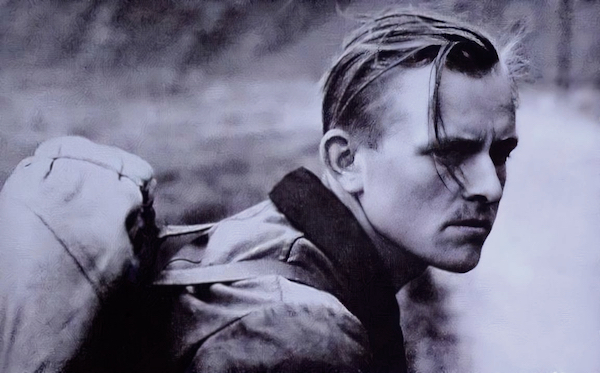
Willi Graf was 25 years old when the Nazis gave him a choice: betray his friends in the anti-Hitler resistance or face death. The Catholic medical student chose silence — and now, more than 80 years after his execution, he is being remembered as a hero and martyr.
Servant of God Willi Graf’s (1918-1943) cause for canonization was opened by the Archdiocese of Munich and Freising in 2017. If the Vatican determines that he lived a life of heroic virtue, he would be given the title Venerable, the next step in the canonization process.
“I think Willi Graf is a hero for our time. He had the courage to face his convictions based on his Catholic upbringing,” said Deborah Lee Prescott, author of “Holy Idealist: Willi Graf, Hero of the White Rose.”
Prescott said his witness remains relevant at a time when people are again forced to confront what courage and conscience require.
RELATED: Meet the Sister of Charity Making Sure Catholics ‘Never Forget’ the Holocaust
Graf was born on Jan. 2, 1918, in Kuchenheim, Germany (a village 50 miles from the city of Cologne), and at 4, his family moved to the city of Saarbrücken. They attended Mass at St. Johann Basilica, where young Graf later was an altar server.
As a teenager, he refused to join the Hitler Youth — defying a government order that all boys between 10 and 18 must belong to the organization. Instead, he remained an active member of Catholic youth groups the government banned.
In 1935, when he was 17, he and a group of his friends marched in the annual May Day Parade in Saarbrücken. However, instead of wearing swastikas and offering Nazi salutes to spectators, they marched with a banner from their school.
Later, as a medical student at the University of Munich, Graf joined the White Rose, a group that held protest marches, distributed anti-Nazi leaflets on street corners, and scrawled anti-Hitler graffiti on public buildings.
When he was arrested by the Gestapo in 1943, Graf refused to reveal the identities of other members of the White Rose and was executed by beheading at Stadelheim Prison in Munich on Oct. 12, 1943. He was 25 years old.
At age 22 in 1940, Graf was drafted into the German army as a medic. He served on the front lines in France and Belgium, then transferred to the eastern front in Serbia and Poland during World War II.
RELATED: Museum Shows Catholics Helped Jewish People During the Holocaust
While in Poland, he saw the atrocities taking place in the Warsaw Ghetto, where Jews were fenced in by the Nazis and starved to death.
“Terrible!” he wrote in a diary entry in 1941.
Graf was eventually allowed to resume his studies and enrolled in the University of Munich, where he became involved in the White Rose.
The group members displayed great courage, Prescott said.
“Certainly, the Christians who stood up against Hitler were in the minority. People had to be concerned that taking a stand against Hitler or the Nazis implicated their families and loved ones,” she explained. “But Willi Graf did what he thought was right because he loved Jesus and he loved the Catholic Church.”
He was arrested by the Gestapo on Feb. 18, 1943, and imprisoned and tortured for several months. His jailers offered him freedom in exchange for giving up the names of White Rose associates. He refused.
Graf was sentenced to death and was killed on Oct. 12, 1943.
“He paid the ultimate price for his beliefs,” Prescott said. “I think for him, it was more important to have the courage of his convictions and live the life that God wanted him to live.”