


Mention the name Michelangelo, and the average person might think first of the Italian artist of the Renaissance period who created sculptures like the “Pietà” and “David,” plus the painting of the Sistine Chapel’s ceiling.
The ceiling is a multi-image work that includes the famous scene, “The Creation of Man,” in which the Creator God and the first man, Adam, reach to touch each other’s fingers. But as thousands of visitors gaze up at the ceiling every day, it could be easy for them to overlook the wall behind the Sistine Chapel’s altar.
There is Michelangelo’s “Last Judgement,” and, as the title implies, it is a dramatic depiction of about 400 characters rising to heaven or falling into hell during the yet-to-happen second coming of Jesus and his final pronouncements for all humanity.
RELATED: New Stations of the Cross Unveiled at St. Peter’s Basilica for Lent 2026
While it may not be as well-known as Michelangelo’s other works, this fresco “inspired awe and wonder,” according to one biographer, another Renaissance artist, Giorgio Vasari, who was younger than Michelangelo but still a fan of his work.
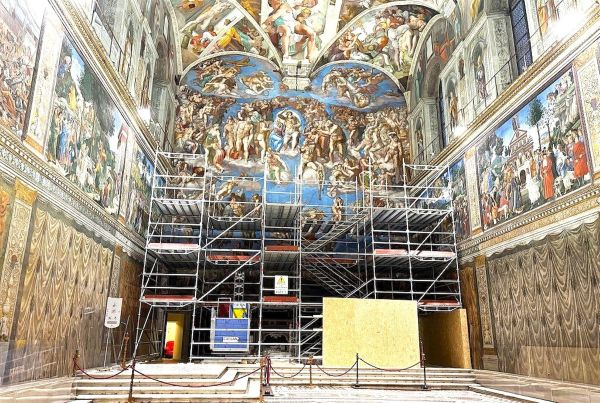
“The Last Judgment” is now making headlines amid a major cleaning that is expected to take about three months, according to a news release from the Vatican Museum.
The project was announced last summer by Paolo Violini, the head restorer of the Painting and Wooden Materials Restoration Laboratory of the Vatican Museums. He provided an update soon after the work began in February.
“We are currently performing focused maintenance on the ‘Last Judgment,’ ” he said in a statement, “because this is where a general whitish film has reduced contrast between light and shadow and homogenized the original colors of the fresco over time.”
Violini further explained that this coating, “formed from deposition by airborne microparticles on alien matter brought in by air currents.”
Meanwhile, the chapel will stay open to the public.
“I’m excited to see what comes with this,” said Christine Axen, a history professor who has taught at St. John’s and Fordham Universities. “Often, we don’t imagine the damage that humans do to art.
“For example,” she explained, “a lot of our Medieval effigies — people just touch them, and their finger oils that are deposited on these sculptures discolor them over time. We don’t consider that we’re harming these miraculous works of art.”
Axen specializes in Medieval history, which was followed by the Renaissance period, so her research has examined how the former influenced the latter.
She said the Church was at a critical juncture in the mid-16th century. Pope Clement VII turned to Michelangelo in 1534 to help make a difference with “The Last Judgment.”
“This was created during the period when Michelangelo was almost in retirement,” Axen said. “It’s brushing up against the first wave of Reformation. So, the Church has a real agenda at this moment to reinforce the authority of the pope.”
However, the fresco also has a broader mission: to reaffirm Catholic doctrines by emphasizing salvation through the authority and teachings of the Church, Axen said.
RELATED: Vatican Completes Official Mosaic Portrait of Pope Leo XIV for Papal Basilica
For example, appearing near the central figure of Jesus is St. Peter, the oft-described “first pope,” holding the keys to heaven. On the other side is Jesus’ mother, Mary.
Also surrounding Jesus are other saints known for their good works, including St. Bartholomew, who was martyred by being skinned alive. He is shown restored to his former appearance but still grasping his flayed human hide.
The influence of such figures ran counter to the tenets of the Protestant Reformation, which held that faith alone achieves salvation.
Axen explained that most of these figures were nude when Michelangelo first painted them. But, in 1564, leaders of the Church, during the Council of Trent, hired an apprentice of Michelangelo to paint clothing over many of the naked body parts.
Quoting a statement from the council, Axen related the intention that “all the hideousness should be avoided in such wise (that) the figures not to be painted or adorned with beauty (that is) exciting to lust.”
“So,” Axen noted, “that was the official statement of the Church that ultimately resulted in Michelangelo’s work being censored.”
Michelangelo, who died in 1564, spent the last part of his career focusing on designs for major building projects. He was the chief architect of St. Peter’s Basilica and the designer of its iconic dome.
Vatican Museum officials have said they hope to complete the cleaning of the fresco by Easter.
Meanwhile, a high-definition reproduction of “The Last Judgment” will conceal the restoration team members as they continue the work. Therefore, chapel visitors can still experience the fresco’s place in this historic venue for papal conclaves.