
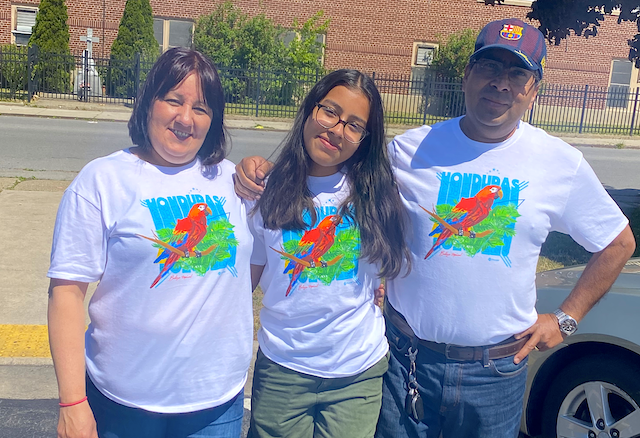
MASPETH — Since 1999, a government-issued Temporary Protected Status (TPS) designation has allowed Juan Romero, a Honduran, to legally reside in the U.S. — able to work, own property, raise a family, and pay taxes.
TPS prevents deportation for eligible migrants in the U.S. who can’t return to their homelands because of wars or other dangerous conditions. For Romero, it was a natural disaster in 1998, Hurricane Mitch, which ravaged Honduras and Nicaragua.
The protection for Hondurans and Nicaraguans like Romero, however, ends on Sept. 8, when their TPS status dissolves in a new directive from the Secretary of the Department of Homeland Security, Kristi Noem, who reasoned that in each case, TPS was designed to be just that –– temporary.
RELATED: Ending TPS for Honduras, Nicaragua Shows ‘No Discernment,’ Sparks Fear, Say Experts
“It is clear that the Government of Honduras has taken all of the necessary steps to overcome the impacts of Hurricane Mitch, almost 27 years ago,” Noem said in a July 7 statement. “Honduran citizens can safely return home, and DHS is here to help facilitate their voluntary return.”
As for Nicaraguans, Noem said in a similar but separate statement the same day that “The impacts of a natural disaster impacting Nicaragua in 1999 no longer exist,” adding that “The environmental situation has improved enough that it is safe enough for Nicaraguan citizens to return home.”
Romero is among an estimated 72,000 Hondurans and 4,000 Nicaraguans who will soon lose their TPS designation, according to DHS figures. On July 7, they were given 60 days to leave the U.S. before the Sept. 8 deadline.
“We are in trouble,” Romero said.
Romero, 52, is a construction worker who lives in Maspeth with his wife and teenage daughter. He disagreed with Noem’s assertion that Honduras has fully recovered from Hurricane Mitch, noting how the economy has lagged, which has given rise to cash-hungry, violent gangs.
“All the country is very bad,” Romero said.
Romero is originally from La Ceiba, a port city on the north coast of Honduras. He said that he first entered the U.S. illegally at age 20 in 1994, looking for construction work. A year after Hurricane Mitch, however, Romero qualified for TPS for 18 months. He successfully reapplied for TPS at the end of each term.
Since coming to the U.S., Romero steadily worked in construction. He stated that he has been with his current employer for approximately five years.
These days, his family attends Our Lady of Sorrows Parish in Corona. Romero owns his home, and his daughter, Stephanie, is enrolled as a freshman at St. John’s University, where she plans to study medicine.
“For 25 years, we had the permit, and now they want to cancel it,” Romero said. “I don’t know what is going to happen later. Because in my country, it is very dangerous.”
 Since President Donald Trump returned to office, Noem has similarly canceled TPS for Venezuelans, Afghans, and people from Cameroon and Nepal. She also reduced a previously extended TPS designation for Haitians from 18 to 12 months.
Romero and his friend, fellow Honduran Walter Hernandez, said they learned about the end of TPS for them by watching Spanish-language newscasts, which is how they also know Honduras is rife with crime, they noted.
“The president of Honduras, Iris Xiomara Castro Sarmiento, says the country is very nice right now,” Hernandez said. “He said there is a lot of security. But I see every day, the news. And every day, from my country, I see crime everywhere.
“Two people killed here; three people die over here … It’s crazy.”
Hernandez, 53, is a painter and day laborer in construction. He is originally from Comayagua, Honduras. He, like Romero, was already in the U.S. when TPS was given to him after Hurricane Mitch.
He and Romero noted that they are too old to receive construction work in Honduras.
“How can I get a good job over there?” Romero asked. “They don’t pay good. And after 35 years old, you don’t find a good job. The job you work over there is maybe only for food.”
Romero said he needs to make what he earns now in the U.S. to sufficiently care for his family and secure his daughter’s education.
“She wants to be a doctor,” he said. “She wants to help people.”
Noem encouraged former TPS holders to use the U.S. Customs and Border Protection “CBP Home” app. She said the technology extends a safe, secure way to self-deport. Users of the app are eligible for a complimentary plane ticket, a $1,000 exit bonus, and “potential future opportunities for legal immigration.”
For now, Romero said he is looking for a good immigration lawyer.
I believe 25 years is more than enough time to have “temporary” protected status. A wise move would have been to apply for US citizenship.