
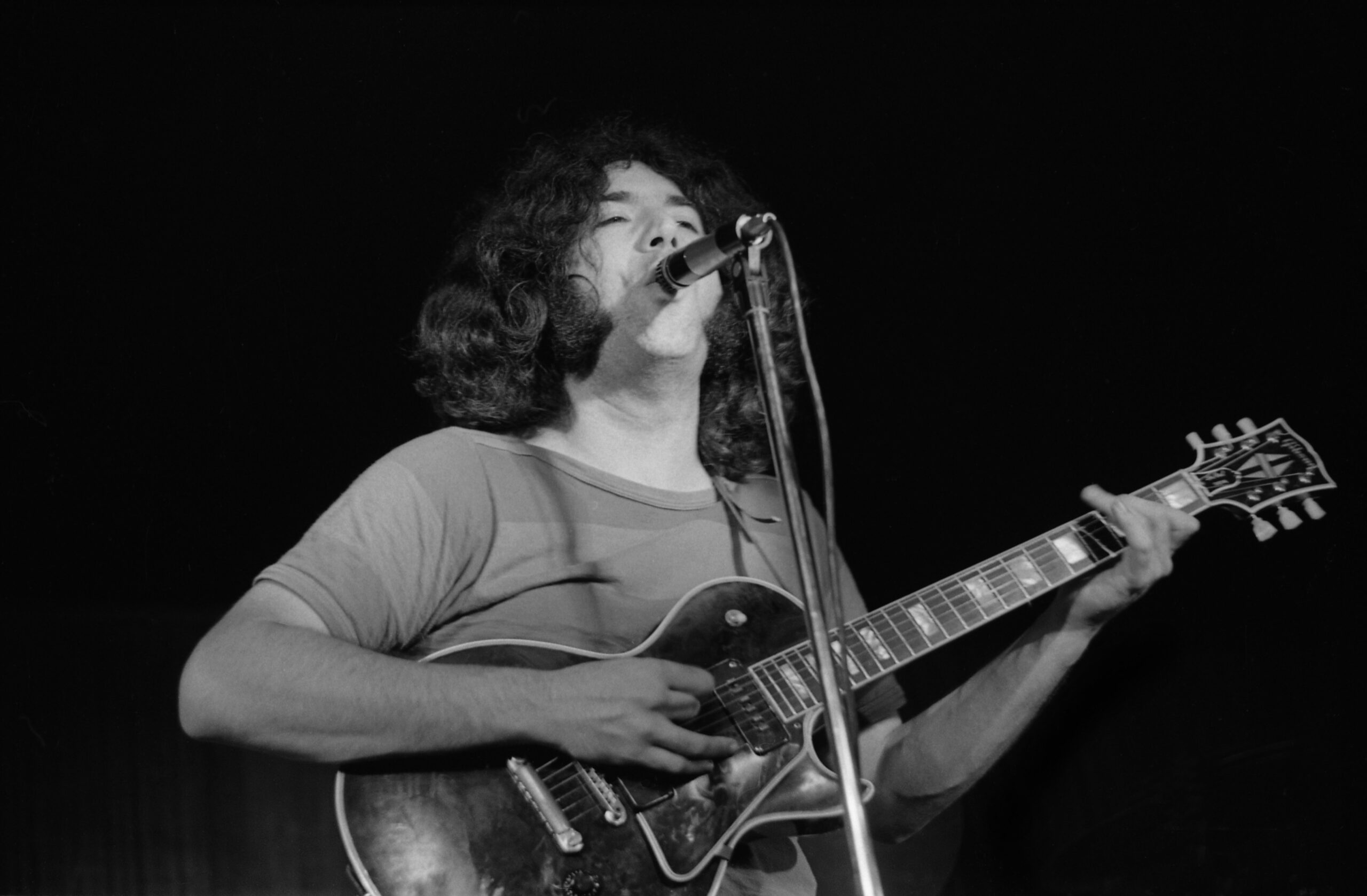
While the iconic skull and skeleton images have become synonymous with the Grateful Dead, fans may be surprised to learn that frontman Jerry Garcia was a man of faith.
“I was raised Catholic, so it’s very hard for me to get out of that way of thinking,” Garcia once admitted. “Fundamentally, I’m a Christian in that I believe to love your enemy is a good idea somehow.”
Garcia was born in San Francisco on Aug. 1, 1942, and grew up in a household filled with music.
His Spanish Catholic ancestry on his father’s side played a significant role in his upbringing. His mother, Ruth Marie Clifford Garcia, was of Irish and Swedish ancestry and a practicing Catholic.
As a child, he was fascinated by the tradition and drawn to the Latin Mass ritual, which inspired the music he would create throughout his lifetime. It also developed a love of gospel music, which he would record over the years.
RELATED: From ‘Born to Run’ to ‘The Rising’: Bruce Springsteen’s Spiritual Journey
That early Catholic influence stuck with him through his career in music as Garcia and Grateful Dead co-founder and organist Ronald “Pig Pen” McKernan, also a baptized Catholic, brought a touch of their faith to the Dead’s songs.
Everything the Dead espoused revolved around the Christian notions of brotherhood, love, and unity, and living life to the fullest. That’s why the band’s legacy lives on.
The Dead formed in 1965 as the Warlocks and continued to perform until Garcia’s death. Not happy with the name “Warlocks,” Garcia randomly opened a dictionary and stumbled upon the phrase “grateful dead” from European folklore, referring to someone who helps take on the debts of the deceased and pay for their burial, which is eventually repaid by the grateful spirit of the dead individual.
They incorporated multiple genres of music into their signature sound, including rock, pop, folk, gospel, country, bluegrass, reggae, and blues, as well as psychedelic elements that helped reinforce their reputation as the ultimate jam band.
The Dead’s third album, “Aoxomoxoa,” opened with the biblical track “St. Stephen,” written by Garcia, Phil Lesh, and Robert Hunter. The country-folk-rock track refers to St. Stephen, from the Book of Acts, the first Christian martyr who was stoned to death for his beliefs.
The 1970 album “American Beauty” contained “Ripple,” one of the group’s most beautiful country-folk ballads. Written by Garcia and Hunter, and sung by Garcia, it contains imagery of heavenly fountains and a plea for spiritual salvation in the lines, “Reach out your hand, if your cup is empty; If your cup is full, may it be again; Let it be known there is a fountain, that was not made by the hands of men.”
After releasing their first nine albums on Warner Brothers, the group formed their own “Grateful Dead” label with the 1973 release of the more spiritual “Wake of the Flood” album. It included the jazz-inflected ballad “Eyes of the World,” written by Garcia and Hunter and sung by Garcia. It sees God in nature and reflects on where humans fit into His grand design. Garcia sings: “There comes a redeemer, and he slowly too fades away. … And the seeds that were silent all burst into blood, and decay.” It’s an exploration of the seasons of life through the lens of God’s divinity.
LISTEN: ‘Touch of Grace’: Jerry Garcia and the Dead – A curated Spotify playlist from The Tablet.
The group’s 1974 album “From the Mars Hotel” contained the Garcia-Hunter collaboration “Scarlet Begonias,” which describes an awakening akin to St. Paul’s conversion on the road to Damascus when Garcia sings, “Once in a while, you get shown the light in the strangest of places if you look at it right.”
The Grateful Dead signed with Arista Records in 1977 and in 1981 released their seventh live album “Dead Set,” which contained two of their most overtly religious tracks, the traditional “Samson and Delilah” and the original “Greatest Story Ever Told.” The first is a folk retelling of the biblical story, opening with the lines, “Delilah was a woman, she was fine and fair; she had good looks — God knows — and coal black hair.” Meanwhile, “Greatest Story” is an allegorical depiction of figures in the Old and New Testaments, including Moses, Abraham, Isaac, Gideon, and Jesus: “Ask him for water, he poured me some wine.”
And many songs feature religious themes sprinkled throughout Garcia’s immense catalog of compositions. Garcia adapted the Charles Johnson gospel song “My Sisters and Brothers (In Christ)” and performed it from 1976 to 1995 with The Jerry Garcia Band. The lyrics offer Garcia’s most devout views on his faith.
“I want to say to my sisters and my brothers, keep the faith,” Garcia sang. “We can all shout together, we have overcome; We’ll talk to the Father and the Son when we make it to the promised land.”
RELATED: How Christianity Shaped Bob Dylan’s Life and Music
Garcia died in 1995 at 53. His friend and musical colleague Bob Dylan best summed up his legacy when he said, “There’s no way to measure his greatness or magnitude as a person or as a player. I don’t think eulogizing will do him justice.”
What a long, strange trip it’s been for Jerry Garcia, who ultimately kept the faith that carried him from San Francisco to the Promised Land.