
A longtime missionary in Hong Kong has praised the pro-democracy activists who received jail sentences last week for their vocal opposition to the city’s new national security law.
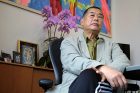
A longtime missionary in Hong Kong has praised the pro-democracy activists who received jail sentences last week for their vocal opposition to the city’s new national security law.
Prison sentences handed down this week for three young pro-democracy activists, in tandem with the arrest of media tycoon Jimmy Lai, has been largely read as the latest chapter in China tightening its grip on Hong Kong and eviscerating the principle of “one nation, two systems” under which the territory was transferred to Chinese control in 1997.
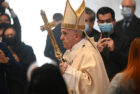
The Chinese foreign ministry dismissed Pope Francis’ criticism of China’s treatment of Muslim Uighurs as groundless. In a new book to be released next month, “Let Us Dream: The Path to a Better Future,” the pontiff said that he often thinks of “persecuted peoples: the Rohingya, the poor Uighurs, the Yazidi.”
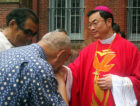
The Vatican and the Chinese government will extend an agreement signed in 2018 regarding the appointment of bishops. As the initial agreement expired Oct. 22, the two sides “have agreed to extend the experimental implementation phase of the provisional agreement for another two years,” the Vatican said in a communique the same day.
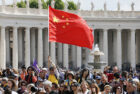
The Vatican has proposed to the Chinese government that they extend an agreement signed in 2018 regarding the appointment of bishops, Vatican Media reported.
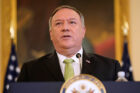
About 10 days before he was expected in Rome, U.S. Secretary of State Mike Pompeo tweeted that the Vatican “endangers its moral authority” by considering an extension of its 2018 agreement with China on the nomination of bishops.
Top officials from both China and the Vatican have given indications that the controversial agreement between the two on the appointment of bishops, which expires at the end of September, will be renewed.
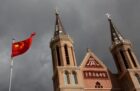
As the Vatican sits poised to renew its historic agreement with China on the appointment of bishops later this month, one of the Catholic Church’s leading experts on Chinese affairs has argued that while the desire for dialogue is understandable, there is still nothing to show for the deal two years later.
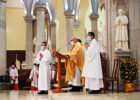
China has been accused of hacking Vatican computers as well as those in the Diocese of Hong Kong and other Catholic organizations in May. The hacking appears to be an attempt to gain an advantage in talks between the Vatican and China, due to resume as early as this week, about a fresh deal on the appointment of bishops.

China, in a sense, has become the third rail of geopolitics, in the sense that anything it touches automatically becomes controversial, from cell phones (“are they spying?”) to the coronavirus (“are they lying?”)