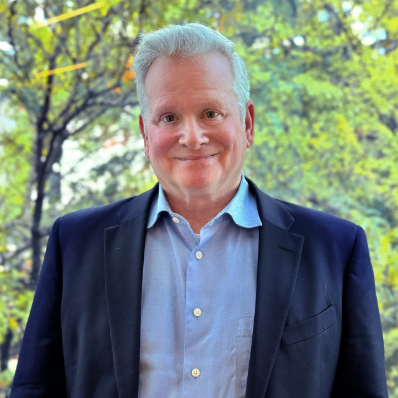

PROSPECT HEIGHTS — Shifting careers from religious brother to schoolteacher to security expert to motivational speaker may seem like an odd collection of job pivots, but Vincent Bove counts it all as providence.
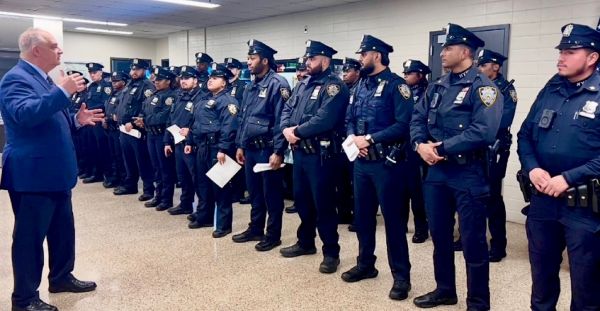
In 2024, then-New York City Police Commissioner Thomas Donlon appointed Bove the Honorary Law Enforcement Motivational Speaker for the Police Self Support Group.
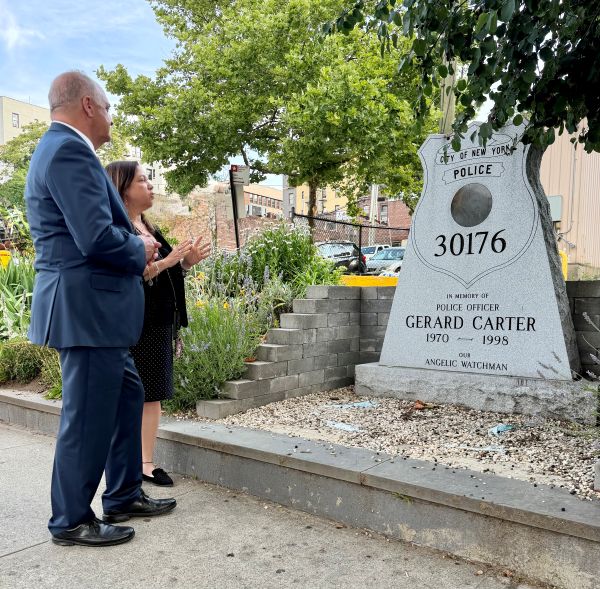
Also called the PSSG, this organization began 40 years ago as a peer-driven cadre of NYPD officers who have survived catastrophic injuries, serious illnesses, or the loss of fellow police officers killed in the line of duty. Despite the hardships they have faced, the members dedicate themselves to helping fellow police officers recover from life-altering challenges.
To do so, they learn how to manage the wounds of trauma and share those techniques with colleagues. It’s an endeavor that resonates with what Bove has been promoting for a quarter century through his years of ministry, school administration, and corporate and private security.
“I’ve been able to integrate the thoughts on my pillars of ethical leadership, morale, emotional resiliency, suicide prevention, and violence prevention,” Bove said. “Some people might think this came about coincidentally, but I think it’s providentially integrated to what I’ve been doing for 25 years.”
RELATED: NYPD Academy to Be Renamed for Late Det. Steven McDonald
Bove, 72, lives in New Jersey with his wife, but he grew up in the Bronx during the turbulent 1960s. For him, it was a front-row seat to history in the making as he watched protests against the Vietnam War and how his community reacted to the assassinations of the Kennedy brothers and Martin Luther King Jr.
“It was a fascinating time to grow up in New York City in the midst of all that,” he said. “But I loved growing up in the Bronx. The whole world was at your fingertips.”
“It was a mosaic of diversity, with people from every imaginable country as friends and neighbors,” he added. “It served me very well because it gave me lessons in appreciating the dignity of humanity.”
Bove attended John Jay College of Criminal Justice because he originally considered a career in law enforcement, but that shifted to a priestly vocation. The Salesians of Don Bosco accepted him. He enrolled at the Pontifical College Josephinum in Columbus, Ohio, where he earned a master’s degree in Scripture and another in divinity.
Bove also worked at Salesian summer camps, taught high school theology in New Orleans, and was a missionary in the Bahamas, again working with youth. He even became a Catholic high school principal for a brief time. Along the way, he learned to identify and help at-risk youth and oversee school security.
“Then I felt called to serve in a different direction,” Bove recalled. “I received the full canonical dispensation to return to the laity.”
His first job was in an executive position for the former Wells Fargo Armored Services Corporation. Armored truck security was added to his school security experiences, along with his early education in law enforcement.
Soon, he was developing professional relationships with police officers.
Corporate security led to work as a private security consultant. His teaching experiences became handy for training sessions.
“I’ve been doing that now for well over 40 years,” Bove said. “I remain a devout Catholic and am using that background to be of service in every way I can.”
Bove’s skill sets were summoned in the responses to national tragedies, like the Columbine High School massacre of April 20, 1999, in Littleton, Colorado, and the mass shooting on April 16, 2007, at Virginia Polytechnic and State University in Blacksburg, Virginia.
After Columbine, he was sought to train communities on school violence prevention, crisis management, and emergency planning. Following Virginia Tech, he became the spokesman for a coalition of victims’ families seeking answers about gaps in warnings and responses from public safety agencies.
The work he did in the aftermath of these tragedies formed the basis of his 2008 book, “Listen to Their Cries: Calling the Nation to Renewal after Columbine and Virginia Tech.” It was one of three books he has authored.
So, like the kid mesmerized by the events of the 1960s, Bove got a front seat to trauma wrought by mass casualty events of the 21st century, including the terrorist attacks on Sept. 11, 2001.
He observed how people dealt with grief, both personal and national, which made him think about the “wounded healer.” This concept was explored by the Dutch priest, Henri Nouwen (1932-1996), in his 1972 book, “The Wounded Healer: Ministry in Contemporary Society.”
Bove said his personal copy of the book was one of his most prized possessions. In it, the author posits that a caregiver’s own trauma and vulnerability can be channeled into a healing power for others.
The caregiver may never be “cured” of the trauma, but their inner pain can become a powerful bridge of empathy to help others manage their grief and endure, according to the concept.
RELATED: Warriors, Come Out to Pray! Civilian Group Show Support for NYPD Officers
Likewise, Bove refers to police officers as the “wounded protectors” and, he asserted, the PSSG members are great examples of that.
“I believe they are at the epicenter of what moral courage and resiliency represent,” Bove said. “And they serve as a model for police departments throughout the country.”
When asked to give an actual example of the wounded protector, Bove did not hesitate to name Det. Steven McDonald, who became quadriplegic in 1986 when he was shot three times while trying to question three teenage boys in Central Park.
But McDonald chose to forgive the kid who shot him. Although dependent on a wheelchair and respirator, he spent the rest of his life traveling the world to share the joy and blessings that come with forgiveness.
McDonald died in 2017 at age 59, but the NYPD honored him by putting his name on the New York City Police Academy in College Point in a special ceremony on July 16.
Bove, who met McDonald numerous times, said he championed human dignity for himself and everyone else. His story demonstrates that everyone, no matter how badly wounded they become, can still find reason to see themselves and others as God sees them, and serve the community.
Bove noted, however, that these principles of resiliency, character, and purpose aren’t just for police officers — or Catholics.
“This is for every human being who walks the planet,” Bove said. “Everybody who has experienced some type of trial, tribulation, and trauma — we’re all called to be wounded protectors or wounded healers.”