
PROSPECT HEIGHTS — On June 7, 1926, a man who appeared to be in his mid-70s was struck by a passing tramway on the Gran Via, a busy avenue in Barcelona, Spain.
The severely injured man was unconscious, emaciated, and dressed in a shabby suit. People assumed he was a beggar and were slow to render aid, but he was eventually taken to a hospital.
With no identification on him, it wasn’t until the following day that a chaplain recognized the injured man — renowned architect Antoni Gaudí. He died of his injuries on June 10, two weeks short of his 74th birthday.
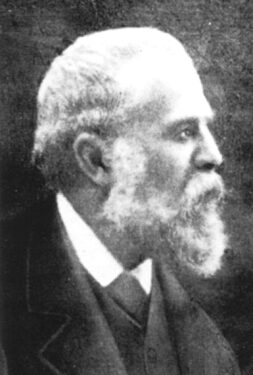
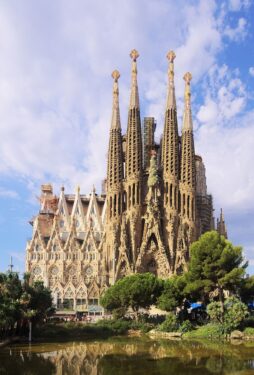
Today, Gaudí is remembered as the driving force behind the enormous Basilica of the Holy Family, or, in Spanish, Basílica de La Sagrada Família, now a UNESCO World Heritage site.
This basilica in Barcelona has been under continuous construction since its groundbreaking in 1882.
It’s nearing completion, expected this summer during the100th anniversary of Gaudí’s death.
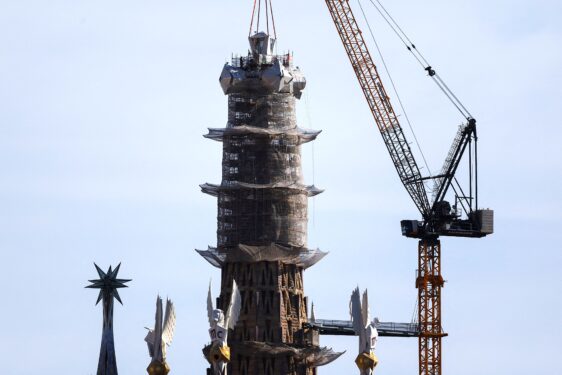
The upper arm of the cross atop the tower of Jesus Christ was installed Feb. 20.
At over 564 feet in height, the addition of the new tower makes the basilica the tallest Catholic church in the world, surpassing the Basilica of Our Lady of Peace in Yamoussoukro, Ivory Coast, which stands at 518 feet.
The more than 140 years of construction were marked by fundraising challenges, the destruction of Gaudí’s original plans during the Spanish Civil War, and the intricate complexity of the basilica’s sprawling design.
But even during his lifetime, Gaudí, who took over the project in 1883, was pressed to explain why its completion always seemed so distant.
“My client,” he would reply, “is not in a hurry.”
Heroic Virtues
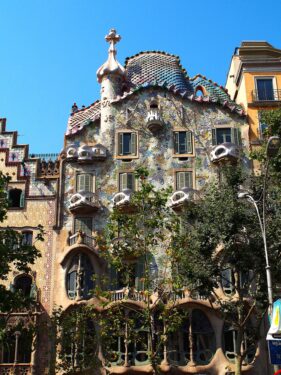
Gaudí was well paid for designing or redesigning homes in and around Barcelona, such as the famous Casa Batlló in the city center.
However, he spent the last 40 years of his life focused on Basílica de La Sagrada Família and other sacred spaces.
According to a statement from the United States Conference of Catholic Bishops, Gaudí’s dedication to his faith and serving God through architecture earned him the title, “God’s architect.”
In one of his final actions, Pope Francis, on April 14, 2025, issued a decree that Gaudí is “venerable,” the second of four steps on the path to sainthood.
Yet despite his renown, Gaudí mostly kept to himself. He was neither a martyr nor a profound orator of the gospel.
But, according to the USCCB, Pope Francis recognized Gaudí for “heroic virtues” that give profound glory to God.
RELATED: The Remarkable Unsung Legacy of Church Architect Patrick Keely
Fool or Genius
Gaudí was born in 1852, the youngest of five children born to Francesc Gaudí, a coppersmith, and his wife, Antònia.
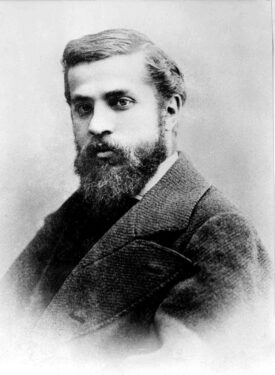
The family spent a lot of time exploring the outdoors, which instilled in Gaudí a love for studying nature.
Gaudí learned architecture at the Llotja School and the Barcelona Higher School of Architecture. He graduated in March 1878 with the reputation of an average student, according to biographies.
One account describes how a school administrator commented after handing Gaudí his diploma that, “We have given this academic title either to a fool or a genius. Time will show.”
The answer came a few months later when the recent graduate gained international attention for a showcase that he designed for a glove manufacturer at the Paris World Fair of 1878.
RELATED: Strokes of Faith — Brooklyn Museum Preserves James Tissot’s ‘The Life of Christ’ Collection
Bursting With Color
Next, he was designing buildings with his signature style, bursting with color and texture — ideas rooted in spirituality and nature, in a unique homage to creation itself.
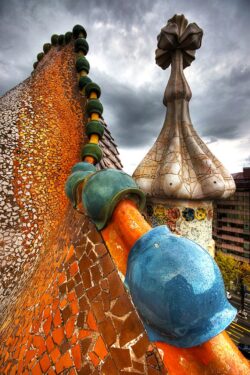
He thus employed a wide range of materials for exterior and interior design, including wrought iron, stained glass, mosaics, and ceramics, to mimic natural forms such as trees, seashells, and flowers.
Duncan Stroik, a professor of architecture at the University of Notre Dame, said Gaudí’s designs are “very organic, very voluptuous, or very curvilinear, with lots of shapes on the facades.”
“They’re not straight,” Stroik, who has his own architecture firm specializing in sacred spaces, told The Tablet. “They have that kind of natural sensibility, almost like a cliff along the sea, or even a sandcastle.
“They look like maybe they were poured out of a jar.”
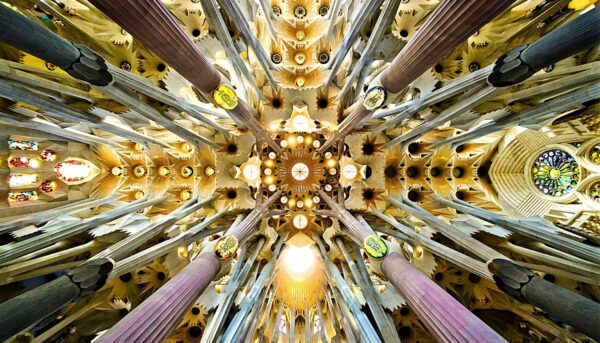
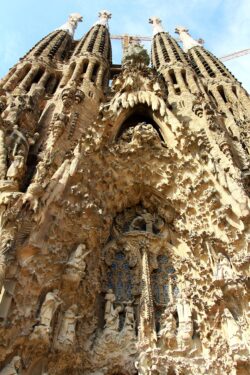
For example, the nave in the Basílica de La Sagrada Família has columns that resemble trees with branches rising to the ceiling.
Also, parts of the basilica’s facade appear to be a coastal cliffside, embedded with statues of angels and the Holy Family.
Intensified Fervor
Gaudí reportedly fell in love with a woman who declined his marriage proposal. He subsequently dropped all thoughts of having a family and focused on his work instead.
Already a lifelong Catholic, Gaudí intensified his religious fervor with daily prayer, fasting, and Mass. He lived simply and preferred his old suits over fancy new clothes.
Stroik said 20th-century observers loved Gaudí’s groundbreaking designs because they eschewed traditional architecture. Modernists in particular saw his work as a necessary progression leading to minimalism.
“They saw him leading to no ornament or no architecture with columns that expressed a base or a top, or no sculpture that was figurative,” Stroik said. “And obviously that’s not what Gaudí was about.”
Instead, Stroik noted, Gaudí’s aesthetic was “over the top.”
“It does kind of amaze me how much people love it. Americans love it. My students love it,” he added. “He’s a maximalist, and I think that’s refreshing, because minimalism doesn’t have a whole lot to it.”
Admired by Thousands
According to the biographies, Gaudí was living in his workshop at the basilica’s building site. He had departed there to receive confession when he was hit by the tram.
His funeral Mass, unlike the accident scene, was attended by thousands of admirers, and he was buried at the basilica.
A sainthood guild for Gaudí started in 1992, and the cause was officially opened in 2003 by the bishops of Catalonia.
The next step of Guadi’s cause for sainthood is beautification, followed by canonization.
Meanwhile, a major inauguration Mass for the basilica’s Tower of Jesus Christ, the building’s tallest spire, is scheduled for June 10, 2026, and special concerts. Pope Leo XIV will also visit the basilica to mark the centenary of Gaudí’s death during his June 6-12 trip to Spain.