
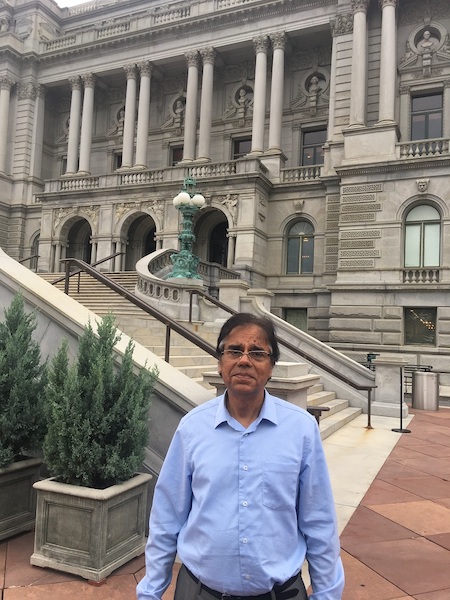
MIDDLE VILLAGE — Father Joseph Palackal, parochial vicar for St. Margaret Church since 2019, is a world-renowned musicologist and a foremost authority on liturgical music. He can even chant in multiple languages, including Aramaic, the language spoken by ordinary people in Judea at the time of Christ.
While the ancient language is seldom used in modern times, Father Palackal told The Tablet that it’s essential — both historically and practically — to preserve it.
“If you went to another city and someone spoke to you in English, you feel good, and if they said your name correctly in English, you feel good,” Father Palackal explained. “So, if you get the message in the original language, it is much better than a translation. It’s truly a great privilege to use the words as Jesus did.”
As a member of the Syro-Malabar Catholic Church, which follows the Eastern Syrian Rite liturgy, Father Palackal celebrates Mass and uses the words that Jesus used at the Last Supper. He said that he takes immense joy in using the words of Jesus at the consecration.
For example, he chants The Lord’s Prayer in Aramaic.
“We translate the opening line as ‘Our Father, who art in heaven,’ which is fine, but that’s not exactly what Jesus said,” Father Palackal explained. “He said to pray to ‘Abba,’ which would translate to the warmer ‘Dad.’ Jesus’ entire life’s message was making God intimate to us in His person and in His message.”
RELATED: Our Lady of Angels Music Director Has Devoted Career to Serving the Church
According to Father Palackal, the more formal change in the prayer occurred when the Scriptures were translated into Greek and Latin, using the word “Pater,” which means “father,” and ultimately into the English translation as we know it.
Before his arrival at St. Margaret, Father Palackal served for 23 years as parochial vicar for St. Stanislaus Kostka Church in Maspeth. He is the senior founder of the Carmelites of Mary Immaculate, a monastic order that works to preserve traditions of Indian Christianity, and founder-president of the Christian Musicological Society of India.
Father Palackal is also the lead singer on more than 40 albums released in five languages, including English, Malayalam, Hindi, Sanskrit, and Syriac.
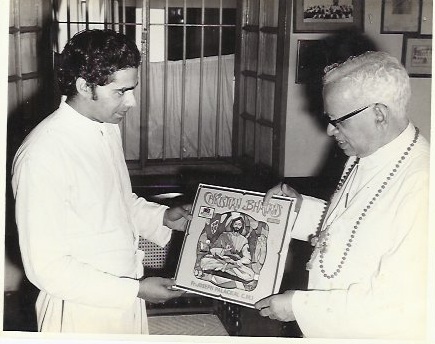
In 1979, he released his first albums, “Christian Bhajans,” in Malayalam, a language native to India, and “Qambel Maran: Syriac Chants from South India,” which was the first commercial CD of Syriac chants. Both albums are landmark recordings in the history of Christian music in India.
Father Palackal was known as a talented singer in his hometown in India and started singing in his local church as a young boy. The liturgy was still in Syriac at that time, and he grew up singing Aramaic chants before Vatican II. In 1965, Father Palackal entered the seminary and still occasionally sang in Aramaic before it faded away. He then studied Raga, a style of Indian classical singing, which evolved into his first album. He called it “a very choral, audacious movement for the 70s.” After completing his studies in classical music in India, he came to New York to pursue graduate degrees.
This led Father Palackal to return to India and conduct fieldwork collecting melodies from older priests from his congregation that would ultimately become the basis for his second album, “Qambel Maran.”
“We chose 29 melodies for the CD, which is a precious goldmine of gems with some of those melodies existing only on that album, and they are so unique, and you might say precursors to Gregorian chants,” explained Father Palackal.
The album was released in the Netherlands and brought him world acclaim, leading to a library of rare recordings, “opening the world’s eyes to the fact that India is also a Christian country with an ancient Christian heritage.”
Today, Father Palackal’s works can be found in the Library of Congress, Harvard University Library, the British Library, and the New York City Public Library for the Performing Arts. And he is currently completing his new book, “Syriac Chants in South India: Toward Remapping the Musical Geography of a Country.”
To preserve those melodies, he embarked on what he called the “Aramaic Project,” in which he began compiling a digital library to document anything related to Aramaic chants in India, a project that continues today. He still maintains an office in India, which he visits in the summer and writes articles about the chants.
RELATED: Keys to the Past: How Brooklyn Church’s Pipe Organ Bridges Faith, History
At St. Margaret, he has introduced the children to Maranatha, an Aramaic phrase meaning “Our Lord has come” or “Come Lord Jesus,” by creating a simple melody for it. He also incorporated a chant for the creed in Aramaic to help keep the language alive.
He admits that his goal is to pique people’s curiosity about the language of Jesus.
“I wish to keep the mother tongue of Jesus alive to enrich their prayer life,” added Father Palackal. “St. John Paul II very accurately said that ‘the Church has to breathe with three lungs, not just Greek and Latin but also Aramaic,’ because there is something special about that.
“My hope is to instill in people a curiosity for tradition and to not let the language of Jesus die.”
I have known and been friends with Father Joseph Palackal for about 30 years. This article on his music and preservation of Aramaic, the language of Jesus is well done and well deserved.