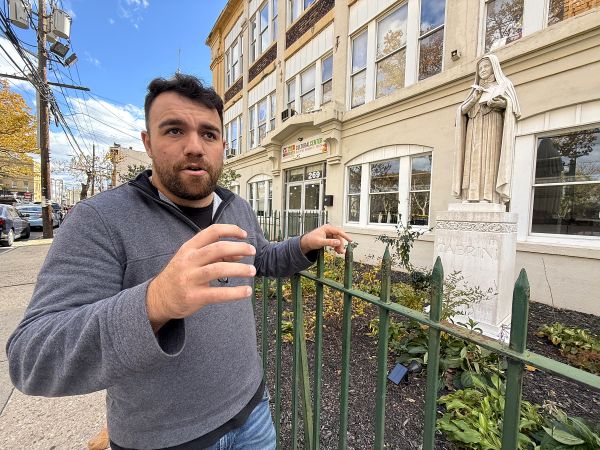
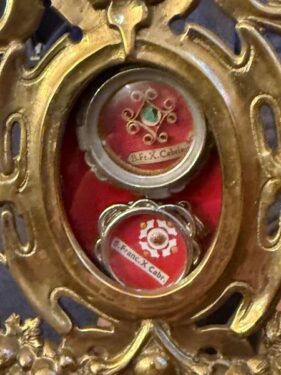
NEWARK — Eric Lavin recalls “rescuing” a relic of St. Frances Xavier Cabrini from an antique shop in Montclair, New Jersey. The piece of bone and a lock of her hair, both contained in the same reliquary, had all the proper documentation certifying a first-class relic.
“It was quite a find — authentic,” Lavin said, “and as real as real can be.”
Lavin paid “a few hundred bucks” for the relic, but not for himself. That, he noted, would be a “sin of simony.” Instead, it is now one of nearly 700 saintly artifacts housed at Our Lady of Mount Carmel Parish in Newark, where Lavin, 30, is a lifelong member.
Lavin teaches Italian at James Caldwell High School in nearby West Caldwell.
But his labor of love is serving as OLMC’s business administrator and pastoral associate.
He happily recalls his youth in the parish when its pastor was Father Nicholas DiMarzio, now known as Bishop Emeritus Nicholas DiMarzio of Brooklyn.
RELATED: Invoking Mother Cabrini, Bishops Call For ‘Christian Charity’ on Immigration
Building such a vast collection of relics at the parish may seem like a multi-generational effort, but it has been achieved mainly by Lavin, who is also the director of the Archdiocese of Newark’s Italian Apostolate.
He told The Tablet on Nov. 7 that he was in the seventh grade when he began collecting relics under the supervision of a parish priest, the late Msgr. Joseph Ambrosio.
The collection has grown to include hundreds of relics of saints from St. Francis de Sales to St. Mother Teresa of Calcutta.
There are also fragments of the Blessed Mother’s veil and splinters from St. Joseph’s cabin, Jesus’s crib, and his “true cross.”
“This is really a hidden gem of the Catholic Church in New Jersey,” said Sean Quinn, spokesman for the Archdiocese of Newark. “I don’t think even a lot of people in Newark know about this.
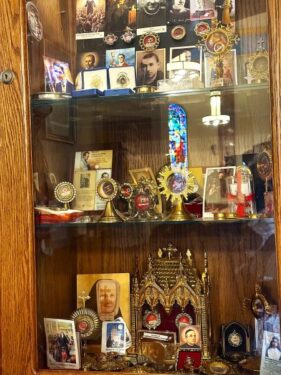
“I tried doing research about local parishes that have relics, and not that many have as many as this one, certainly not in a large diocese. Or even in the country.”
OLMC has more than one Mother Cabrini relic, including a tiny piece of her heart. Quinn said Catholics especially cherish these items in Newark because of this saint’s local legacy.
Lavin is a devotee of the history of Mother Cabrini, whose feast day is celebrated on Nov. 13 in the U.S.
He said her work grew beyond New York City and Newark to New Orleans, Los Angeles, Denver, and Chicago.
“She was constantly on the move,” Lavin said, while giving The Tablet a whirlwind street tour of Newark’s Cabrini connections.
“Linearly, I couldn’t tell you what she did first,” he said from behind the wheel of his car. “Obviously, Five Points in Manhattan was her first stop, and then she took it from there.”
The Italian-born Frances Xavier Cabrini, a diminutive religious sister who battled lifelong health issues, arrived in the U.S. in 1889. She came at the direction of Pope Leo XIII to address the health, safety, and spiritual development of immigrant orphans in Manhattan.
RELATED: New Chapel in Astoria, Queens Honors Modern Saints Including St. Carlo Acutis
Her work expanded to Brooklyn, where she taught catechism and established a Catholic school for the Church of St. Stephen, now Sacred Hearts and St. Stephen Parish in Carroll Gardens. The site of the original church building at Van Brunt and President Streets is now Mother Cabrini Park.
In 1899, Mother Cabrini founded Newark’s first Italian parochial school at OLMC, then on Ferry Street. And, in 1903, she created the St. Anthony’s Villa Orphan Asylum for girls in what today is Kearny, New Jersey, a suburb of Newark.
In 1990, that property became the Redemptoris Mater Archdiocesan Missionary Seminary of Newark.
Lavin paused the street tour to show the seminary and its chapel with its breathtaking murals of Mother Cabrini’s life.
Included is a depiction of her with the Statue of Liberty in the background, and the ship that carried her across the Atlantic Ocean, accompanied by members of the community she founded, the Missionary Sisters of the Sacred Heart of Jesus.
Her efforts endured despite scant support from politicians and even some Church leaders.
Her health suffered, but she pressed on with Philippians 4:13 as her motto — “I can do all things through Christ who strengthens me.”
Mother Cabrini, a naturalized U.S. citizen who died in 1917, became the first American saint when she was canonized in 1946.
Lavin said that, despite last year’s biopic, “Cabrini,” the saint is largely unknown to the American public.
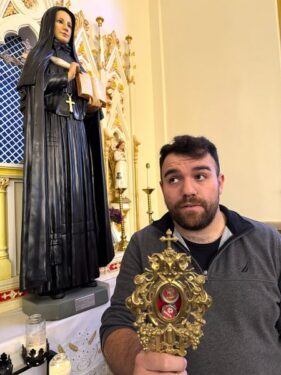
He recounted how Bishop DiMarzio and others struggled to overcome the snubbing of Mother Cabrini by the “She Built New York” monument project, despite popular support for her.
Alternatively, a Mother Cabrini Memorial statue was created in 2020 in the Battery Park section of Lower Manhattan. But last year, in Newark, city leaders ordered a statue of her removed from a park named for her near Newark Penn Station.
Lavin said they were concerned about vandalism in the neighborhood, so he urged more law enforcement patrols instead of removing the statue.
In the end, the statue was positioned in front of OLMC’s school. That pleases Lavin, although he wished it would’ve stayed in the prominent site of the park that carries her name.
“It disappoints me because it’s an incredible story,” Lavin said. “In a day and an age when we’re much more cognizant of equality, especially among genders, Mother Cabrini was shattering glass ceilings decades before it became part of our daily discourse.
“Mother Cabrini was truly a trendsetter in her own right, and we have her here among us in northern New Jersey.”