
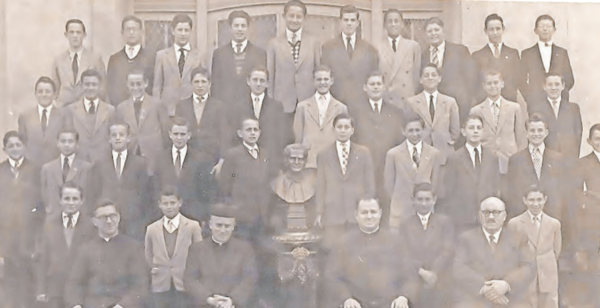
by Michael Rizzo
It had never happened before. The College of Cardinals in March 2013 selected a prelate from the Americas, specifically South America, as pontiff. More than that, they had selected Argentine Cardinal Jorge Mario Bergoglio, a member of the Society of Jesus, as the leader of the world’s Roman Catholics.
He was the first Jesuit ever elected pope.
The impact of Pope Francis’ Jesuit formation began with his earliest training in the order’s prayers and meditations, which were developed by St. Ignatius of Loyola, the founder of the order.
Those meditations are more commonly known as the Spiritual Exercises in which every Jesuit novice participates.
“The idea behind the Spiritual Exercises is to know, love, and serve Christ,” said Father Nicholas Colalella, parochial vicar for Our Lady of Hope Church in Middle Village, who spent three years in formation with the Jesuits beginning in 2021, and subsequently returned to serve as a diocesan priest in 2024.
Pope Francis’ embodiment of the Jesuit influence was evident through his emphasis on the need to listen, Father Colalella explained.
“I think his emphasis on a listening Church reflects the way in which Jesuits in community interact with one another,” he said. “I think his emphasis on a listening Church was getting people to talk and to listen to one another without rushing to judgment. It’s part of the discernment of the Spiritual Exercises.”

Jesuit Father John Cecero, vice president for mission integration and ministry at Fordham University and a former Jesuit provincial in the United States, said the Holy Father’s emphasis on inclusion reflects the Jesuit ideal of communal thinking.
“He’s kind of modeled for us a way of moving forward that includes as many people as possible. He sees a very inclusive Church. He’s always saying, ‘todos,’ ‘todos,’ everyone, everyone belongs in the Church,” Father Cecero said.
RELATED: Laypeople Gain Influence Under Revolutionary Papacy
“He’s willing to bless everyone and welcome everyone.” Jesuit Father Kenneth Gavin, the superior of the Carroll Street Jesuit Community in Crown Heights, recalled meeting Pope Francis when Father Gavin was the assistant international director of the Jesuit Refugee Service.
“He believed that the mission of the Society of Jesus and the mission of the Church is the service of faith and the promotion of justice,” Father Gavin said, noting that Pope Francis’ 2013 encyclical, “Evangelii Gaudium,” put words to his Jesuit thinking.
“It starts out by saying the joy of the Gospel fills the hearts of every man and woman who encounters Jesus, and that word encounter is very much part of St. Ignatius,” Father Gavin said. “I think that shoots through in everything that [Pope] Francis has said. He’s calling us to be compassionate … as Jesus is compassionate.”
Pope Francis’ own words described the impact of the Ignatian way on his life and papacy. He foreshadowed what some would think of his papal leadership as a Jesu- it in a July 2013 interview when he said, “The Jesuit must be a person whose thought is incomplete, in the sense of open-ended thinking.”
RELATED: Pope Francis, In His Own Words
The Society of Jesus was officially recognized as a religious order in 1540, with St. Ignatius as its first father general. Father Cecero explained that, per the order’s constitutions, Jesuits should never aspire to the hierarchy of the Church, though Jesuits are allowed to accept those appointments. He added that the aim is for members to always be ready and available to travel and serve in missionary work when needed.
Father Colalella noted that Pope Francis called for freedom from our earthly attachments and a freedom to be rich in what matters to God, and that this call for a poor Church “is indicative of his religious formation.”
Father Cecero also highlighted the humility in Pope Francis’ messages. “He wears that simple cross around his neck, his pectoral cross. He continues to live in Santa Marta [guesthouse] rather than the Apostolic Palace,” he said. “This is really coming from his core belief that it’s all about Jesus and that any kind of person who is a representative of Jesus should live as he lived or as humble to the extent that we can.”