
As Archbishop Kenneth Richards of Kingston, Jamaica, spoke with people in the communities hardest hit by Hurricane Melissa, he was amazed by their faith and fortitude in the face of unimaginable circumstances.
“Those persons that we interact with, there’s a resilience and a strength and a faith that is amazing because those persons give thanks to God for life,” Archbishop Richards told The Tablet. “They say ‘our houses can be rebuilt, but we give thanks for life.’ ”
“They have not lost hope,” he noted. “They are demonstrating their own strength and their own faith in the face of the disaster that they are confronted with.”
Father Dwayne Davis, who is Jamaican and has spoken with Archbishop Richards in the aftermath of Hurricane Melissa, echoed the sentiment that Jamaicans are resilient.
“One thing about Jamaica is that in times of crisis we come together,” Father Davis, pastor of St. Thomas Aquinas Church in Flatlands, told The Tablet. “We’re a very resilient people. So
I think we will rise up even better and stronger.”
As of Nov. 4, the official death toll in Jamaica from Hurricane Melissa was 32. However, that number is expected to rise as there are many areas that authorities have yet to reach. The hurricane made landfall in Jamaica on Oct. 28 as a Category 5 storm, one of the worst in the country’s history. The western part of the country was particularly devastated.
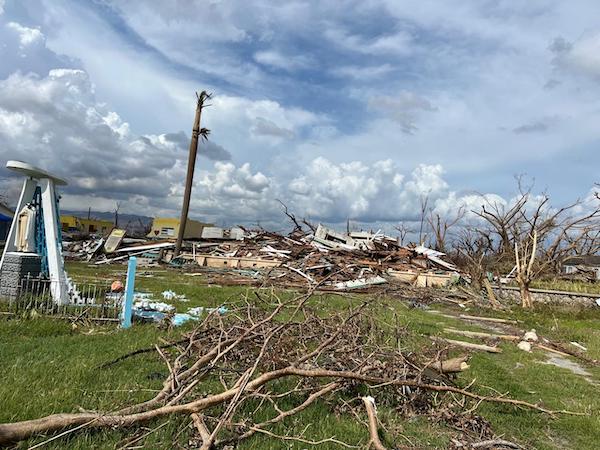
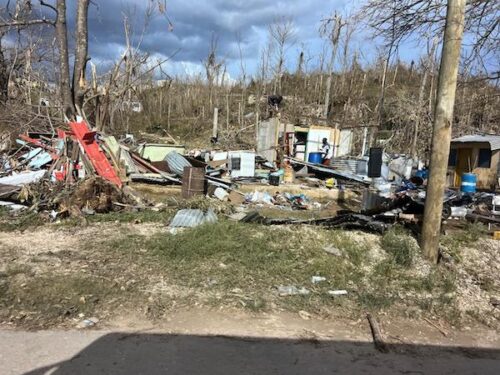
“It is the worst,” Archbishop Richards said of the storm. “There are areas that are wiped out completely, washed away. It’s heartbreaking.”
Archbishop Richards visited some of the hardest-hit areas on Nov. 1. He described the destruction of people’s homes and said that many churches are completely leveled. He noted that the chancery, rectory, bishop’s residence, and three Catholic schools in Montegro Bay were destroyed, as well as a clinic and convent in Maggotty. To make recovery efforts worse, roads are also washed out and blocked by downed trees.
“It’s going to be months, if not years, to get some of these places up again,” he said.
The damage to the schools, he noted, is especially concerning. “One of my great concerns is for our schools to be habitable again for students because we need to have a place that our students can get back to school,” Archbishop Richards said. “I’m hoping that we can receive resources to be able to repair those roofs.”
As of Nov. 3, when The Tablet spoke to Archbishop Richards, he said that most of the affected areas are still without electricity, and telephone service remains down, as “the infrastructure has been destroyed.”
He said that while people along the main corridors are able to receive the food, water, and supplies they need, “the tragedy is those off the beaten track are isolated and resources are not reaching such persons, so that is creating distress.”
To help, Father Davis encouraged people to donate to the Compostela Fund of the Roman Catholic Diocese of Brooklyn, and participate in the ongoing special secondary collection at Mass.
“It is important for us to participate in the second collection or donate to the fund because it truly helps to impact the people on the ground,” Father Davis said. “As they continue to uncover and find places they haven’t reached, we know [the donations] are truly going to impact people, so we ask people to be as generous as they can.”
HOW TO HELP
To donate directly to the Diocese of Brooklyn’s Hurricane Melissa Relief Fund, send a check made payable to the COMPOSTELA FUND OF THE RC DIOCESE OF BROOKLYN (with notation “MELISSA”) which can be sent to:
Diocesan Finance Office
310 Prospect Park West
Brooklyn, NY 11215