
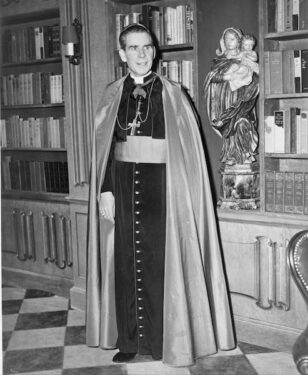
JAMAICA — He was perhaps the first Catholic influencer.
Long before TikTok or Instagram, there was Archbishop Fulton Sheen.
His 1950’s television show, “Life Is Worth Living,” was viewed by millions of Americans each week who considered it must-see TV.
“He reached about 30 million people a week. You don’t see those kinds of numbers today,” said Father Robert Lauder, a philosophy professor at St. John’s University, who was one of those faithful viewers.
RELATED: Blackboard to Broadcast: Archbishop Fulton Sheen’s Media Genius Explained
Archbishop Sheen (1895-1979) was one of the first people in the Church to see the potential of television as an evangelization tool, and he was among the first to use mass media to encourage people to go to Mass, Father Lauder said.
“He used television extremely well,” he noted. “He understood the power of the television camera and the power of the closeup. He was a compelling figure to watch. And he used television to evangelize, to bring people to God.”
Ed Wilkinson, The Tablet’s editor emeritus, said he remembers watching the show as a kid growing up in Greenpoint.
“He was very dramatic, and he had steely eyes. He would look directly into the camera, and he really got your attention. He was a very dramatic preacher,” Wilkinson said. “I’m amazed at how the themes hold up today.”
“Life Is Worth Living” originally aired on the DuMont Television Network from 1952 to 1955. It then moved to ABC, where it was broadcast from 1955 to 1957. Archbishop Sheen later starred in a second series, “The Fulton Sheen Program” on ABC from 1961-1968, featuring a similar format.
Before the digital age of iPhones, apps, and livestreams, television was the primary medium through which those who wanted to influence large numbers of people would present their case. And before television, there was radio, where Archbishop Sheen got his start. He hosted a nighttime radio program, “The Catholic Hour on NBC,” from 1930 to 1950. “He had been a professor at Catholic University, and I heard that his classes were mobbed,” Father Lauder said. “He had a very dramatic speaking style. I think he brought some of that to radio and then television.”
However, television is where Archbishop Sheen had the most significant impact. He appeared in approximately 250 episodes between the two series and won an Emmy for Most Outstanding Television Personality in 1953.
Archbishop Sheen would incorporate artistic themes into the show, like the time he rewrote William Shakespeare’s famous “To be or not to be” speech from “Hamlet” to make a point about faith, Father Lauder recalled.
Another part of his appeal came from his show’s appearance. Like influencers today, who make sure their backgrounds are picture-perfect, and the products they promote are placed just so, Archbishop Sheen put a lot of thought into set design. That’s why, Father Lauder explained, his set resembled the living room.
Archbishop Sheen was also known as a skilled showman.
“People would wait for the end of the show because there was a big ending to the show every week,” Wilkinson said. “And people would wait for that moment.”
However, Archbishop Sheen’s delivery style set him apart.
“He was a great, great communicator,” Wilkinson added. “People always say, ‘Who’s going to be the next Fulton Sheen?’ We really haven’t seen it.”