


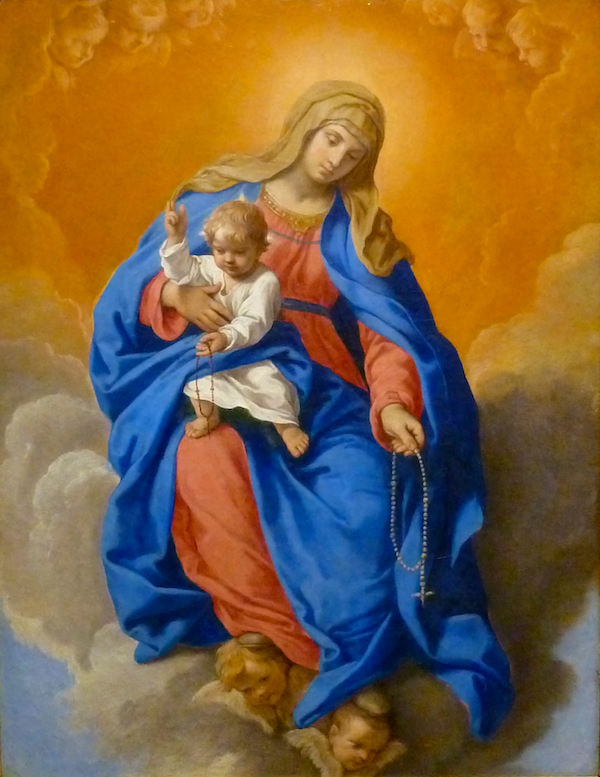
The feast of Our Lady of Guadalupe is one of Mexico’s most sacred holidays, as tens of millions of pilgrims descend on Mexico City every Dec. 12 to visit the Basilica of Our Lady of Guadalupe on Tepeyac Hill and participate in a procession through the city streets to honor the Blessed Mother.
Here in the Diocese of Brooklyn, thousands gather each year at the Co-Cathedral of St. Joseph in Prospect Heights on the feast day for Mass, and then, led by torchbearers, they process back to their churches.
Our Lady of Guadalupe is one of many Marian devotions popular among Hispanic Catholics, who make up a large share of the Catholic population in the U.S. — 36% in 2025, up from 29% in 2007, according to the Pew Research Center. In the Diocese of Brooklyn, a 2024 survey by the U.S. Conference of Catholic Bishops found that 68 of the diocese’s 172 parishes celebrated Mass in Spanish.
Here are examples of Hispanic Marian devotions and the nations that popularized them:
OUR LADY OF GUADALUPE: MEXICO
Feast day: Dec. 12
On Dec. 9, 1531, the Blessed Mother first appeared to Juan Diego, an indigenous peasant, on Tepeyac Hill in what is now Mexico City. She identified herself and, speaking in his native tongue, instructed him to build a shrine on the hill. Our Lady of Guadalupe appeared to Diego four times between Dec. 9 and 12.
At one point, the peasant went to a local archbishop, Juan de Zumárraga, to tell him about what he saw on the hill. However, the archbishop did not believe him and told him to offer proof. Diego returned to the hill where he encountered Our Lady of Guadalupe again. This time, she instructed him to pick flowers from the top of the hill to present to the archbishop. She wrapped the flowers he picked in his cloak (known as a tilma).
RELATED: Our Lady of Guadalupe Nail Art Becomes Evangelization Tool
When Diego presented the cloak to the archbishop, roses fell out, and an image of the Blessed Mother was imprinted in the garment. The tilma, which survived the centuries, is now one of the most sacred objects in Mexico. And the basilica stands on the spot where the Blessed Mother appeared to Diego
OUR LADY OF CHARITY OF EL COBRE: CUBA
Feast day: Sept. 8
The feast of Our Lady of Charity of El Cobre commemorates the Blessed Mother as the patron saint of Cuba. Around the year 1612, three young men were caught in a storm while on a boat in the Bay of Nipe in northeast Cuba. When the stormy seas calmed, they spotted a small statue of the Virgin Mary holding Jesus in one hand and a cross in the other. The statue sat on a floating board with a sign reading, “Yo soy la Virgen de la Caridad (I am the Virgin of Charity).”
The three young men took the statue with them, and when they returned to land, they brought it to the town of El Cobre, where they eventually erected a shrine to honor Our Lady of Charity. In 1916, Pope Benedict XV declared Our Lady of Charity the patroness of Cuba
OUR LADY OF ALTAGRACIA: DOMINICAN REPUBLIC
Feast day: Jan. 21
Our Lady of Altagracia is known as the protector of the Dominican Republic. Her story begins in the early 16th century, when a girl in Salvaleón de Higüey had a dream about a portrait of the Virgin Mary and asked her father, a merchant, to find it for her during his travels. He was unable to locate one in Santo Domingo, but when he stopped at an inn on his way home, he told an elderly fellow traveler about his search. The elderly man created an image of the Virgin Mary and gave it to the girl’s father.
VIDEO: St. Helen Catholic Academy Students Study Hispanic Saints
The father brought the portrait home and hung it in the family’s house. However, the portrait kept disappearing, only to be found under a nearby orange tree. The community saw the portrait’s repeated appearances under the orange tree as a divine sign and built a church there, where the Cathedral Basilica of Our Lady of Altagracia now stands. The feast day of Our Lady of Altagracia is also a national holiday in the Dominican Republic.
OUR LADY OF THE ROSARY: GUATEMALA
Feast day: Oct. 7
Our Lady of the Rosary has been venerated in Guatemala for centuries. The devotion is partly based on the belief that Mary and the Baby Jesus traveled through the Americas at one point, and when Jesus fell asleep in Guatemala, Mary decided to stay there.
The name Our Lady of the Rosary is derived from the story of the Blessed Mother appearing to Dominic de Guzmán and teaching him how to pray the rosary. In 1592, Father Lope de Montoya, a Dominican friar, commissioned a statue of the Blessed Mother. The statue was kept in a temple for more than a century. In 1717, an earthquake struck and destroyed the temple. However, the statue remained intact.
Afterward, Guatemalans prayed before the statue in times of trouble, convinced Our Lady of the Rosary would protect them.
It is believed that if the Virgin Mary’s face on the statue changes color, the nation’s people will face hardship.
OUR LADY OF LUJÁN: ARGENTINA
Feast day: May 8
In 1630, a small terracotta statue of the Immaculate Conception was being transported in a horse-drawn caravan when one of the horses suddenly stopped at the Luján River in Argentina and refused to budge. It moved again after the workmen removed the statue, which local residents saw as a sign that the Blessed Mother wanted to stay in Argentina.
The statue was brought to a local ranch and entrusted to a slave from Angola, who cared for it and insisted a chapel be built to house it. They built the chapel and placed the statue there, but it disappeared even though the doors were securely locked. The statue was then found at the same spot by the river where the horse had stopped.
The chapel attracted so many pilgrims seeking to venerate the statue that a larger church had to be constructed to accommodate the crowds.
The statue is now housed in the Minor Basilica of Our Lady of Luján and draws millions of pilgrims a year.
OUR LADY OF SUYAPA: HONDURAS
Feast day: Feb. 3
A Honduran worker named Alejandro Colindres and a young boy were clearing cornfields on Piligüin Mountain in February of 1747 when night came, and the sky grew dark. Since it was too late to return home, he decided to stay put and sleep there.
However, he was awakened by a sharp pain in his side. When he looked to try to determine the source of the pain, he saw that he was sleeping on a statue of the Virgin Mary.
Colindres brought the statue home and placed it on an altar that his family kept.
As word spread that the statue had suddenly appeared beneath Colindres as he slept, pilgrims started flocking to his family’s home. A chapel was soon built to house the statue, but it quickly became clear that it would require a larger shrine.
Today, the statue is kept in the Basilica of Our Lady of Suyapa in Tegucigalpa, Honduras’ capital.
OUR LADY OF COROMOTO: VENEZUELA
Feast day: Sept. 11
The feast of Our Lady of Coromoto commemorates a 1651 apparition in which the Blessed Mother appeared to Chief Coromoto, an indigenous tribe leader, beside a stream in Guanare, Venezuela. The Blessed Mother told him to have his tribe members baptized.
But Chief Coromoto refused. In 1652, she appeared to him again, this time in his hut. When he tried to grab her finger, she disappeared behind a tiny relic that depicted her and Jesus seated on a throne with crowns.
RELATED: Venezuelan Catholic Community Honors Our Lady of Coromoto, Prays for Earthquake Victims
Chief Coromoto was later bitten by a poisonous snake, and on his deathbed, he finally repented and requested to be baptized. As a result, his tribe members were also baptized into the faith.
The statue now sits in the Basilica of the National Shrine of Our Lady of Coromoto near Guanare.