


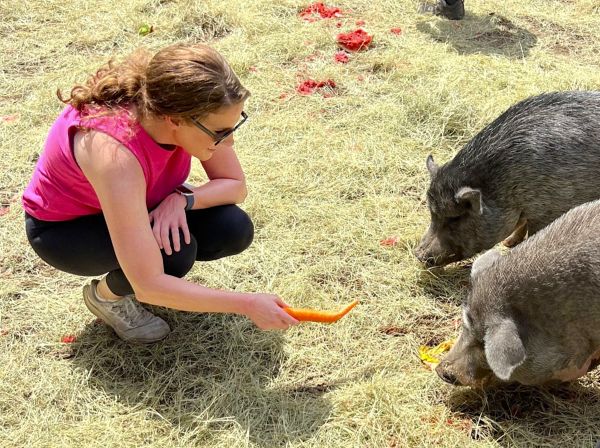
As a child in Florida, Kristin Dunn did not consider herself an “animal person.”
However, as an adult in Brooklyn, she became educated about “factory farming” methods, which fatten livestock for slaughter in confined spaces like “broiler houses” or feedlots. For example, Dunn was shocked to learn that many newborn male chicks are destroyed every year because they can’t lay eggs.
So, in March 2026, Dunn launched the St. Francis Institute for Animals, which advocates for alternatives to factory farming.
“We’re focused on educating and empowering our fellow Catholics,” she said, “to end needless suffering and create a kinder world for all God’s creatures.”
Dunn was born on Eastern Long Island and grew up in Florida. In 2011, she came to Brooklyn to pursue a career in fundraising and development. Her parish was the Oratory Church of St. Boniface in Downtown Brooklyn.
Dunn’s education on animal issues began in 2014 when a former colleague offered an opportunity to work for his new employer, the U.S. branch of World Animal Protection.
“I responded with some hesitation,” Dunn said. “I mean, I loved dogs, and I knew that there were a lot of issues related to animals.
“But I kind of thought that it was like this other world that I was not part of.”
Still, she agreed to study the issues, and was moved to join the animal welfare group.
“As I learned more about factory farming, I was so taken aback by it,” Dunn said.
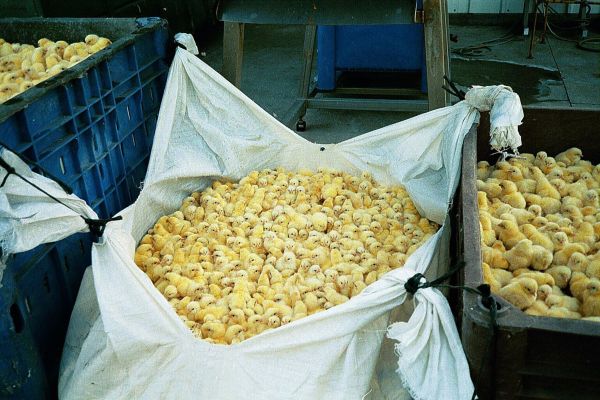
For example, egg producers “cull” most male chicks because they don’t lay eggs and their meat is considered inferior to females, she explained.
Meanwhile, the U.S. Department of Agriculture has reported that the nation’s annual chicken consumption jumped from about 33 pounds per person in 1980 to 68 pounds in recent years, which funnels more male chicks to destruction.
The United Egg Producers has confirmed that each year the U.S. poultry industry kills about 300 million male chicks. Methods include asphyxiating the chicks or scooping them into high-speed grinders.
Dunn eventually relocated to Austin, Texas, but her concern for animals grew.
She read extensively on the topic, including the 2015 encyclical “Laudato si’ ” in which Pope Francis asserts that the Catholic faith regards all animals as God’s creation.
Therefore, the pontiff wrote that every creature is worthy of human kindness in the tradition of St. Francis of Assisi. This formerly wealthy 13th-century merchant became a poverty-embracing friar, a saint, and the patron of all animals.
“St. Francis is known for such a gentle, loving spirit,” Dunn said. “Then I thought about these horrific things happening to animals that also contradict what we know about St. Francis, who loved every animal.
“I thought, ‘Every Catholic needs to know about this.’ ”
RELATED: Lights Out Bill, or ‘Flaco’s Law,’ Advocates Rally Support
Dunn used the skills she gained through nonprofit work to develop the Saint Francis Institute for Animals (SFIA). Its launch culminated a decade of planning and recruiting SFIA’s board of directors.
She chose to start it during the ongoing Jubilee Year of St. Francis, which continues through Jan. 10, 2027.
Pope Leo XIV created this celebration to mark the 800th anniversary of the saint’s death on Oct. 3, 1226.
The organization’s founding board includes Father Christopher Steck, a Georgetown University professor of theology and author of “A Heaven for Animals: A Catholic Case and Why It Matters.”
“The Catholic Church has increasingly embraced an expansive understanding of God’s salvific work in Christ,” Father Steck said. “Its scope is cosmic. As Pope Francis states, ‘All creatures are moving forward with us and through us towards . . . God’ (LS 83).’
SFIA’s website offers a suite of educational content, including practical ways to ease animal suffering by choosing plant-based foods. Another suggestion is pursuing “meatless” days to reduce the impact on both animals and the environment.
The site also includes the “30-Day Harmony with All Creatures Journey” — a free downloadable set of daily reflections that explore animal protection.
“From St. Francis’ legacy of kindness, to Pope Francis’ urgent message in ‘Laudato si’, to Church teachings that call us to consider the needs of all God’s creatures, there’s a strong call for our Catholic community to protect animals,” Dunn said. “We are here to amplify those teachings, connect them with the realities animals face today, and empower compassionate people to make a difference.”