
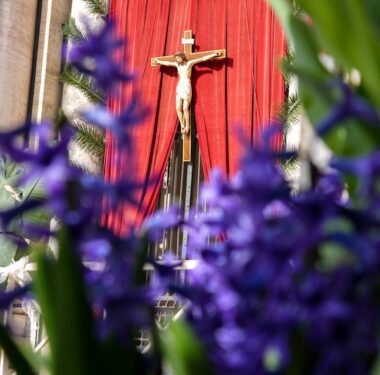
On Easter Sunday, not only will pews fill, but music will ring out from churches nationwide to celebrate the Resurrection. The common denominator among these hymns is that they are special to the Easter season, with many dating back to the 12th century.
Some are rooted in the Resurrection, while others are themed around salvation and redemption.
Below, The Tablet looks at 10 popular hymns you may hear this Easter.
1. “Jesus Christ is Risen Today”
This popular Latin hymn dates back to the 14th century. Often heard during the Catholic liturgy, it was first translated into English in 1708 by John Baptist Walsh and set to the music of William Henry Monk’s “Easter Hymn.”
It was revised in 1749 to the version known today by John Arnold.
“Jesus Christ is risen today, Alleluia!
Our triumphant holy day, Alleluia!
Who did once, upon the cross, Alleluia!
Suffer to redeem our loss, Alleluia!”
2. “Christ the Lord is Risen Today, Alleluia!”
This hymn, often confused with “Jesus Christ is Risen Today,” was inspired by its predecessor but has distinct lyrics. It was published in 1739 by Charles Wesley, a founder of the Methodist Church, along with his brother John Wesley.
It was originally titled, “Hymn for Easter Day” in the “Hymns and Sacred Poems” hymnal. It is also frequently heard at Catholic services during the Lenten period.
It originally consisted of 11 verses of four lines that were eventually pared down to six.
Then, early in the 19th century, “Alleluia,” borrowed from the Book of Psalms, was added to the end of each line.
In the Catholic Church, “Alleluia” is not sung during Lent but is restored with Jesus’ resurrection on Easter Sunday.
“Christ the Lord is risen today, Alleluia!
Earth and heaven in chorus say, Alleluia!
Raise your joys and triumphs high,
Alleluia!
Sing, ye heavens, and earth reply,
Alleluia!”
3. “I Know That My Redeemer Lives”
“I Know That My Redeemer Lives” was written in 1775 for Easter Sunday by Samuel Medley, who had been a sailor in the Royal Navy.
He wrote the hymn while he was a minister in the Baptist Church in Liverpool, England. The hymn gained popularity in the 20th century thanks to a contemporary arrangement by musician and composer Scott Soper.
It is included in Catholic hymnals celebrating Christ’s resurrection.
“I know that my redeemer lives; what
comfort this sweet sentence gives!
He lives, He lives, who once was dead; He
lives my everlasting head.”
4. “Crown Him With Many Crowns”
The lyrics to this widely recognized Catholic hymn were written in 1851 by Matthew Bridges, a convert to Catholicism, and Godfrey Thring.
It is sung to the tune of Sir George Job Elvey’s “Diademata.” The hymn, sung during the Easter season, references the resurrected Christ as the lamb upon his throne.
The hymn’s 12 stanzas celebrate the glory of the Lord, and in the 10th stanza, it directly addresses the resurrection.
“Crown Him the Lord of life, who triumphed
o’er the grave;
And rose victorious in the strife, for those
He came to save;
His glories now we sing, who died, and
rose on high,
Who died, eternal life to bring and lives
that death may die.”
5. “The King of Love My Shepherd Is”
Written in 1868 by Henry Williams Baker and based on Psalm 23, with the melody “Dominus Regit Me,” “The King of Love My Shepherd Is” is often heard at funerals.
The lyrics praise Jesus for His love and guidance.
“The King of love my shepherd is whose
goodness faileth never,
I nothing lack if I am His and He is mine
forever.”
LISTEN: ‘The Soundtrack of the Easter Season’ — A curated Spotify playlist from The Tablet.
6. “Praise the Lord, the Almighty”
“Praise the Lord, the Almighty” is an ecumenical Christian hymn that is often used in the Catholic liturgy as an entrance or praise hymn.
Based on Psalms 103 and 150, the original German-language lyric is by Joachim Neander and was first published in 1680 in “A Dictionary of Hymnology.” Catherine Winkworth published the English translation in 1863. The opening verse of the hymn offers praise and adoration.
“Praise to the Lord! The Almighty, the
King of Creation!
O my soul, praise Him, for He is thy
health and salvation!
All ye who hear, now to His temple draw
near,
Join me in glad adoration!”
7. “The Strife is O’er, the Battle Done”
This 17th-century Latin hymn is predominantly sung at Easter in honor of the Resurrection.
Based on the text, “Finita iam sunt proelia,” it was translated into English in 1861 by English hymn writer Francis Pott.
The lyric extols Jesus’ triumph over death, with each verse concluding in the joyful refrain “Alleluia!”
The text first appeared in 1695 in the Jesuit collection “Symphonia Sirenum Selectarum” and has become a staple in the Catholic liturgy.
“The strife is o’er, the battle done;
Now is the Victor’s triumph won;
O let the song of praise be sung. Alleluia!
Death’s mightiest powers have done
their worst, and Jesus hath His foes
dispersed;
Let shouts of praise and joy outburst.
Alleluia!”
8. “All Hail the Power of Jesus’ Name”
While not exclusively a Catholic hymn, “All Hail the Power of Jesus’ Name” focuses on Christ’s resurrection. Due to its ecumenical standing, it has been referred to as the “National Anthem of Christendom.”
The lyrics were written in 1779 by Edward Perronet, the son of an Anglican priest. It was popularized by Bing Crosby and included on his 1951 album, “Beloved Hymns.”
“All hail the power of Jesus’ name! Let
angels prostrate fall.
Bring forth the royal diadem, and crown
him, crown him, crown him, crown him
Lord of all!”
9. “Alleluia! Sing to Jesus”
William Chatterton Dix composed “Alleluia! Sing to Jesus” in 1866, and it is often sung as a Eucharistic hymn during the Easter season.
Samuel Sebastian Wesley, the great-nephew of John Wesley, composed the tune “Alleluia!” specifically for this hymn in 1868.
It is based on the Book of Revelation, with its concluding lines serving as high praise for Christ’s resurrection.
“Thou within the veil hast entered,
robed in flesh our great High Priest;
Thou on earth both priest and victim in
the Eucharistic feast.”
10. “Regina Caeli”
The Latin Marian hymn’s title translates as “Queen of Heaven” and is addressed to the Virgin Mary, as used in the Roman Rite of the Catholic Church during Easter.
The author of this hymn is unknown, although it has been traced back to the 12th century. It is a powerful devotion to the Holy Mother to rejoice in Christ’s resurrection and to pray for all humanity.
“Queen of heaven, rejoice, Alleluia, the
Son you merited to bear, Alleluia;
Has risen as He said, Alleluia, pray to
God for us, Alleluia”