

BOROUGH PARK — After two trips to Cuba in eight months, Auxiliary Bishop Emeritus Octavio Cisneros says conditions in his homeland have deteriorated from “very bad” to “even worse.”
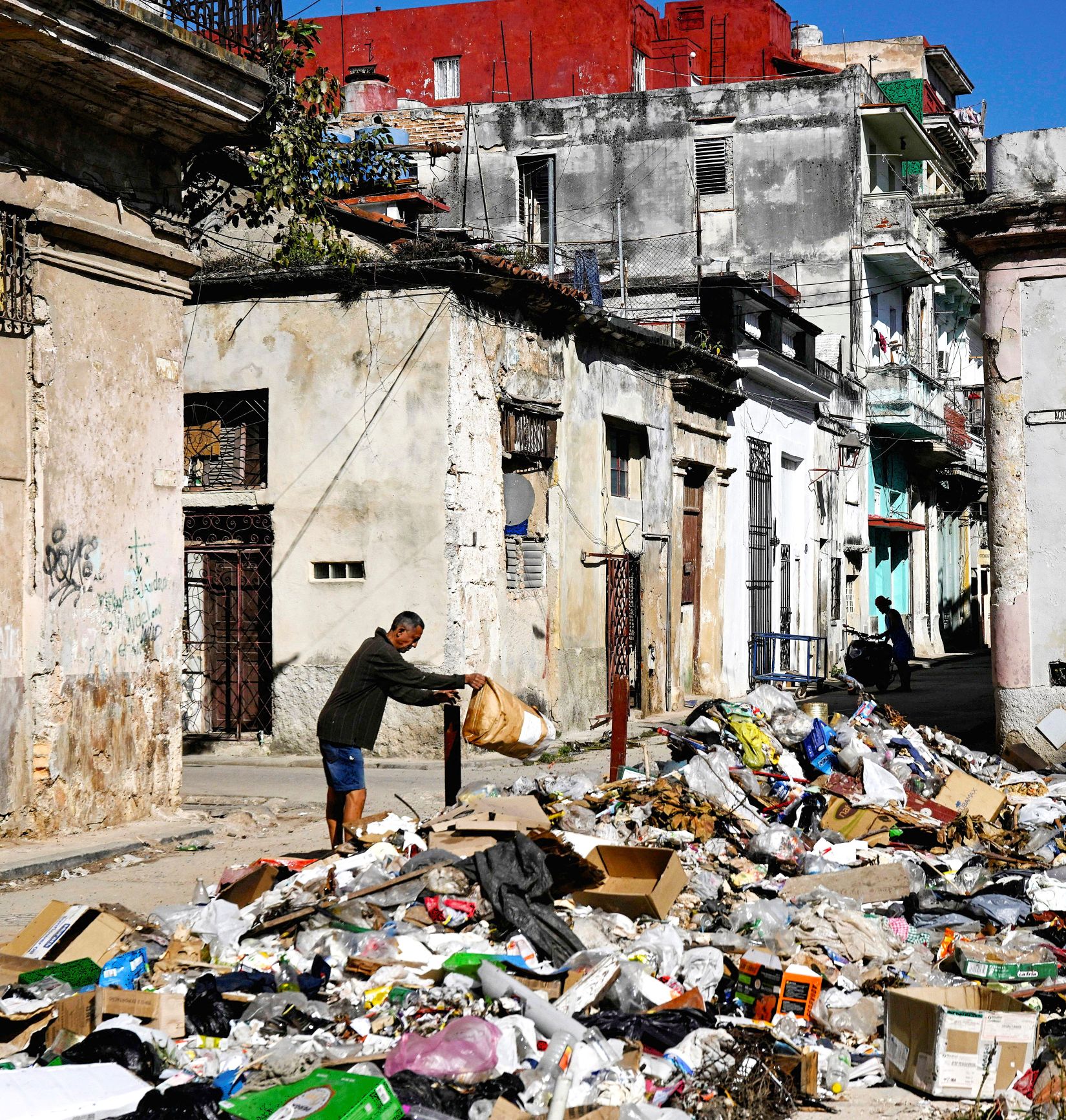
“There is no medicine, there is no food, and there is no gasoline. There is no water. Garbage is all over the place,” he recently told The Tablet, while discussing the chaos in Cuba on April 20 at St. Catharine of Alexandra Parish in Borough Park. “But most important, there is no freedom.”
His March visit occurred amid an energy blockade of Cuba ordered by President Donald Trump in January. The blockade soon followed the U.S. arrest of Venezuela’s socialist president, Nicolás Maduro, on Jan. 3.
Maduro sold oil to Cuba, which resold it to customers in other countries, but used most of the profits to keep its government in power rather than help its people, Bishop Cisneros explained.
President Trump, meanwhile, has said he ordered the blockade to force Cuba into cutting its support of rivals to the U.S., like Russia and China. He also wants to see the island nation pursue social and economic reforms.
Bishop Cisneros noted, however, that the problems in his homeland were underway long before the blockade began in January.
For example, he noted, among the nation’s crumbling infrastructure are its decrepit oil refineries.
“Everybody talks about the blockade, but remember, too, none of those plants have been kept up,” Bishop Cisneros said.
Problems spiral from there because it takes fuel to power electric generators.
“Since there is no gasoline, you don’t get electricity all the time, and sometimes you go 24 hours without it,” he said. “When you have no electricity, pumps do not work, and, therefore, you may have no water.”
With no fuel, garbage trucks don’t run; mounds of trash grow in the streets, Bishop Cisneros said.
“You can see people are fed up with it,” he said.
A few protests have occurred, with people banging pots and pans with sticks, but to do so risks imprisonment, Bishop Cisneros said. Still, the retired bishop aims to be neutral in any conflict between the two countries to help facilitate diplomacy, even if that upsets the Cuban diaspora in the United States.
He confirmed that a bit of controversy was directed his way in September 2023 after he briefly visited with Cuban President Miguel Díaz-Canel Bermúdez, who was in New York City for talks at the United Nations.
The president made a stop at the historic Catholic Church of the Transfiguration, founded in 1836 by Father Félix Varela, who is a candidate for sainthood.
Bishop Cisneros told The Tablet then that, “We never say no to anyone who would come to a church. So, I tried to explain to him a little bit about what this church is all about — this parish.”
The retired auxiliary bishop takes a similar stance when people ask him about the current Cuban blockade.
“I say I always agree with what the pope has said on Cuba,” Bishop Cisneros said. “He is the Vicar of Christ. He speaks as a religious leader, not as a politician.”
During his Angelus on Feb. 1, Pope Leo XIV said he wanted to “echo” a recent message of Cuban bishops, “inviting all responsible parties to promote a sincere and effective dialogue, in order to avoid violence and every action that could increase the suffering of the dear Cuban people.”
Hospitals have reported that patients died when electricity blackouts cut power to ventilators, although an official death count has not yet been compiled.
Yet despite the chaos, the Catholic Church thrives in Cuba, Bishop Cisneros said.
His trip to Havana in July was to celebrate the recent completion of repairs to the Church of the Good Shepherd of Jesus del Monte, which was severely damaged by a tornado in 2019. He recalled the joy of an elderly parishioner in a wheelchair.
RELATED: A Man for All Reason, Félix Varela
“She sat there with this big smile,” Bishop Cisneros said. “And she said to me, ‘I was baptized here, I made my communion here, and I married here.’ How happy she was to see her church restored.”
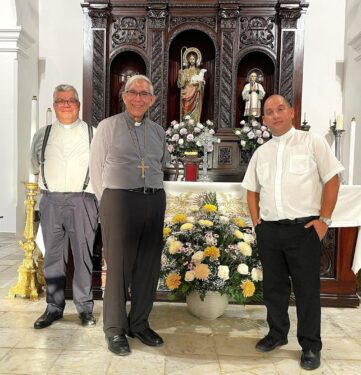
The congregation, including teenagers and young adults, packed the church for joyous worship. Bishop Cisneros said he was “bolstered” by their faith, as was Father Jose Agustin Orellana, pastor of St. Catharine of Alexandria, who accompanied the bishop.
Father Orellana, a native of Chile, said he was apprehensive at first, having lived through communism as a child. But he agreed with Bishop Cisneros that it was a delight to see that the congregants, although poor, came to church in their best clothes.
“My great surprise was the life of the Catholic Church in Cuba,” Father Orellana said. “Inside the church, there is poverty with dignity.”
Fervent worship also highlighted the March trip Bishop Cisneros made to celebrate the installation of Bishop Osmany Massó Cuesta for the Diocese of Santísimo Salvador de Bayamo y Manzanillo in the Granma province of eastern Cuba. This area received extensive damage from Hurricane Melissa last October.
The bishop is a longtime friend of Bishop Manuel de Jesús Rodríguez, the former pastor of Our Lady of Sorrows Parish in Corona, who was installed as the bishop of the Diocese of Palm Beach, Florida, in February. The new bishops were in seminary together for the same religious order, the Salesians of Don Bosco.
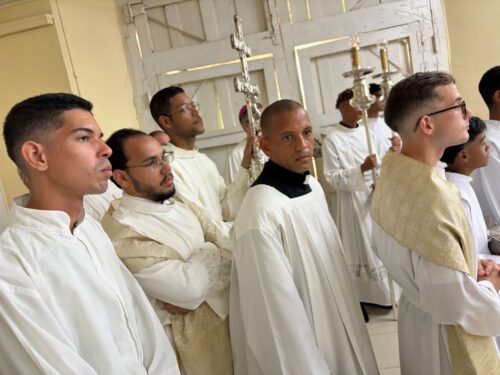
Bishop Rodríguez also attended his friend’s installation and was alarmed by the worsening quality of life in Cuba, where he had also previously worked and visited.
“What I encountered was not merely hardship,” Bishop Rodríguez wrote for the Florida Catholic newspaper. “It was a profound and worsening humanitarian crisis — raw, visible, and deeply human.”
“Malnutrition is no longer hidden — it is visible in the faces of children, in the frailty of the elderly, in the quiet exhaustion of parents who have nothing left to give,” he added. “Cuba is crying out. And we must respond.”
RELATED: Auxiliary Bishop Cisneros Recalls Cuba’s Repression of Catholics, From Revolution to Recent Protests
To that end, Bishop Cisneros offered three suggestions: pray for Cuba’s people, be informed to hedge against misinformation, and help “materially in every way possible.”
He also suggested partnering with Archbishop Thomas Wenski of Miami, who has been working with Caritas Cuba (caritas.org/cuba), Catholic Relief Services (crs.org), and Catholic Charities of Miami (ccadm.org).
“Just make sure your check says this is for Cuba,” he said.