
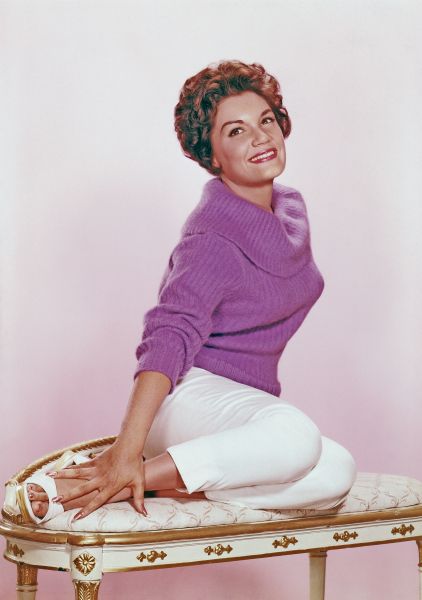
Concetta Rosa Maria Franconero, better known as Connie Francis, was one of the most popular female artists of the ’50s and ’60s. Born in 1937 in Newark, New Jersey, she earned 56 songs on the Billboard Pop Chart and scored three No. 1 hits. She was also the first Catholic female artist, and the first female artist of any denomination, to have a solo No. 1 hit on the chart with “Everybody’s Somebody’s Fool,” in 1960, beating out fellow female singer Brenda Lee’s chart-topper “I’m Sorry” by three weeks.
Interestingly, by that time Francis had already secured her signature song, “Who’s Sorry Now” in 1957, and would go on to add classics like “My Happiness,” “Among My Souvenirs,” as well as two other No. 1 hits, “My Heart Has a Mind of its Own,” in 1960 and “Don’t Break the Heart That Loves You” in 1962.
She was also the first female to chart three No. 1 solo hits, making her the most popular female vocalist between 1958 and 1962. Add to that the top 10 ballads “Second Hand Love,” and “Where the Boys Are,” and the catchy up-tempo favorites “Stupid Cupid,” “Lipstick on Your Collar” and “V-A-C-A-T-I-O-N,” a song she co-wrote with Bay Ridge, Brooklyn songwriter Hank Hunter and Gary Weston.
Francis grew up in the Italian-Jewish Crown Heights section of Brooklyn on Utica Avenue and St. Mark’s Place, where she learned to speak Italian and Yiddish, resulting in her critically acclaimed “Connie Francis Sings Jewish Favorites” album in 1960. But her biggest-selling album was “Connie Francis Sings Italian Favorites” in 1959, which peaked at No. 4 and remained on the charts for 81 weeks. It contained one of her most beloved ballads, “Mama,” that reached the Top 10 in 1960.
Musically, Francis ruled radio and records throughout the ’60s, but her own heart was broken when her father disapproved of her relationship with future music legend Bobby Darin. Francis met Darin in 1956 when he was a young songwriter. Francis’s father ultimately forced them to part ways. Darin went on to score major hits including “Splish Splash,” “Dream Lover,” and “Mack the Knife.”
Darin would marry actress Sandra Dee, while Francis was less than lucky in love, marrying four times. Sadly, Darin died of congestive heart failure in 1973 at the age of 37. Francis considered Darin the love of her life.
Further tragedies struck when she was raped at knifepoint in a hotel room following a performance at the Westbury Music Fair in 1974, and when her beloved brother, attorney George Franconero Jr., was shot to death outside of his New Jersey home in 1981 by what was purported to be a Mafia hit job.
RELATED: NYPD’s ‘Italian Sherlock Holmes’ Honored With Headstone Nearly a Century Later
After a break from performing, she returned to the stage and recording studio, where she found success. However, it was short-lived, as she suffered from depression, which resulted in a suicide attempt in 1984.
Once again, she rebounded and later that same year published her bestselling autobiography, “Who’s Sorry Now?” She eventually returned to performing live and recording new material, culminating in a headlining stint in Las Vegas in 2004 and the release of her second autobiography, “Among My Souvenirs,” in 2017.
After facing many challenges, including nasal surgery in 1977 that caused her to lose her voice for four years, Francis stated in 1981, “I have my voice, a gift from God I took for granted before. He gave it back to me,” also highlighting that she believed that it was her faith that helped her survive all the adversity she struggled through.
Francis retired in 2018 and lived quietly in Florida until her passing on July 16.
Her only child, Joseph Garzilli, Jr., with her second husband Joe Garzilli, eulogized his mother. “The world saw the star,” he said. “But I saw the struggle. And in her final days …she was tired. Not of life — but of the weight she carried alone for so long. She didn’t want anyone to worry. She just wanted to leave behind peace … and music.”
And ironically, while the caliber of success she enjoyed throughout the ’60s eluded her for the last half-century, she did achieve a remarkable feat this past May when “Pretty Little Baby” – an obscure song she released in 1962 – went viral on TikTok and helped introduce her to a brand new audience over half a century after releasing her first single.
Her response to the newfound acclaim was heartfelt.
“I am thrilled and overwhelmed at the success of ‘Pretty Little Baby,’” she wrote in a statement on May 19. “I recorded that song 63 years ago, and to know that an entire new generation now knows who I am and my music is thrilling for me.
“Thank you so much, everybody, thank you TikTok.”
“Pretty Little Baby” is just another keepsake from Connie Francis. In a career marked by triumphs and tragedies, her triumphs were truly remarkable. Her legacy is cemented in a series of artistic firsts, and there is no doubt that she left the world many souvenirs to remember her by. In response to her musical question, “Who’s Sorry Now,” the world is sorry to hear about the loss of a legendary artist. Still, for generations to come, people will enjoy the musical souvenirs she left behind.
Biographies says Connie was born in Newark. When her parents were visiting friends in their former Crown Heights neighborhood, Mom (Ida) went into labor. On December 12, 1937, Connie was born at St. John’s Episcopal Hospital on Atlantic Avenue, now Interfaith Medical Center.