


The story of how a nativist gang targeted Mass at St. Peter’s in 1806, and how a defiant parish fought back.
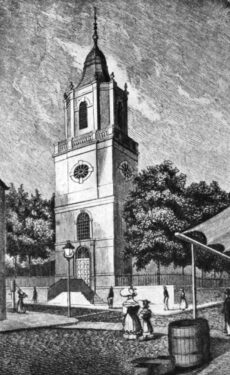
LOWER MANHATTAN — On Christmas Eve 1806, parishioners gathered at St. Peter’s Church on Barclay Street for midnight Mass, celebrating the Nativity of Jesus amid music, sweet incense, luminous candlelight, and silent prayer.
Outside was another scene entirely — about 50 members of the “Highbinders” nativist gang assembled outside St. Peter’s to disrupt the Mass and harass worshippers.
Years later, one of the rioters, William “Big Bill” Otter, recounted the violence.
In his 1835 autobiography, “History of My Own Times” — a boastful memoir of unrepentant thuggery and antisocial behavior — Otter described rushing toward reports of a riot at the local Catholic church.
“The church was surrounded with a motley crew of Irish and sailors engaged in deadly conflict,” Otter wrote.
“A great deal of property was destroyed by the mob, and a great deal of human blood shed.”
St. Peter’s Church was an easy target for this gang of drunken hooligans.
Founded in 1785, it supplanted the pre-Revolution days when Jesuit priests like German missionary Father Ferdinand Steinmeyer (aka Ferdinand Farmer) snuck into the city on horseback to secretly celebrate Mass in the homes of covert Catholics.
But after the war, anti-Catholic laws outlawing Mass dissolved, said Father Anthony Andreassi, an expert on early Church history in the Americas and administrative vicar of the Oratory Church of St. Boniface in Downtown Brooklyn.
“There was a warming towards Catholics between the time of the Revolution and about 1830,” Father Andreassi said. “They generally supported the Revolution, and I think that helped win over people who were sort of suspicious of them.”
By 1806, St. Peter’s was the sole Catholic parish in New York City and famously dubbed the “Mother Church” of Catholic New York.
A year earlier, St. Elizabeth Ann Seton was received into the church, where she made her first holy Communion, Father Andreassi said. Venerable Pierre Toussaint, a candidate for sainthood, also worshipped there.
Yet despite the advances Catholics made in the culture of the early 19th century, animosity and mistrust of them lingered.
Meanwhile, working-class laborers and sailors treated late December as a time for drinking, shooting guns into the air, and roaming the streets in noisy bands.
This cauldron of anti-Catholic and anti-Irish hooliganism sparked the 1806 Christmas Riot outside St. Peter’s.
Christmas in New York City wasn’t anything like today’s holiday vibe of festive Fifth Avenue window displays, massive Rockefeller Center tree lightings, or spectacular high-kicking Rockettes.
Many Protestant New Yorkers, shaped by Puritan and Calvinist traditions, viewed formal Christmas worship as a suspect “Popish” custom, Father Andreassi said.
“In some Calvinist branches of Christianity, Dec. 25 was just another day of the year,” he explained. “They’d be rare nowadays. Most Protestant churches have gotten on board, but historically, the more Calvinist they were, the more unlikely they were to celebrate Christmas.”
As for the Highbinders, it was an excuse to get drunk.
“You could actually see them as a precursor to the nativist anti-Catholic wave that hit the country between the 1830s and the Civil War,” Father Andreassi said.
That hostility outlasted the war. After a brawl between police and Irish marchers at the 1867 St. Patrick’s Day parade on the Lower East Side, newspapers and cartoonists seized on the clash to portray Irish Catholics as a lawless threat — a sign of how deeply the suspicion first seen outside St. Peter’s had taken root.
While bragging about his involvement in the Christmas riot, Otter wrote that he left a dance with a buddy to investigate reports of a disturbance outside St. Peter’s.
“We were informed that the Irish had killed a sailor,” he wrote. “And without further ceremony, we entered the list of combatants and espoused the cause of the sailors.”
On Christmas Eve, city watchmen dispersed the crowd, but rumors swirled that the mob would return on Christmas night to raze the church. Irish Catholic parishioners grabbed clubs and stones to defend the building.
A street battle erupted and spilled a quarter mile toward the Irish neighborhood around Augustus Street, near today’s City Hall.
Otter was incorrect in reporting a sailor died — the victim, Christian Luswanger, was a city night watchman who was fatally stabbed, making him New York’s first law enforcement officer killed in the line of duty.
On Dec. 27, Mayor DeWitt Clinton issued an official proclamation in the New-York Evening Post offering a reward for the capture of the “disorderly persons who insulted the Congregations of the Roman Catholic Church in the city and violated the public peace,” resulting in the watchman’s death.
Luswanger’s killer was never caught, yet St. Peter’s Church survived — growing from a besieged Barclay Street parish into the foundation of Catholic life across New York.