
by Gina Christian
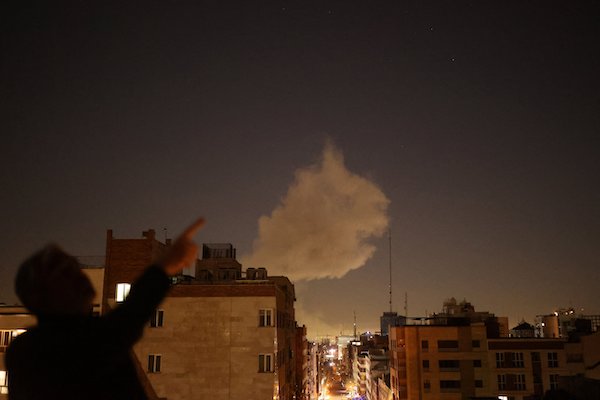
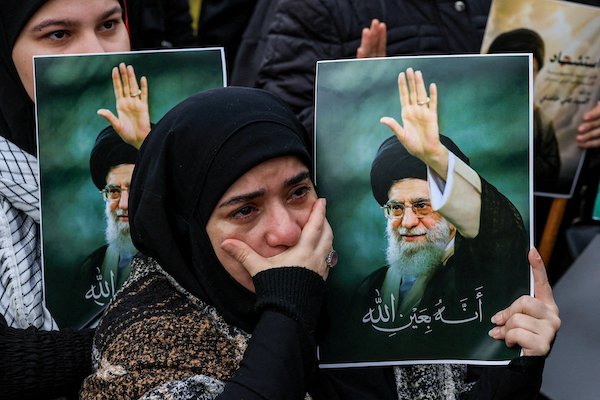
(OSV News) — Catholic clergy are calling for prayer and peace following U.S.-Israel strikes on Iran Feb. 28 that killed supreme leader Ayatollah Ali Khamenei as well as senior leaders and civilians.
“We pray that there be a return to dialogue, diplomacy, justice, and peace,” said Msgr. Peter I. Vaccari, president of the Catholic Near East Welfare Association and the Pontifical Mission for Palestine, in a statement to OSV News.
Msgr. Vaccari said he had spoken to each of CNEWA-Pontifical Mission for Palestine’s regional directors in Jerusalem, Beirut and Amman, Jordan.
“And I assured them, their families, and the families of all our staff, of our prayers at this very difficult hour,” he said, adding that the “highest immediate priority is the safety of our staff and their families.”
He described the regional teams’ works as “great and heroic,” and “extraordinary testaments” to the organization’s mission.
“Our teams throughout the region work long hours on behalf of the churches and peoples whom we are committed to serve,” said Msgr. Vaccari. “Their lives and schedules are the living translation of the Gospel question, ‘Who is my neighbor?’, as they are there for everyone!”
Archbishop Paul S. Coakley of Oklahoma City, president of the U.S. Conference of Catholic Bishops, issued a March 1 statement echoing Pope Leo XIV’s call at the Angelus in St. Peter’s Square that same day for deescalation and diplomacy.
Noting Pope Leo’s plea for peace and warning of an “irreparable abyss” if the violence continues to spiral, Archbishop Coakley said, “We are faced with the possibility of a tragedy of immense proportions.”
He said, “My brother bishops and I unite our voice with our Holy Father and make the heartfelt appeal to all parties involved for diplomacy to regain its proper role.”
Archbishop Samuel J. Aquila of Denver — whose canonically required resignation at age 75 was recently accepted by Pope Leo XIV — issued a Feb. 28 statement in which he expressed “deep sorrow and grave concern over this dangerous escalation of violence.”
“While the Church recognizes that nations possess the right to legitimate self-defense under the strict moral conditions articulated in the just war tradition, she also insists that the use of force must always be a last resort, guided by moral restraint, proportionality, and a sincere commitment to protect innocent life,” wrote Archbishop Aquila, citing the Catechism of the Catholic Church (2309).
He added, “Any action that endangers civilians or fuels broader regional instability must weigh heavily on the consciences of leaders and decision-makers. The dignity of human life must always come first!”
Archbishop Aquila called on archdiocesan faithful to “pray fervently” for “an immediate de-escalation of violence,” increased charity towards one’s neighbor, and the protection of innocent civilians.
He also urged the faithful to pray that leaders in the region and around the world would be “guided by the first premise, the respect of the dignity of the human being, in pursuing peace.”
In addition, Archbishop Aquila implored intercession for people of goodwill in the Middle East and beyond, that they may not lose hope, and that their efforts for reconciliation and a just society may bear lasting fruit.”
The archbishop invited prayer as well for “the protection and preservation of holy places throughout the region.”
“The path of vengeance leads only to further suffering; fueling hatred of neighbor which is not the way of the Gospel!” he said. “The path of peace, though difficult, is the only road that secures a future for generations to come.”
Chaldean Catholic Archbishop Bashar M. Warda of Irbil, Iraq echoed those words.
“I witnessed the years of violence, displacement, and bombings that shook Iraq after 2003,” he said in a Feb. 28 message to OSV News, referencing the U.S-led invasion of Iraq that year in retaliation for the 9/11 terror attacks.
“These are not chapters in a book for us. They are memories we still carry,” Archbishop Warda stressed. “We know what sirens sound like in the middle of the night. We know what it means for a child to fall asleep afraid. We know the silence of empty streets, the fear in a mother’s eyes, the pain of families who leave their homes not knowing if they will ever return.”
For that reason, said Archbishop Warda, “When we see tensions rising again in our region, we do not see it as distant news. We feel it in our hearts.
“Every new escalation reopens wounds that have not fully healed,” he explained. “Our people are still recovering, emotionally, economically, spiritually, from the wars of the past.”
“The Middle East does not need another war,” Archbishop Warda said. “Our children deserve stability. Our families deserve peace. Ordinary people have already paid too high a price for conflicts they did not choose.”
He concluded, “From Irbil, a city that once welcomed thousands who fled violence, I appeal for wisdom, restraint, and dialogue.”
“Strength is not shown through destruction. True strength is shown through protecting life,” he said. “Peace is not a political slogan. It is a human necessity.”
With an estimated 2.2 million Filipino migrant workers in the region — most of whom are Catholic — Cardinal Jose F. Advincula of Manila, Philippines, directed the faithful of his archdiocese to add special intentions to the universal prayer at March 1 Masses.
“May God purify the world of all violence, greed and misuse of power that bring suffering and death to many,” read the first prayer.
The second prayer interceded for peace for “those who suffer from the scourge of war.”