
The experience of traveling to Rome for the Jubilee with the Diocese of Brooklyn to see Pope Leo XIV was unbelievable. The experience remains vivid in my mind, as I recall the distinctive energy of being in the Church’s central location.

The experience of traveling to Rome for the Jubilee with the Diocese of Brooklyn to see Pope Leo XIV was unbelievable. The experience remains vivid in my mind, as I recall the distinctive energy of being in the Church’s central location.

Assuming that the synodal process is not an end in itself and recognizing that the synodal process of 2021-2024 has produced some good fruits, perhaps it may be suggested that it’s now time to move from synoding to applying the fruits of the past three years to mission and evangelization.
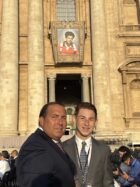
My dad, Vincent LeVien, works for the Diocese of Brooklyn. As a result, my family is often invited to attend special Church events. In April, we traveled to Italy for the canonization of then-Blessed Carlo Acutis, but it was canceled after Pope Francis died. So, instead of the canonization, we were there for the funeral of a pope, which is something I never thought I would get to witness.
Pope Leo XIV’s spiritual lodestar is St. Augustine. In his first months in office, the Holy Father summoned the Church to pray, fast, and work for an end to the 21st century’s wars. That spiritual orientation and that summons invite us to consider what “peace” is possible in this world.
Robert Royal and I have been friends, colleagues, and co-conspirators for nigh on four decades.
Vatican II did not call the Church to just “meet the modern world.” The council called the Church to convert the modern world. How? By offering Jesus Christ as the icon of a genuine humanism and the sacramental Church as the icon of authentic human community.
Karl Rahner, SJ (1904-1984), one of the most influential Catholic theologians of the 20th century, is a favorite whipping boy for many traditionally minded Catholics. Yet, Rahner was something of a split personality.
“Do not fold, spindle, or mutilate” was printed on the punch cards that fed data into IBM computers in the 1950s, when those primitive machines could occupy the entire floor of a building. That admonition came to mind when, as has happened with depressing frequency over the past four decades, the just war tradition of moral analysis was folded, spindled, and mutilated — not to mention distorted, inverted, and rendered unrecognizable — in a lot of the secular and religious commentary on the military action undertaken by Israel and the U.S. in Iran in June. Let me try to repair some of the damage with a few reminders of what the just war method of moral analysis isn’t and is.
How appropriate that Flannery O’Connor should have been born on the solemnity of the Annunciation: the liturgical feast celebrating the willing acceptance of a God-given vocation.
That national civic renewal will begin when, one by one, “We, the People” rebuild the link between freedom and virtue; recommit themselves to republican constitutionalism; refuse to countenance demagoguery by holding elected officials accountable to adult standard; and conduct ourselves in a manner befitting the maturity we should have achieved in two and a half centuries of national life.