
View this post on Instagram
Many milestones are occurring this year for Bruce Springsteen, not the least of which was the 50th anniversary in August of his landmark classic “Born to Run.”
The Long Branch, New Jersey-born music icon celebrates his 76th birthday on Sept. 23 and is still touring the world with a revamped E Street Band. Additionally, he recently released a boxed set of seven “lost” albums and is preparing for the expanded reissue in October of his haunting 1982 album “Nebraska.” And if that wasn’t enough, “Springsteen: Deliver Me from Nowhere,” a biopic of his life, is scheduled for release on Oct. 24.
While Springsteen’s youthful anthems of rebellion are rooted in his racing through the back streets of the small Jersey towns in his youth, which he immortalized in song, his mother, Adele (Zerilli) Springsteen’s roots stretch back to Bay Ridge, Brooklyn, where she lived with her parents and sisters until 1940, when the family moved to Freehold, New Jersey.
However, while Springsteen is heralded for his rebellious anthems, he admitted in his 2016 autobiography “Born to Run” that his insightful lyrics are actually rooted in his Catholic upbringing.
He said it was the priests and the nuns at St. Rose of Lima Parish in Freehold that helped shape his lifelong quest for redemption and reaffirmation. He attended Mass regularly with this family and viewed the priests and nuns as authority figures and “our local bridge to the next life.”
In the third chapter of the book, “Church,” Springsteen writes, “This was the world where I found the beginning of my song. In Catholicism, there existed the poetry, danger, and darkness that reflected my imagination and my inner self. I found a land of great and harsh beauty, of fantastic stories, of unimaginable punishment and infinite reward.”
Rich and abundant Catholic imagery and metaphors infuse the songs on his first album, “Greetings From Asbury Park” (1973), as well as his latest self-penned project, “Letter to You” (2020). Springsteen imbued his songs with religious undertones as he struggled to come to terms with the faith he was born into.
“It’s Hard to be a Saint in the City” details an impassioned young man trying to embody the swagger of antiheroes like Brando and Casanova while “the devil appeared like Jesus in the street, showin’ me a hand I knew even the cops couldn’t beat.”
After two critically acclaimed albums, in Aug. 1975 Springsteen hit his full stride with the iconic “Born to Run,” a record that helped redefine the parameters of rock with songs that burned with youthful passion and heartfelt poetry.
LISTEN: From ‘Born to Run’ to ‘The Rising’ – A curated Spotify playlist from The Tablet.
Springsteen had finally taken on the mantle of Bob Dylan, earning a hallowed spot among the finest songwriters of his generation. Fifty years later, it still sounds as fresh and powerful as it did upon its release. From the opening line of the first song, “Thunder Road,” “The screen door slams, Mary’s dress sways …” it serves as both an introduction and invocation of what’s to come.
The “Darkness on the Edge of Town” album fulfilled the promise with the title song ranking among his finest compositions –– a brutal vignette of a man who has lost his money and his wife but still clings to the hope that he can overcome the loss of his dreams and escape from the despondent darkness he has been relegated to.
For “The Promised Land,” he borrows the title of the breezy Chuck Berry tune and paints a bleak picture of a desert landscape while clinging to his faith and believing that he can ultimately escape the dark clouds hovering above the desert floor, proclaiming “Mister, I ain’t a boy, no I’m a man and I believe in the promised land.”
The harrowing biblical metaphor of “Adam Raised a Cain,” with its vivid Catholic imagery, depicts the struggles between a father and son, inspired by John Steinbeck’s novel and film “East of Eden.” The opening line incorporates a baptism by fire and explains, “In the Bible brother Cain slew Abel; And East of Eden, mama, he was cast; You’re born into this life paying for the sins of somebody else’s past.”
On his next album, “The River,” he introduces us to two teenagers, the narrator and his girlfriend Mary, who meet as high school sweethearts at seventeen and proceed to drive down to the river, where they are metaphorically baptized before he takes on the guilt of getting Mary pregnant and having to find a job and marry her at 19. Their lives become a harsh acceptance of reality as their dreams all dry up like the reservoir down by the river where they used to swim.
“The River” set the stage for arguably Springsteen’s greatest masterpiece, “Nebraska,” a sparse and raw folk work of art that was originally recorded at home on a 4-track cassette with just a guitar and vocals. The songs tell harrowing stories of murderers, criminals, and ordinary people facing insurmountable challenges in their lives. And yet, behind it all was a sense of justice where debts are paid in full and faith somehow survives.
RELATED: How Christianity Shaped Bob Dylan’s Life and Music
The “Nebraska” album featured songs of reckonings and redemption, including the evocative ballad “My Father’s House,” which draws a direct parallel to the biblical verse from the Gospel of John, “In my Father’s house are many mansions,” which depicts the dynamic between a father and son and the son’s Catholic sense of isolation while craving for that bond in the song’s last line, “Calling and calling, so lost and alone; Shining ‘cross this dark highway, where our sins lie unatoned.”
In 2002, Springsteen’s music took a more fervent religious turn with the release of “The Rising,” with songs that reflected on the tragedy of the 9/11 attacks.
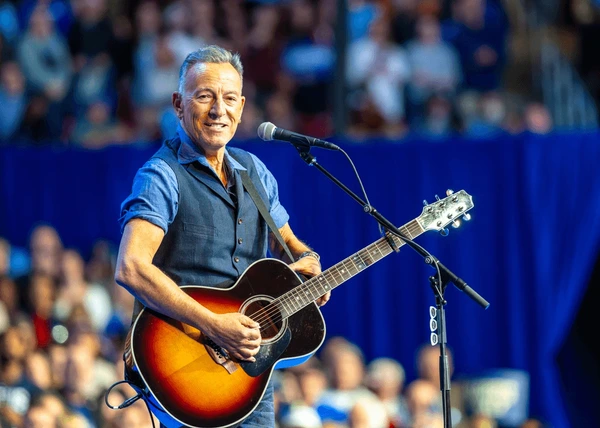
While songs like “You’re Missing” and “My City of Ruins” chronicled the sheer devastation and resurrection in the aftermath of the attacks, the album was permeated with lyrics of resilience and hope, including the title track that helped unite a nation with vivid biblical imagery of everyone joining together to overcome the horror beckoning people to, “Come on up for the rising; come on up lay your hands in mine.”
He further emphasizes the healing power of faith by singing, “Bells were ringing and filled the air; I was wearing the cross of my calling …”. He proclaims the stark reality in the darkness, where spirits surround him from above and behind, but through it all, he witnesses Mary in the garden offering hope by “dancing in a sky filled with light.”
In “My City of Ruins,” he further turns to prayer and the “sweet bells of mercy” for healing, admitting, “Now with these hands I pray Lord; I pray for the strength Lord; I pray for the faith Lord; I pray for your love Lord,” closing out the album on the most hopeful of notes.
Springsteen’s 2005 album “Devils & Dust” included his most religious song to date, “Jesus Was an Only Son,” about Christ’s sadness while in the Garden of Gethsemane, accepting His fate while wondering if it could have been different. The song focuses on the relationship between Jesus and his devotion to his mother as he comforts her: “Jesus kissed his mother’s hands, Whispered, ‘Mother still your tears; For remember the soul of the universe willed a world and it appeared.” It’s a tender, passionate, and heartfelt song that exemplifies Springsteen’s embracing of faith for all to see and hear.
On “Letter to You,” his last album of original material from 2020, Springsteen dwells on the theme of aging and his own mortality. It includes two faith-infused songs that serve as a benediction, taking him back to the source of his Catholic faith.
“If I Were the Priest” casts Springsteen in a western-dreamscape notion of heaven where Jesus is the sheriff and he is the priest as the “Virgin Mary runs the Holy Grail Saloon,” proclaiming his devotion and hope of ridding the world of the “bad guys” through faith-based justice.
“The Power of Prayer” is a lovely dream allegory about finding love and spending idyllic days by a lake during his youth. It’s a stark rebuttal to naysayers as he embraces those cherished moments, “They say that love, love comes and goes; But darlin’ what, what do they know; I’m reachin’ for heaven, we’ll make it there; ‘Cause darlin’ it’s just the power of prayer.”
While Springsteen admittedly found the beginning of his song in church, he developed his craft by following his own musical forebears, whose songs were rooted in faith, such as Woody Guthrie, Pete Seeger, Bob Dylan, and Johnny Cash.
But Springsteen added another layer by delving deeper into his upbringing and writing his own songs from a Catholic perspective. While he drove down to the river and dove into the darkness on the edge of town, he also witnessed the splendor of the rising and what faith and hope could raise from the ashes.