
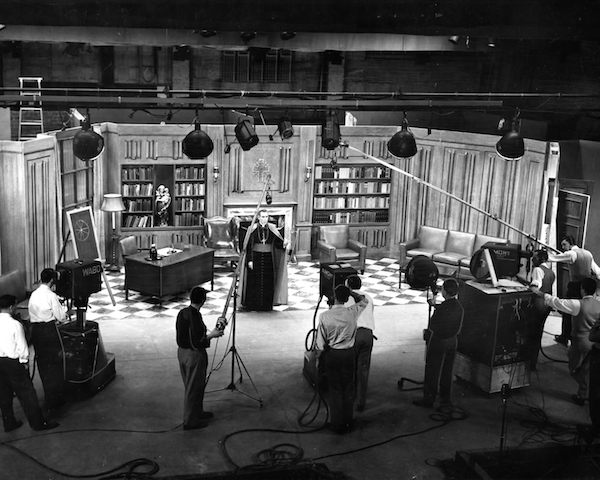
PROSPECT HEIGHTS — Before every television broadcast, Archbishop Fulton Sheen walked onto a bare stage, picked up a piece of chalk, and wrote three letters at the top of a blackboard: JMJ — Jesus, Mary, and Joseph.
There was no script, no teleprompter, and no elaborate set: just a teacher, a chalkboard, and an audience of millions.
In an era when entertainment dominated the airwaves, Sheen transformed a classroom-style lecture into one of the most successful programs in American media history. His Emmy Award-winning show, “Life Is Worth Living,” resonated with 30 million viewers each week — many of them not Catholic.
“Sheen was able to take complex intellectual teachings of the Roman Catholic Church and communicate them in clear, practical terms to anyone who would listen,” said Father Patrick Flanagan, associate professor and chair of the Department of Theology and Religious Studies at St. John’s University. “His disarming and sometimes humorous approach to addressing challenging issues such as family life, young people, stress, and work resonated with his viewers.
RELATED: Archbishop Fulton Sheen’s Beatification Moves Ahead After 6-Year Pause
“They were challenged to frame their legitimate concerns in a healthy spirituality that would lead them to happiness and freedom.”
After completing his graduate studies in philosophy in Belgium, Archbishop Sheen sought guidance from Cardinal Désiré-Joseph Mercier on how to teach effectively in the modern world. Cardinal Mercier urged him to pay close attention to the cultural questions of his time — what people were debating, reading, listening to, and creating — while grounding his responses deeply in Church teaching.
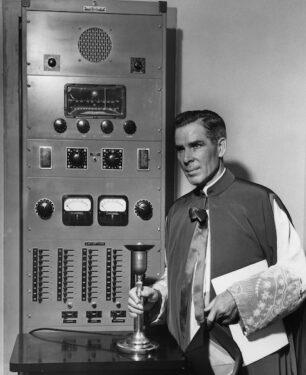
Troy Kassien, a Duke University academic who has studied and written extensively on Archbishop Sheen’s legacy, said that approach is what made him such a credible public figure and example for teachers, parents, and catechists who desire for religious voices to be welcome in modern discourse.
“Here we need a lesson from Sheen. We need to learn again how to think slowly. Sheen did this so well, and it’s what enabled him to be such a credible bridge between the Church and the world,” he said. “Sheen showed his contemporaries that it is possible for a religious person to also be a respected public figure and intellectual.”
Much like St. Francis de Sales, the patron saint of writers and journalists, who used the written word as a primary tool for evangelization, Archbishop Sheen embraced the primary media of his time to teach and invite audiences into more profound reflection.
Today, journalism educators say Archbishop Sheen’s approach still feels relevant — primarily as teachers work to slow students down in an age of constant information, short attention spans, and algorithm-driven content.
“I think what students could learn from watching Sheen, even though it’s from over 60 years ago, is that he used the time he had on air to get into depth and think more fully about a topic,” said Michael Rizzo, associate professor and director of the journalism program at St. John’s University. “If we’re just kind of doing the headlines, the 144 characters, we’re not getting the depth. And I think looking at his shows, where he tried to go deeply into these faith-related matters, that’s where students can learn.”
RELATED: Bishop Sheen’s Iconic TV Shows Come to NET-TV
Even decades after his final broadcast, Archbishop Sheen’s lessons continue to resonate, not only through reruns archived online but through the enduring clarity of his writers: Matthew, Mark, Luke, and John.
“Sheen loved the Lord Jesus and let his life be animated by this love. This explains his incredible teaching ability,” Kassien said. “This explains his influence and impact on American Catholicism in the 20th century.”
“He sought to be holy in every aspect of his life, to know and follow Christ closely, and to heed Christ’s unique call for his life,” he continued. “This is our call, too.”