


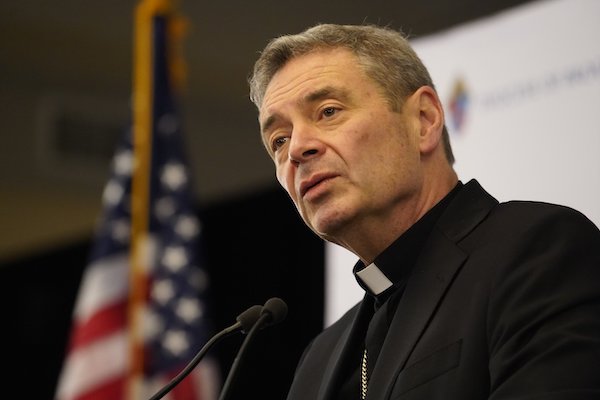
PROSPECT HEIGHTS — As the Church grapples with the rise of artificial intelligence and its use among the faithful, and clergy alike, Bishop Robert Brennan has raised concerns about the potential impacts.
“You’re creating God in your image and likeness, or in the image and likeness of whoever is running the AI,” Bishop Brennan said. “Rather than the other way around — He created us in His image and likeness.
“It’s an age-old problem. It goes back to the very beginnings of creation. It’s idolatry.”
A California-based tech company, Just Like Me, has developed a platform that charges users $1.99 a minute to converse with an AI-generated Jesus.
Bishop Brennan said he understands why adding a voice to Jesus Christ could be comforting for some, but noted that such tools lead users to view Jesus, “who is a real person,” as an “imaginary friend.”
His warning reflects a broader unease among Catholic leaders regarding AI.
Pope Leo XIV has spoken on the dangers multiple times, highlighting the need for society to never forget human dignity and to avoid interfering with the proper neurological development of children and young people.
He has also spoken on the ecclesiastical dangers of AI.
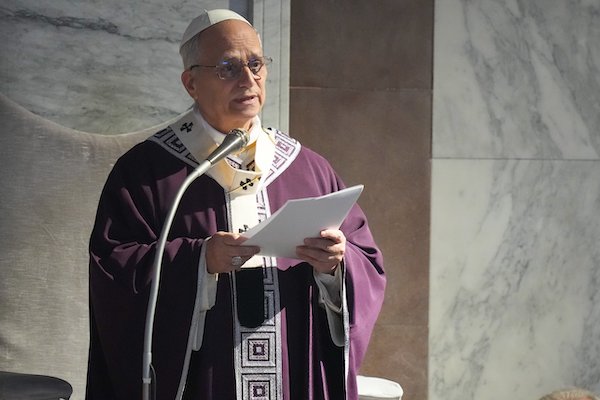
In February, in a meeting with priests from the Diocese of Rome, he made clear that the technology should not be used to create homilies.
“To give a true homily is to share faith, and AI will never be able to share faith,” the Holy Father explained to the priests.
Cameron Pak, a Christian software developer who created faith.tools, a guide of five “unofficial rules for AI apps for Christians,” argues that at this point, faith leaders shouldn’t try to prevent AI, but instead teach how to use it properly.
“AI will keep improving and changing rapidly, for better and for worse,” Pak said. “If it’s going to be ubiquitous, it’s better if I teach followers of Jesus how to use AI in a way that’s well-bounded and value-aligned than if I do nothing. I cannot do nothing.”
Pak’s publicly available framework is meant to help both developers and users evaluate whether a faith-based app is trustworthy, he said.
The content on the website was created with input from pastors, heologians, and other engineers who are addressing the same issues around AI integration into faith, he added.
“I started with prayer and surrender to the Lord Jesus,” Pak said. “I asked his Holy Spirit to show me boundaries for AI that could be easily read and understood by many.”
Bishop Brennan acknowledged the utility of AI in certain contexts — research, productivity, academic work — but denounced equating its use to any sort of spiritual encounter.
The danger, he said, isn’t just theological abstraction. It’s practical.
“AI hallucinations don’t come from an intimate knowledge of Jesus,” he said. “That’s coming from somebody’s cultural bias, built on algorithms — not on reality. You’re not projecting Jesus. You’re projecting who somebody believes Jesus is.”
And that, Bishop Brennan warned, can go dangerously off the rails.
He said the solution is time, Scripture, and the sacraments. “Talking to Jesus is a real possibility — we call it prayer,” Bishop Brennan said. “But it takes a lot of discipline, a lot of patience. It comes out of a life committed to it. “It’s not just a momentary thing.”