

HASBROUCK HEIGHTS, N.J. — Port Authority engineer Paul Carris was trying to save a co-worker’s life when he helped her down 71 flights of stairs in the North Tower on 9/11. What he did not know at the time was that the long descent would begin a journey that eventually led him to the diaconate.
Deacon Paul Carris, who was ordained in the Archdiocese of Newark in 2011, said he now realizes that while he helped Judith Toppin reach safety, he was being guided, too.
“God was leading me to a closer relationship with him,” he told The Tablet in an interview on Sept. 3. “It just took me a while to get there.”
Deacon Carris explained that he suffered from post-traumatic stress disorder (PTSD) and had anger management issues in the weeks after 9/11. An encounter with a priest at his parish, Corpus Christi in Hasbrouck Heights, New Jersey, prompted him to seek therapy, which led to him attending a religious retreat that started his path to the diaconate.
On 9/11, after the first jetliner hit the South Tower, Deacon Carris and his co-workers headed for the exit to begin the long descent down the stairs from the 71st floor of the North Tower, where their office was located.
RELATED: Paulie’s Final Push Honors 9/11 Flight Crews, One Mile at a Time
However, he saw a group of co-workers surrounding Toppin, who suffered from a variety of health issues, including heart disease, lung problems, and obesity. She also had a heart defibrillator implanted in her that had given her an electric shock during all the commotion. As a result of her health issues, she was having difficulty walking, and her worried coworkers were trying to help her. Deacon Carris told everyone to leave and said that he would accompany Toppin down the stairs.
“It was slow going,” he recalled. “I had to get her to take her right arm and hold onto the handrail on the right side. I had my right arm supporting her under her left arm, and I had my left arm holding the handrail on the left side as we went down one step at a time. “I wasn’t going to leave her. I knew that. We were in this together.”
There are two memories that stand out for him from that long climb down the stairs. One is the sense of calm everyone displayed.
“The rest of the world saw those images of what took place, but what people don’t understand is how calm it was in that stairwell,” Deacon Carris explained. “Everybody was cooperating.”
The second memory is the moment he and Toppin reached one of the floors in the 20s and suddenly felt a gust of wind coming toward them: “That’s when the South Tower collapsed.”
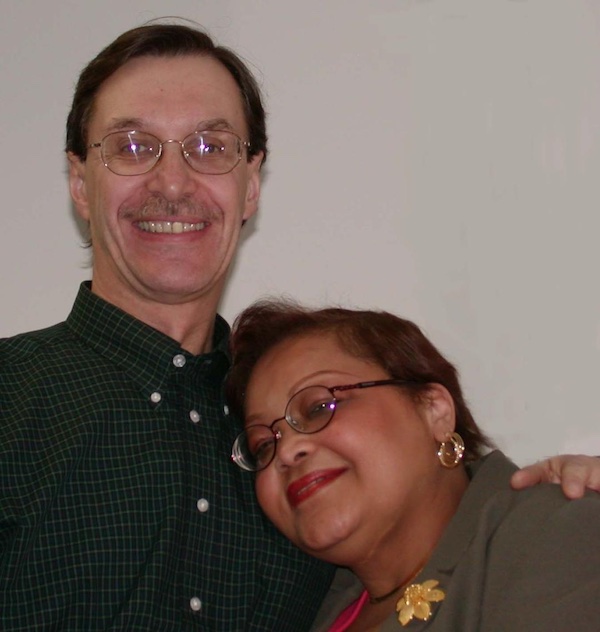
Deacon Carris and Toppin made it to the street level and to safety. They found an ambulance whose crew gave Toppin oxygen, and then they took shelter in a hotel. The two co-workers remained friends until Toppin’s death in 2021.
Deacon Carris struggled after 9/11. It came to a head a few weeks after the attacks. He got lost while driving to his daughter’s high school softball game and wound up missing it. He arrived at the ballfield after the game ended and was so angry in the car that it left his daughter speechless. After dropping her off at home, Deacon Carris went to Corpus Christi Church, where he was a parishioner, sat in a pew, and cried.
Father Ray Holmes, the parochial vicar, spotted him and sat down to chat.
“He asked me how I was doing. I told him, ‘I’m a mess,’ ” he recalled. Father Holmes suggested he talk to Father Jim Patrick Kelly, who was a trained psychologist.
“I spent the next nine months in therapy with him,” Deacon Carris said. “He helped me address some of the anger issues and gave me a little bit of an understanding. But it still wasn’t resolved completely.”
Deacon Carris didn’t know it at the time, but his life was about to reach another turning point.
Msgr. Lewis Papera, the pastor of Corpus Christi Church, urged him to attend a weekend retreat run by the Cursillo Movement, a spiritual movement in the Church led by laypersons that is designed to help people live out their faith in their everyday lives.
RELATED: 9/11 Scholarship Recipients Help Carry Family Legacies to the Next Generation
“It was a weekend of men sharing their stories and opening up, and the culmination was to bring you to a place where you learned more about your faith and grew closer to Christ,” Deacon Carris explained. “And that’s exactly what happened to me.
“That weekend was a real awakening for me.”
Realizing he wanted to do more to serve people, Deacon Carris joined the Franciscan Sisters in building a food pantry in Fairfield, New Jersey.
Deacon Carris spent the next few years working for the Port Authority and performing charitable acts in his spare time. In 2007, he heard that the Archdiocese of Newark was reviving its diaconate program, so he entered.
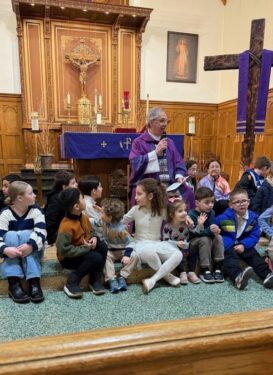
After four years of study, he was ordained in 2011 — with Toppin, the woman he had helped down 71 flights of stairs on 9/11, there to witness it.
He said he often thinks about walking down the stairs with Toppin and the chain of events it set in motion.
“I feel like this is where God wants me to be,” Deacon Carris said. “He was leading me here all along.”