
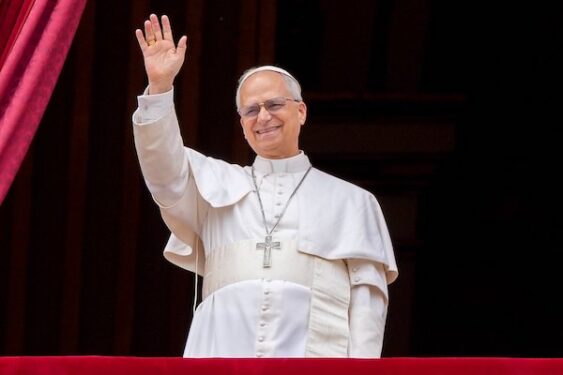
Pope Leo XIV may be distantly related to pop music stars Justin Bieber and Madonna, but the first American pontiff prefers classical music and sings along to Gregorian chants. In fact, the Holy Father is credited with inspiring a resurgence of the chants by frequently incorporating them during Mass.
Now, those who want to join the Holy Father in song can learn how with the new social media series “Let’s Sing with the Pope,” which offers the faithful a way to learn about Gregorian chants and sing along during Mass.
The program was launched by the Pontifical Institute of Sacred Music in Rome and the Vatican Dicastery for Communications. It focuses on the renewed interest in children’s chant camps and workshops. Archbishop Salvatore Cordileone of San Francisco said the program is a powerful new way to evangelize, adding, “Children’s chant camps are a growing phenomenon, and I’m very pleased.”
The “Let’s Sing with the Pope” video series is hosted by Father Robert Mehlhart, president of the Pontifical Institute, who was inspired to create it when Pope Leo first appeared on the balcony of St. Peter’s Square, chanting the “Regina Coeli.”
RELATED: Pope Leo XIV Delivers First Angelus Blessing in St. Peter’s Square
Father Mehlhart told the National Catholic Register that Pope Leo “has a lovely voice.” “He is an experienced singer,” he added. “He lived most of his life in a monastic community of friars where singing in the office is a daily thing.”
Father Mehlhart, a Dominican priest from Germany, said he believes that the program will help people join in and sing with the Holy Father during upcoming liturgical celebrations.
All the videos can be viewed on the institute’s YouTube and Instagram accounts under “Pontificio Instituto di Musica Sacra.”
View this post on Instagram
The first begins with the response to the Pope making the Sign of the Cross at the start of Mass. “Let’s note that in the beginning, only the Holy Father sings, but we all make the Sign of the Cross,” explains Father Mehlhart. The response is “Amen,” adding that parishioners sing the last syllable in two notes. “After this, the Holy Father greets us with the peace of Christ, and in receiving that peace, we respond with ‘and with your spirit.’ ” The introductory video, as is the case with each video, concludes by allowing the viewer to sing along with Pope Leo.
While the introductory video clocks in at a brief 2:35, the second, at 8:15, focuses on “The Lord’s Prayer,” which Pope Leo invites the faithful to sing with him during Mass. It has a beautiful melody, as Father Mehlhart demonstrates by singing the entire “Our Father,” and cueing viewers when and how to respond. He also uses repetition to affirm retention of the responses and concludes by congratulating viewers that they “have learned the entire ‘Our Father’ in Gregorian Chant.”
While the videos vary in length, they all follow the song’s progression.
For example, the third video explains how to sing the “Embolism” prayer, which follows The Lord’s Prayer during Mass. It is a solo in which the pope asks the Lord to give us his peace and deliver us from all evil. And in the first part, according to Father Mehlhart, “we gift Jesus Christ the kingdom, the power, and the glory with our response.” The end of the video once again allows the viewer to sing along with Pope Leo.
REALTED: Old and Forgotten, New and Popular, Hymns Are the Soundtrack of Our Faith
The fourth video, “Mysterium Fidei,” focuses on the Consecration, when the bread and wine become the body and blood of Christ.
The fifth video, “Regina Coeli” (Caeli), which is about Mary, “Queen of Heaven,” to which parishioners may respond with “Rejoice, Hallelujah.” “Regina Coeli” first demonstrated Pope Leo’s love of chant when he chanted it from the balcony of St. Peter’s Square when he was revealed as the 266th successor of St. Peter.
There are 11 videos in the series, each with tens of thousands of views. Father Mehlhart has previously told Vatican News that he was surprised by the success of the videos, but also noted that “Christians sing,” and that when they do, they are “in communion with humanity and with God.”