


American Museum in Little Italy. Taverniti survived the ship’s sinking while immigrating to America. (Photo: Bill Miller)
LITTLE ITALY — Ralph Taverniti, 91, was an apprentice tailor in his early 20s, but his future was bleak as his Italian homeland struggled to rebuild from the carnage of World War II.
Opportunity awaited in Brooklyn, where his father’s uncle, also a tailor, offered work.
So, in 1956 Taverniti booked third-class passage to New York City on a new luxury ocean liner, the SS Andrea Doria. The ship’s manifest recorded 1,134 passengers and 572 crew members on this, its 101st voyage.
The crossing began on July 17, but tragedy struck late on the eighth night about 50 miles offshore of Nantucket, Massachusetts.
Another liner, the MS Stockholm, collided with the Andrea Doria in dense fog.
“It was hard,” Taverniti told The Tablet on Sept. 29. “And you started thinking which way you could survive, which way you could go. And, you know, it wasn’t the boat.”
He chose to go overboard.
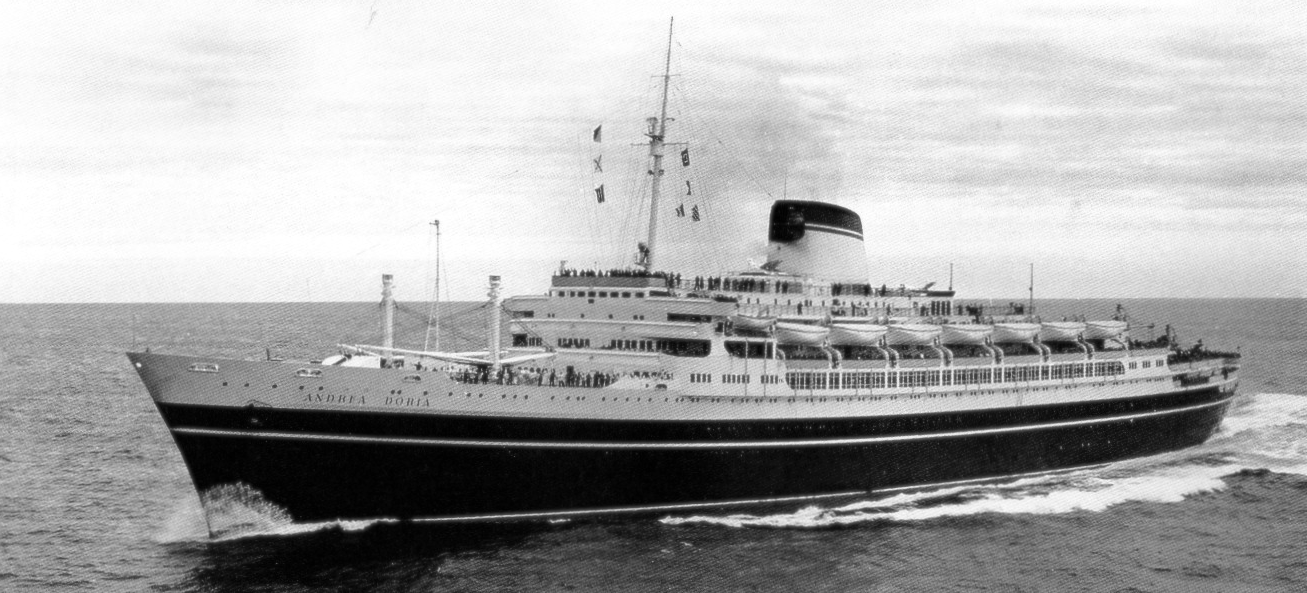
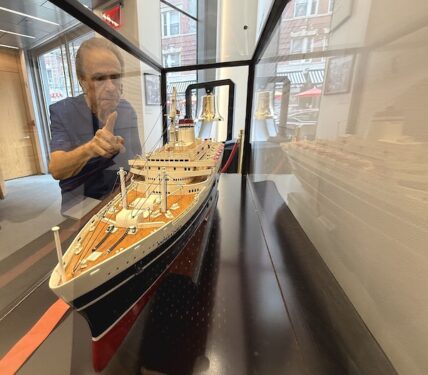
Taverniti, now a retired tailor living in Dyker Heights, made the comments during a visit to the Italian American Museum in Little Italy, the venue for a new exhibition about the doomed ship.
“Andrea Doria: The Final Voyage” opened in July with artifacts retrieved by deep-sea diver and explorer, John Moyer of Vineland, New Jersey.
During his tour, Taverniti moved among the artifacts, accompanied by his granddaughter, Brigette Taverniti; Joseph Scelsa, who is the museum’s founder and president; and Janine Cortese Coyne, the exhibit’s curator.
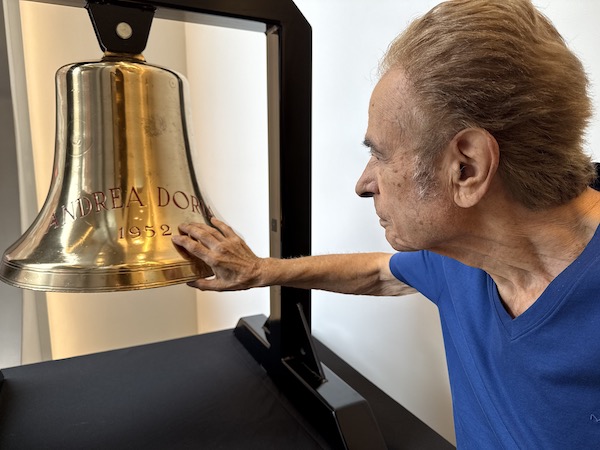
Taverniti reverently placed his right hand on the ship’s bell and gazed at other artifacts — exquisite china from the ship’s dining service, a deck chair, a lifejacket, and other memorabilia.
Coyne explained that the museum hosts an annual reunion of Andrea Doria survivors and their families.
RELATED: Master Seamstress Honored With Italian American Museum Exhibition
While researching the program for this year’s event, the museum’s staff discovered Moyer’s collection of the ship’s artifacts. He agreed to share them for the exhibit.
“The mission of the museum is to promote Italian culture,” Coyne said. “We want to try to bring out the beautiful things that Italians have contributed and have done.”
The Andrea Doria story, she added, is about Italian heroism.
“Forty-six people died,” she said, “but 26 of those people were from Italy and immigrating to America.”
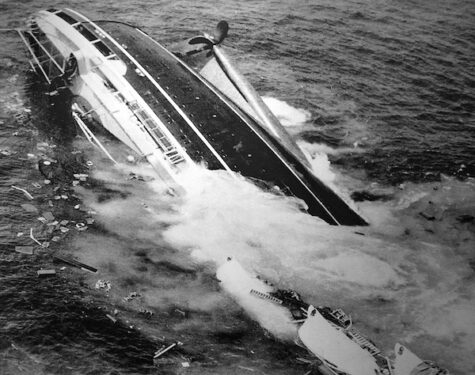
The new exhibit describes how before the wreck the Andrea Doria became a source of national pride in Italy’s war recovery efforts. Since its maiden voyage in 1953, the ship had been known as a “floating art gallery” for its numerous commissioned paintings and sculptures.
Among them was a bronze statue of Admiral Andrea Doria, the 14th-century Italian mariner for whom the ship was named.
Passengers on its first 100 voyages included celebrities from the stage and screen, such as Orson Welles, Tyrone Power, Cary Grant, and Elizabeth Taylor, as well as writers John Steinbeck and Tennessee Williams, among others.
However, it also carried scores of immigrants, many from Italy, such as Taverniti, who sought better lives in the U.S.
During his voyage, Taverniti befriended a crewmember who played the accordion, and the young tailor sang with him. This duo apparently made an impression because they were invited to perform in the first-class accommodations on the night of the collision.
Taverniti recalled hearing foghorns, but he didn’t see Stockholm’s approach. Crewmembers spotted it on radar, but by then the ship was on an unstoppable trajectory.
The impact hit the lower third-class decks where most of the 46 victims died instantly, Coyne said.
Taverniti said he would’ve been in the lower decks if he hadn’t been performing up top. Still, the impact jolted him.
The ship tilted left and listed at a 45-degree angle for several hours, Taverniti said.
Meanwhile, water poured into the Andrea Doria as the surviving crew and passengers struggled to free people still trapped in the wreckage. The bodies of most victims were never recovered.
Taverniti escaped by plunging into the water. He bobbed on the surface in his life jacket, praying for rescue.
The wreck demolished Stockholm’s bow and exposed the lower decks to the open air. Still, it stayed afloat. Its crew plucked Taverniti from the water and carried him to New York.
About 1,660 people were rescued by an armada of freighters, cruise ships, and vessels from the U.S. Coast Guard and Navy, Coyne said.
This operation, she added, remains one of the largest rescues in maritime history.
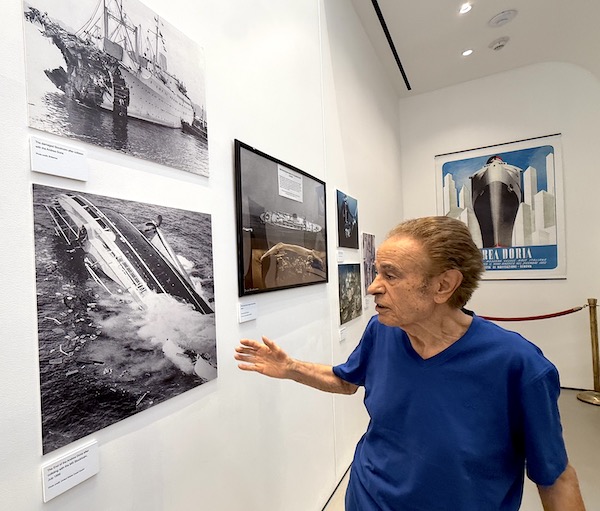
But 11 hours after the collision, the Andrea Doria finally capsized and sank an estimated 250 feet to the bottom of the Atlantic, taking most of the dead to watery graves.
Taverniti arrived in New York with just the shirt he wore during the wreck and pants given to him by the Stockholm’s crew. Officials got busy trying to identify the survivors and connect them with their families.
“They take you to a place and they ask if you want to make a telegram,” Taverniti recalled. “Then we go to another place, and a man asked, ‘Do you want a passport?’ I said, ‘No, I don’t want a passport. I’m not going anywhere.’ ”
Taverniti immediately reached his uncle. The next day, he went to work.
The tailor settled in Bay Ridge and married. He and his wife, Teresa, raised two daughters and a son. They have eight grandchildren and one great-grandchild.
The Taverniti family moved to Dyker Heights and joined the Shrine Church of St. Bernadette. Prayer, Taverniti said, has always been part of his life.
“Still, I’m devoted,” he said. “And I see a lot of things happening to me because I pray for that.”
SEE THE EXHIBIT
“Andrea Doria: The Final Voyage” continues through January at the museum, located at 151 Mulberry Street. For hours and more information, visit: italianamericanmuseum.org.