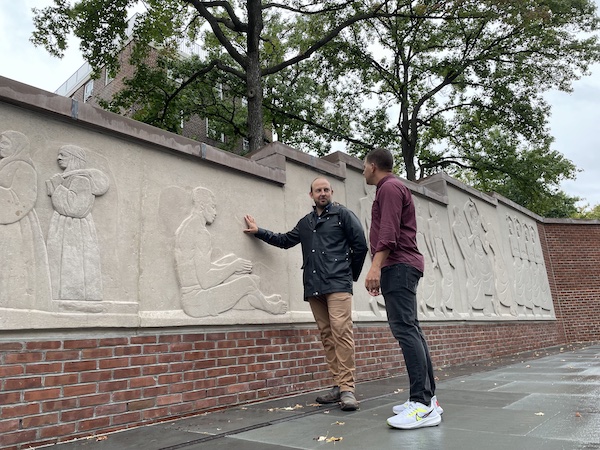


CROWN HEIGHTS — Residents of the Kingsborough Houses don’t have to go to a museum to see art. They can enjoy a great work of art right outside their door.
The courtyard of the 1,100-unit New York City Housing Authority (NYCHA) complex in Crown Heights is home to “Exodus and Dance,” an 80-foot-long frieze by African American sculptor Richmond Barthe (1901-1989), depicting scenes from the Old Testament and images of African dancers.
The work was installed in 1941 but had deteriorated over the decades.
Barthe’s work, which had been marred by graffiti and had sections crumbling off its brick wall, has been restored to its original glory, thanks to a fundraising effort by the NYCHA-affiliated Public Housing Community Fund, as well as painstaking work by EverGreene Architectural Arts, an art restoration firm.
The $2 million restoration project, funded by the New York City Council and the Mellon Foundation, began in early 2024 and was completed in August. Now residents can once again gaze upon Barthe’s work — a series of 16 concrete panels with striking imagery.
Barthe, who came up through the Harlem Renaissance movement and had sculptures displayed at the Museum of Modern Art and the Whitney Museum of American Art, created “Exodus and Dance” in 1939 under the Depression-era Works Projects Administration (WPA).
Barthe was Catholic and was inspired by “The Green Pastures,” a 1930 Pulitzer Prize-winning play by Marc Connelly, which depicts chapters from the Old Testament — such as the Book of Exodus — through the eyes of an African-American child. As a result, he used half of the panels to portray Biblical scenes. The other half depicts African dancers.
The artwork was initially slated for the Harlem River Houses, but Barthe’s panels were instead brought to the Kingsborough Houses and assembled in the courtyard in 1941, where they still stand.
“It’s a historic moment,” Alex Zablocki, executive director of the Public Housing Community Fund, said of the restoration project, which enabled advocates to “get this work restored and bring it back home to Kingsborough, where it belongs, for more generations to see and experience.”
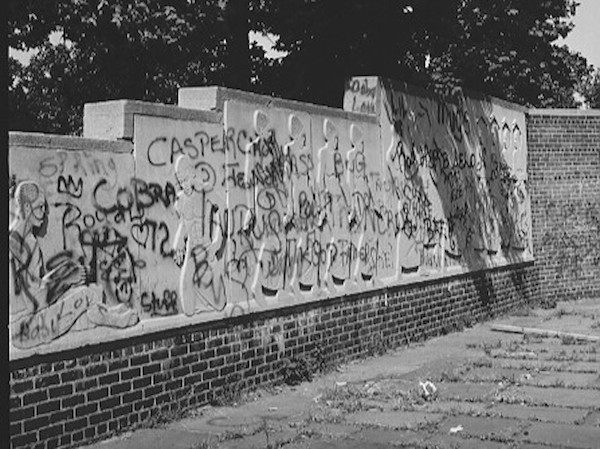
The frieze was removed panel by panel, placed in custom-built crates, and transported to a facility in the South Bronx, where art restorers got to work. It wasn’t easy, said David Gibbons, project manager of EverGreene Architectural Arts.
“The wall itself was heaving in some areas. The brick was falling,” Gibbons said. “So, we really wanted to get in immediately to salvage these panels, to restore them quickly so that we could save the artwork.”
Work began once the piece was safely in the restoration facility. First, Gibbons explained that they conducted a graphic analysis to determine the materials used to make the panels, which allowed them to salvage each piece individually. For the pieces that were missing, the restorers used historic photos of “Exodus and Dance” as a guide.
Each panel was reinforced with stainless steel rods, and then fiberglass-reinforced concrete was added to protect the artwork. When the work was finally done, the panels were transported back to Brooklyn and reinstalled.
Zablocki credited Kingsborough Houses residents for coming up with the idea to restore “Exodus and Dance.”
“Back in 2018,” he said, “the residents worked with local community members to say, ‘Hey, we need to save this piece of artwork. It’s historic. It means so much to our community.’ ”
Generations of people who lived here in Kingsborough public housing had an experience of what they call, ‘The Wall,” he explained. Over the decades, children climbed the wall and played handball, unaware that it held a great work of 20th-century art.
One former resident, who identified himself as Uptown Bey, was walking through the courtyard on his way to visit family on Sept. 10 and stopped to admire the frieze.
“The upgrades are incredible,” he said.