

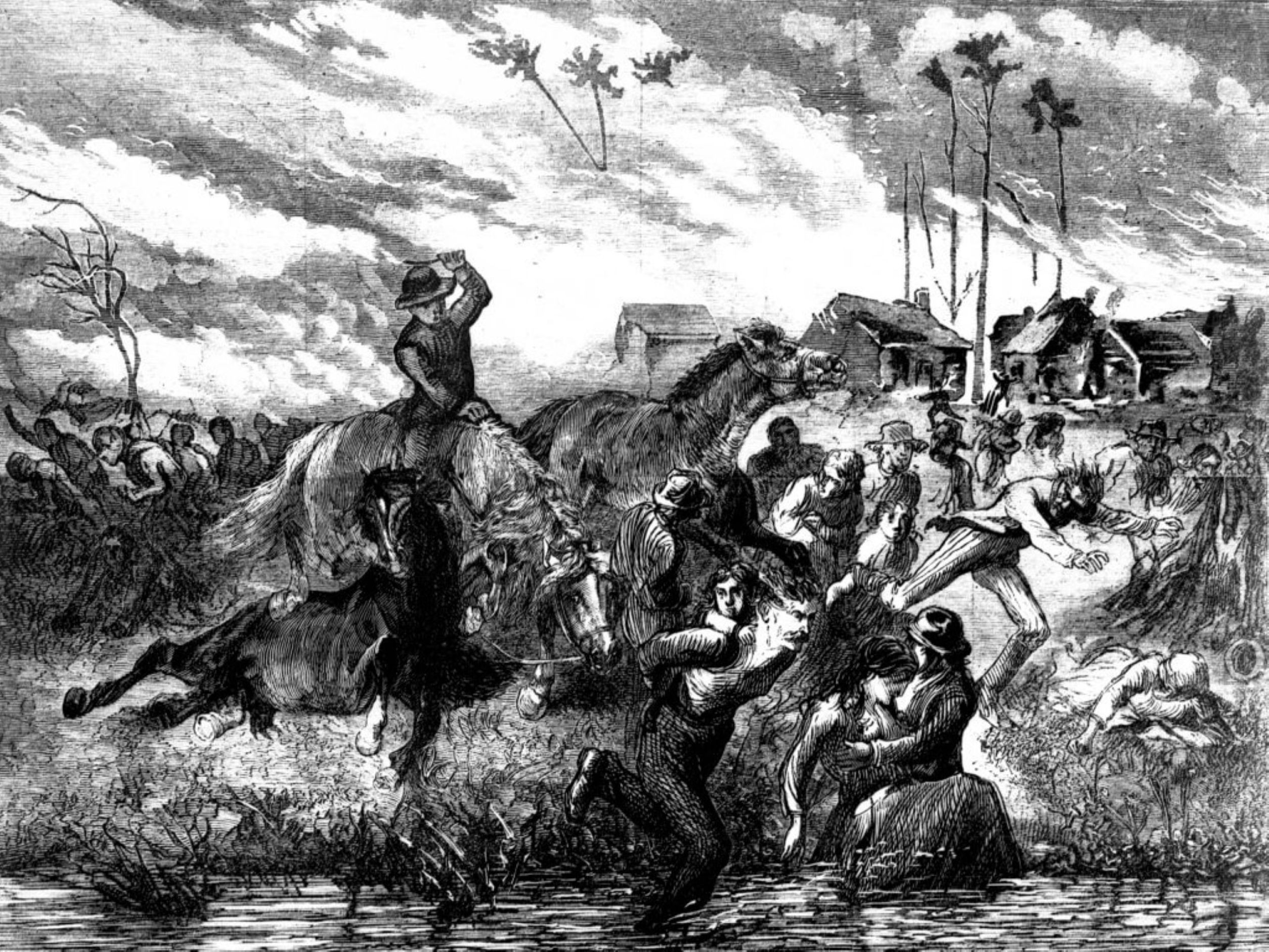
As dense smoke poured into Peshtigo, Wisconsin, a small logging and farming community in northeast Wisconsin, Father Peter Pernin, the local pastor, rushed to his fledgling church to save the sacred vessels for the Eucharist.
For weeks, settlers had been dousing small fires on the drought-stricken landscape. But on this night, Oct. 8, 1871, the blazes merged into an enormous conflagration that, historians say, was never seen before — or since.
Father Pernin furiously dug a trench to conceal the vessels as the danger bore down on him. Then he heard the roar of a wind that reminded him of “locomotives approaching a railroad station, or the rumbling of thunder.”
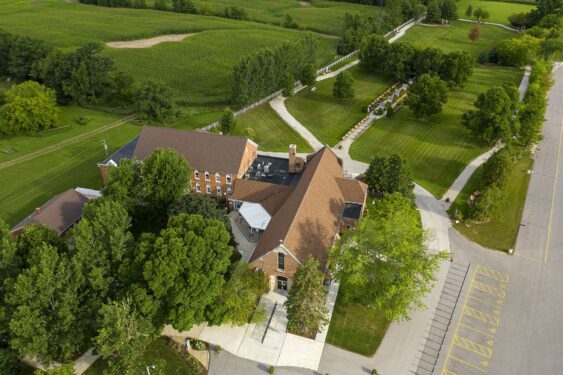
Next, towering flames swept Peshtigo. But about 60 miles to the south on the other side of the “Bay of Green Bay,” settlers found refuge at a religious shrine near the present-day town of Champion. There, 12 years before, the mother of Jesus appeared to a Belgian immigrant, Adele Brice.
Since 2016, the site has been the first and only Church-approved Marian apparition site in the United States, yet most people have never heard of it.
“It’s shocking how few people know about us, even in the Green Bay area,” said Ashley Ebben, communications specialist for the National Shrine of Our Lady of Champion.
“We kind of refer to ourselves as a hidden gem here,” she continued, “because once people come to the shrine, they’re really fascinated by what happened here.”
Opportunity Waned
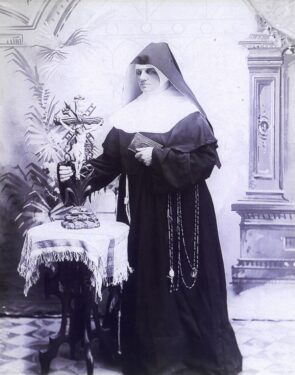
Adele Brice was born in 1831 in Belgium, according to historical information kept at the shrine. As a child, her face was accidentally splashed with lye, a caustic ingredient used to make soap. She was disfigured and had lost sight in her right eye.
Still, Adele had a happy childhood, raised in the Catholic faith taught by her parents, Lambert and Catherine Brice.
She aspired to learn to read and write and become a religious sister teaching Catholic schoolchildren, but that opportunity waned in Belgium.
RELATED: Wisconsin Shrine Unites Faithful and Saints for Fourth of July Celebration
Adele was 24 when her parents moved the family to America. She thought about staying to pursue a religious life, but she chose devotion to her family.
Lambert Brice bought farmland near present-day Champion, east of the town of Green Bay on the lower part of Wisconsin’s Door Peninsula.
First Appearance
Life was harsh on the Wisconsin frontier, where some settlers froze to death in the damp winters made icier by intense lake-effect snow patterns spun up by nearby Lake Michigan.
Still, farmers cleared trees to make way for field crops. It was a slow process because the woods were dense — perfect habitat for wild animals like bears and wildcats.
Adele regularly carried armloads of the family’s grain over a forest trail to a gristmill. It was the same path she took to travel the 10 miles from her family’s farm to the nearest Catholic church for Sunday Mass, no matter the weather or warnings about ferocious animals.
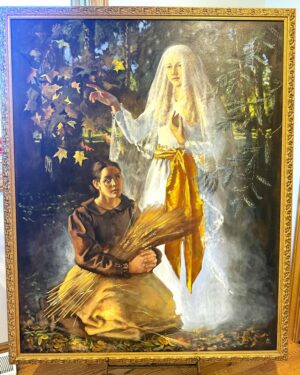
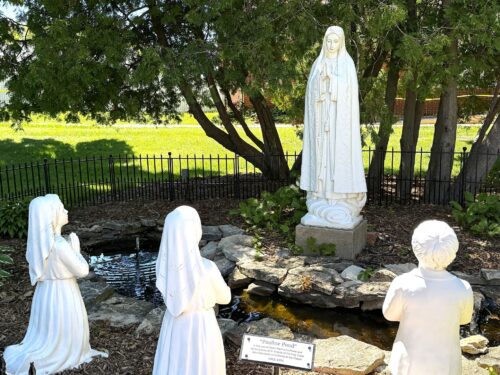
One day, Ebben said, Adele’s grist-mill trek was interrupted when she spotted a mysterious woman in white standing between two trees, one a maple, the other a hemlock. The lady, Ebben added, wore a dazzling white dress with a yellow sash and a crown of stars around her head. Golden wavy hair fell to her shoulders.
The lady said nothing, and Adele kept moving.
Queen of Heaven
A few days later, on Sunday, Oct. 9, 1859, Adele walked to Mass with her sister, Isabel, and a friend. She then saw the mysterious lady again between the same two trees, Ebben said.
“But only Adele could see her,” Ebben added, “which left her frightened and speechless that her sister and friend couldn’t.”
The trio continued to Mass, and after, Adele asked her parish priest what to do if she saw the lady again. Ebben said he told her to ask her in God’s name, “ ‘Who are you and what do you want of me?’ ”
“On her return home, she saw the lady a third time,” Ebben said, “and Adele did exactly what she was told.”
Upon Adele’s inquiry, the lady said, “ ‘I am the Queen of Heaven, who prays for the conversion of sinners, and I wish you to do the same,’ ” Ebben said.
Go and Fear Nothing
Adele’s companions still could not see the lady, who told Adele, “Blessed are they that believe without seeing.”
Ebben said the lady also told Adele, “Gather the children in this wild country, and teach them what they should know for salvation.”
Adele expressed insecurity due to her illiteracy. But, Ebben said, the lady told her, “Go and fear nothing. I will help you.”
“Our Lady vanished,” Ebben said. “And Adele started her mission work.”
She began by visiting local farm families and offered to do chores; for payment she simply asked for the opportunity to tell their children about salvation, the sacraments, and other catechesis.
Never Swayed
Adele’s lessons were strictly verbal because she never learned to read and write — neither English nor her native language, Walloon.
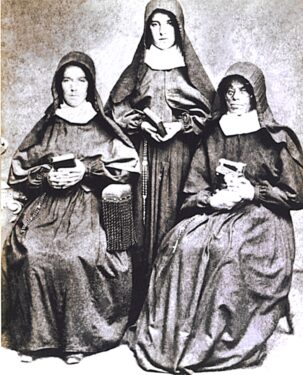
Also, she never took formal public vows as a consecrated religious sister but instead formed a small community of fellow catechists through the Third Order of Secular Franciscans, who were allowed to wear habit-like attire.
Some ridicule ensued, Ebben said. The area had its share of rowdy lumberjacks and farm laborers who hurled profanities as they went to and from local taverns.
“It took her a while to convince the community,” Ebben said. “But she never swayed in her faith. Her family immediately believed her story and helped her.”
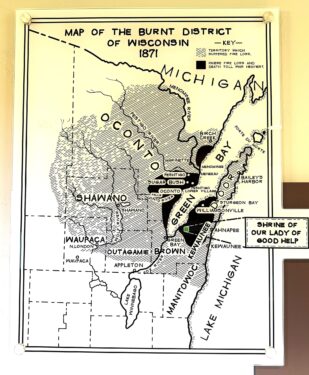
Adele’s father built the first chapel and schoolhouse on the shrine grounds, Ebben noted. On the night of Oct. 8, 1871, people saw the little campus as their only hope to escape calamity.
Nature’s Nuke
The Great Peshtigo Fire is considered by many to be the deadliest blaze in the U.S.
Historians say most people never heard of it, most likely because it happened the same night as the Great Chicago Fire.
Some scientists suggest both fires were ignited by flaming debris dropped by a passing comet, but that theory is debated.
RELATED: American Saints Validate Catholic Presence in U.S., Historian Says
The most widely accepted explanation is that small pop-up fires had already smoldered for weeks in the region’s undergrowth of hardwood stands and white-pine forests. Then, on the night of Oct. 8, a cold front with no rain whipped the blazes into a “firestorm.”
Denise Gess and William Lutz describe the terror in their 2003 book, “Firestorm at Peshtigo: A Town, Its People, and the Deadliest Fire in American History.”
“When a firestorm erupts in a forest,” they wrote, “it is a blowup, nature’s nuclear explosion.”
What is undisputed is that the fire, or fires happening simultaneously, charred 1.2 million acres — about 1,875 square miles — and killed 1,500 to 2,000 people.
Dumb by Terror
Father Pernin’s book, “The Great Peshtigo Fire,” describes the chaos as towering flames blasted through town.
“A thousand discordant deafening noises rose on the air together,” Father Pernin wrote.
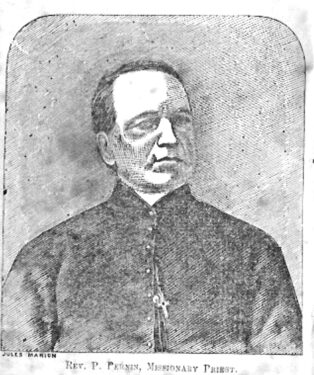
“The neighing of horses, falling of chimneys, crashing of uprooted trees, roaring and whistling of the wind, crackling of fire as it ran with lightning-like rapidity from house to house — all sounds were there save that of the human voice.
“People seemed stricken dumb by terror.”
Likewise, people on the Door Peninsula recoiled at the ever-expanding crimson glow, heat, and fierce winds pushing from the south.
Protective Procession
“But here at the shrine, Sister Adele stayed calm,” Ebben said. “She was at the chapel and prayed for Mary’s protection.”
Soon, refugees got the same idea.
“They fled there to join her in prayer,” Ebben said. “They formed a procession, and they prayed the rosary on the same rosary walk that we have on our shrine grounds today.”
When the wind and fire threatened suffocation, they would turn in another direction to pray and continue the procession with a statue of Mary.
The flames went around the campus and faded after sunup amid sudden rainfall.
Emerald Isle
Father Pernin escaped death by jumping into the Peshtigo River with other people and livestock. He later recovered the sacred vessels, including the tabernacle, which he called a miracle.
Later, he learned about the other miracle at the shrine on the Door Peninsula. He wrote about that too and commended Sister Adele’s work.
Father Pernin wrote, “Everything about them was destroyed; miles of desolation everywhere. But the convent, school, and chapel on the holy land consecrated to the Virgin Mary shone like an emerald isle in a sea of ashes.”
Adele continued her work until her death in 1896; she is buried next to the shrine’s chapel.
Her cause for sainthood was opened this past January in the Diocese of Green Bay.
Gaining Popularity
Like the largely unknown Peshtigo Fire, the National Shrine of Our Lady of Champion is now emerging from obscurity, and one parish in the Diocese of Brooklyn is contributing.
Last year, Our Lady of Angels Parish in Bay Ridge created a devotional space in the church to honor Our Lady of Champion. Father Kevin Abels, the pastor, approved it at the request of Dr. Patricia Cholewka and her husband, Michael Cholewka.
Patricia said she first learned about the shrine three years ago when it was briefly mentioned during a religious TV news report.
RELATED: Devotional Site Honors Our Lady of Champion In Bay Ridge Church
“I was incredulous, almost shocked,” she recalled. “And I thought, ‘Oh my gosh, we have a Marian apparition here in United States, and nobody knows about it?
“I got more information, and then I said, ‘Why can’t we have a little shrine here in our church in Brooklyn?’ ”
Cholewka said she and her husband haven’t been to the shrine yet, but they might get there this fall.
The 2016 designation by the Church as a Marian shrine serves as a springboard for marketing campaigns, but word of mouth is also playing a big role, Ebben said.
“I think it’s just starting to gain popularity,” she noted. “The big takeaway we hear is just how at peace people feel here. They feel our Lord’s love and Mary’s love for them.
“And they’re excited to take that back to where they are from.”