
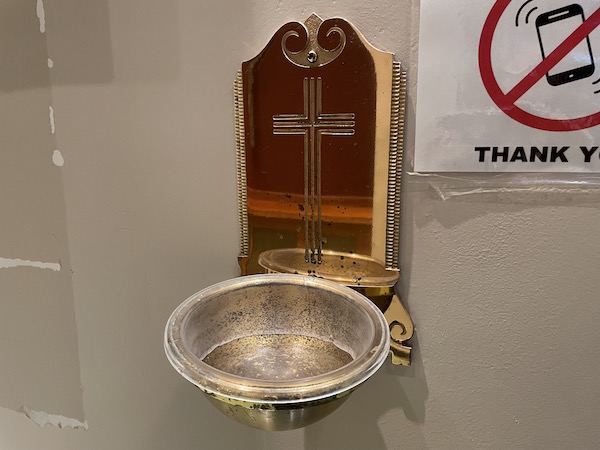
PROSPECT HEIGHTS — It’s one of those things that Catholics do every time they walk into church without thinking about it: gently dipping their fingers into the holy water font and blessing themselves before heading to their pews to await the start of Mass.
While many Catholics might not be aware of it, the simple act of blessing oneself with holy water upon entering a church is filled with symbolism and meaning.
“The holy water signifies our baptism. When we were baptized into Christ Jesus, we were baptized with water,” explained Father Alonzo Cox, director of liturgy for the Diocese of Brooklyn. He added that holy water fonts are placed at the church entrance to harken back to one’s baptism and to serve as a reminder of the role water plays in Catholicism, he said.
RELATED: Keys to the Past: How Brooklyn Church’s Pipe Organ Bridges Faith, History
“Our Lord was baptized by John the Baptist in the Jordan River,” Father Cox said. “It’s always important to make sure that when we go into church, we recall how our faith in Jesus began through the saving orders of baptism.”
Like holy-water fonts, many items in churches have fascinating histories.
Take the Stations of the Cross, for instance. Most Catholics are aware that the stations depict the Passion of Jesus Christ. But many might not know that the idea of erecting stations in churches dates back to the 5th century.
According to the Museum of the Bible in Washington, D.C., churches began featuring Stations of the Cross in the 5th century to recreate the path Jesus took to his crucifixion. The decision was made to accommodate the faithful who were unable to travel to Jerusalem to walk the path. (Tidbit: It was Pope Clement XII, in 1731, who set the number of Stations of the Cross at 14. Before that, there had been no set number, and stations would vary from church to church.)
The sanctuary of a church contains items that Catholics see during the Mass without considering their histories.
The ambo, a podium-like structure in a Catholic church from which, according to liturgical norms, the Scriptures are read, and the homily may be preached.
The ambo is believed to have originated in Judaism and was said to be the platform on which rabbis spoke to their congregations. They were first seen in Catholic churches in the 4th century and became a regular part of church iconography in the 9th century.
“And there are certain churches, like St. Patrick’s Cathedral, where the ambo is grand,” Father Cox said. “You walk up the steps. The ambo is beautiful because that really is a clear sign that this is a special place.”
RELATED: Prepared in Faith: Welcoming Christ Amid Life’s Uncertainties
Another important part of the church is the tabernacle, which contains the Blessed Sacrament and is usually behind the altar. It comes from the Hebrew tabernacle in the Old Testament.
The word was initially used to describe a tent that the Israelites believed contained God’s presence as they moved through the wilderness.
For Catholics, the tabernacle also signals God’s presence. “The tabernacle, of course, is Jesus Himself — body, blood, soul and divinity,” Father Cox explained. “He is the center of the church. He is why we come to church. So, in the sanctuary, should be the tabernacle.”